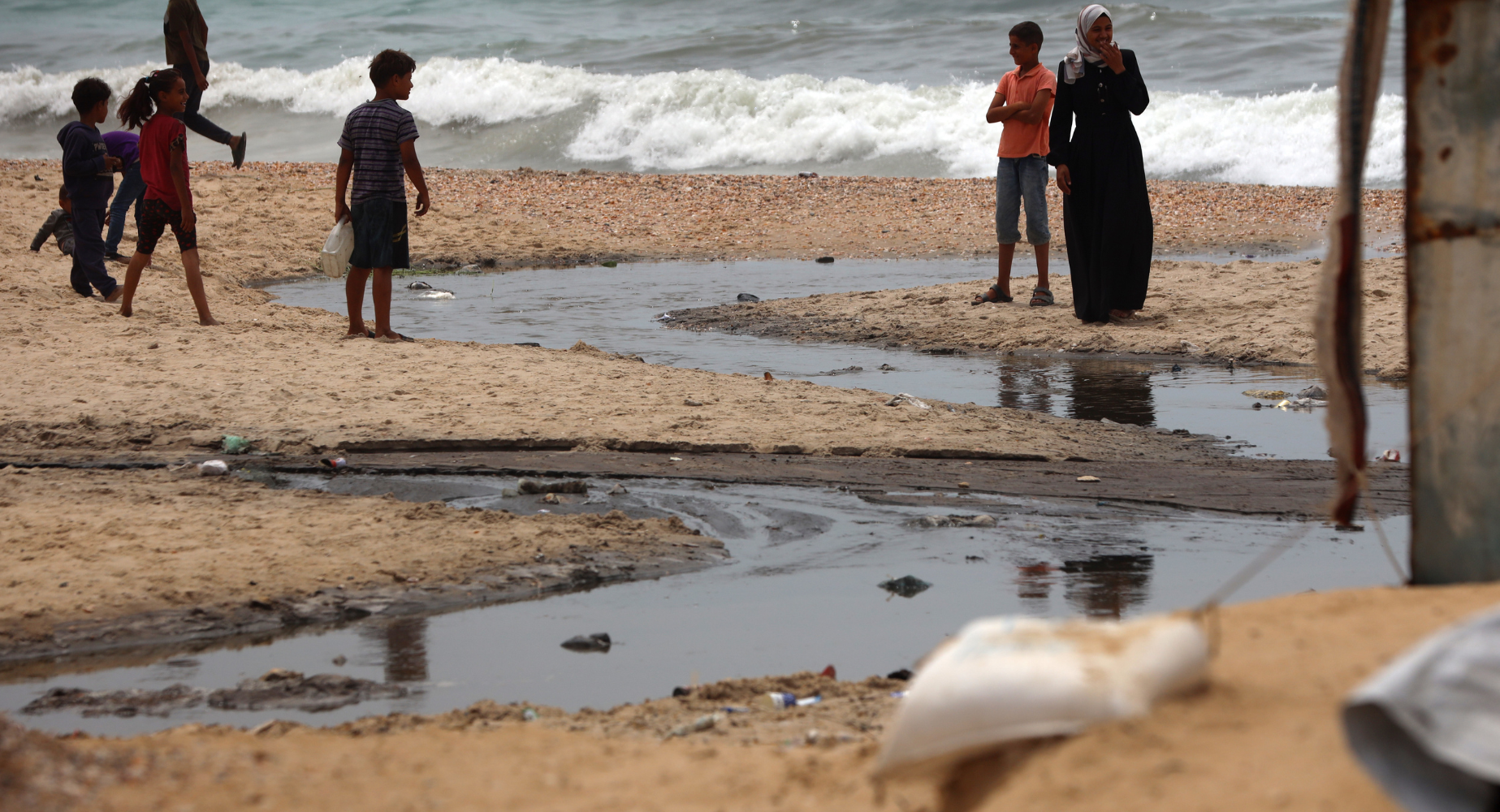
Gaza’s sewage has reached Israel’s taps. We had thirty years of warnings and chances to prevent it.
The squills are up on the hills, white and upright as surveyors’ stakes — which is more or less what they were since antiquity. Farmers here planted them in rows to mark where one field ended and the next began, back when a boundary was something you could put in the ground and argue over. It is a very local idea. We have since added fences, a Green Line, a border with Egypt, and three years of war over all of them, with an overdue earthquake and a nuclear program up the road thrown in. Then, at the end of August, the Mediterranean pointed out that it had not been consulted about any of it. It has troubles of its own: warming faster than almost any sea on earth, rising, acidifying, absorbing our pollution and losing its coastal habitats. It has now sent some of that back.
A microalgae bloom some 100 kilometers long clogged the intakes of our seawater desalination plants. Ashkelon, Ashdod, Palmachim and both Sorek plants went offline or were sharply curtailed, leaving only Hadera at full capacity. Three weeks later, output was back to only about half. Mekorot National Water Company drew hard on the Sea of Galilee and cut water to farmers.
Six weeks on, the emergency has eased but it has not ended. All six plants are running again, several of them only partially. In mid-September the Water Authority told the Knesset State Control Committee that national desalination output stood at about 60 percent of normal and would likely stay there through the end of the year. The shortfall is being drawn from the Sea of Galilee, then some forty centimeters below its lower red line, and from wells that are meant to be our emergency reserve. What ended the acute phase was a change in the weather, not a change in our preparedness. The El Niño behind those winds is forecast to strengthen through the winter, and specialists expect the blooms to return.
This was not a freak event. Researchers at Ben-Gurion University’s National Institute for Climate and Environmental Policy, among them Avner Gross and Anton Lokshin, found that algae concentrations off Gaza at the end of August were the highest in fourteen years of measurement. That was twice last year’s peak and three to four times the level of earlier years. Then a rare weather system brought the strongest late-August wind since 2000. On August 29 it pushed the water north along the coast, then drove it straight toward the shore and our intake pipes. The Israel Meteorological Service ties these unusual systems to an El Niño at its strongest summer intensity since 1950. El Niño peaks in winter. No toxin has been confirmed, but the strain involved, a Synechococcus, has not yet been identified or cleared. The more concrete exposure so far is a documented pesticide application near a public beach.
The weather was the trigger. The fuel had been building for years. Nutrients from the Northern Sinai and a warmer sea played their part. Gaza added its own. All six of its wastewater treatment plants are destroyed or out of service, and every day tens of thousands of cubic meters of raw sewage, by some estimates more than 150,000, flow into a sea whose currents run north toward Ashkelon. Scientists will argue over how much each factor contributed. The lesson that must be learned does not depend on the answer. The eastern Mediterranean is a single system in a nearly closed basin, and Israel’s most important environmental water infrastructure sits in its path. The Sea renews itself through a single narrow sill over roughly a century, and its surface current runs counterclockwise — east along Egypt, then north past Sinai and Gaza to our coast. It is also one of the most nutrient-poor seas on earth, which means a modest load of sewage goes a long way. Gaza’s sewage matters less for its volume than for where it lands and which way the water moves.
We were warned. In 2017, State Comptroller Joseph Shapira called cross-border water pollution “Israel’s most serious cross-border environmental hazard.” He found no government policy, no agency in charge and a dormant Joint Water Committee. In 2024 a second audit found that no one had ever surveyed algal toxins or other biological threats to our desalination plants.
Gaza’s own history shows how long this has been coming, and how often it could have been prevented. The Beit Lahia treatment plant in north Gaza was built in 1976 for 50,000 people. World Bank files record that the original plan was to use its effluent to irrigate nearby farms, and that this “was never realized.” As the population grew, the overflow formed a lake of raw sewage in the dunes, soaking into the aquifer that Gaza shares with Israel.
In 1995–96, in the hopeful Oslo years, we explored a practical fix with Israel’s Foreign Ministry and communities along the Gaza border that were later invaded on October 7. Kibbutzim and moshavim in the western Negev, which were already among the world’s most experienced users of treated wastewater, would transfer their greenhouse and effluent-irrigation know-how to Gazan growers. The sewage would be treated, the water would irrigate greenhouses in the dunes, and the produce would be sold. The lake would stop rising. It went nowhere. Agriculture ranked below borders, security, and awaited “final status” agreements that never came. The Joint Water Committee became a place to veto projects, and donors preferred large projects run through governments.
A second chance came with the 2005 disengagement. The Gush Katif settlers were leaving behind about 1,000 acres of export greenhouses, with packing houses and irrigation systems (and a dairy), that employed thousands of Palestinians. They could have become the backbone of Gaza’s export agriculture and the natural customer for its treated effluent. Instead the handover turned into a farce. A $15 million transfer deal advanced by the Quartet collapsed: the Palestinian Authority would not let aid money compensate settlers, Washington faced objections in Congress, and Israel had already spent its relocation budget. The PA’s fear was of Hamas, and it was well founded. Five months later Hamas won the parliamentary election, and within two years it had driven the PA out of Gaza. That was the last Palestinian election held — Abbas is now in the twenty-first year of a four-year term.
At the time I compared the whole business to the wise men of Chelm, who, needing light to study by, burned down the town. Settlers dismantled many greenhouses and Gazan looters stripped others. By the time donors assembled the money, only about 600 acres could be saved. Then Israel closed the Karni crossing that winter over Hamas tunnel warnings, and the company running the greenhouses exported less than a fifth of its crop subsequently rotted and lost more than $8.5 million.
Then came the disaster. On March 27, 2007, an emergency basin built to relieve the Beit Lahia lake burst, and raw sewage flooded the village of Umm al-Naser. Five people died, including a toddler and an infant. A new treatment plant finally delivered what the 1976 designers had intended, treated water clean enough to recharge the aquifer. It took twelve years, three funders and three restructurings. Today it is one of Gaza’s six idle plants.
I have seen this pattern before. On the Alexander River, Israeli and Palestinian authorities kept restoration work going even during the Second Intifada. Crews worked behind screens to shield them from sniper fire, and teams sprayed for mosquitoes on both sides of the Green Line, because mosquitoes bite everyone. But upstream Palestinian treatment was never financed, so Israel built a “temporary” emergency plant downstream. It became permanent, proved too small, and in 2019 failed, blackening the coast near Mikhmoret. Downstream defenses without upstream capacity do not stay temporary. They last until they break.
Israel’s response to the algae so far is the same kind of downstream defense: protect the intake pipes. That is necessary, but it is not enough. Five steps would make a difference.
First, treat intercepting Gaza’s sewage as Israeli national security and as a humanitarian response in postwar Gaza. Modular treatment units, pumps, chlorine and spare parts should be allowed in, with whatever screening security requires. Médecins Sans Frontières reports that all its requests to bring in water and sanitation equipment have been denied since January. Every such refusal ends up on our own coastline.
Second, build shared monitoring. Satellites tracked this bloom from Port Said to Ashdod. A joint Israeli, Palestinian and Egyptian warning system could alert plant operators days in advance.
Third, create and finance a Regional Water Revolving Fund and Environmental Infrastructure Platform. The same failure recurs in every one of these stories: each project has to be financed from scratch through a separate political negotiation. A standing fund, capitalized by donors, climate finance and governments, would lend to utilities on both sides and recycle the repayments into the next project. Selling treated effluent to farmers, as Israel already does better than any other country, would give the fund a revenue stream.
Fourth, give someone the job. Shapira called for a single lead body on the Israeli side and a functioning joint commission for the shared aquifer, the coastal sea and the streams that cross the lines. Transboundary governance of shared assets has worked on the Danube and its tributaries, on the Mekong Delta, on the Senegal River, in Mexico, and in other conflict and post-conflict settings.
Fifth, fix what the shutdown exposed at home. Extending intake pipes westward into deeper water, adding coagulation and flotation pretreatment, holding a national emergency stock of membranes, and settling in advance how the concession companies are compensated when the sea itself is the fault — all sensible, all overdue. So is using the capacity we already pay for: in 2024 we produced about 540 million cubic meters against some 800 million under concession, while the Health Ministry carried out none of its required annual inspections of the plants between 2018 and 2023. And the aquifers and the Kinneret should be treated as the strategic reserve they are, not as the overdraft we reach for whenever the coast fails. But every one of these measures protects the intake pipe. None of them changes what flows into the sea.
This winter the first heavy rains will flush Wadi Gaza into a sea already at a fourteen-year nutrient high. We have had the audits, the financing models and at least two chances to turn sewage into an asset. The sea does not recognize the Gaza fence, the Green Line or the Egyptian border. Israel’s water security depends on what flows into the sea on the other side of all of them, and our water policy should start from that reality.