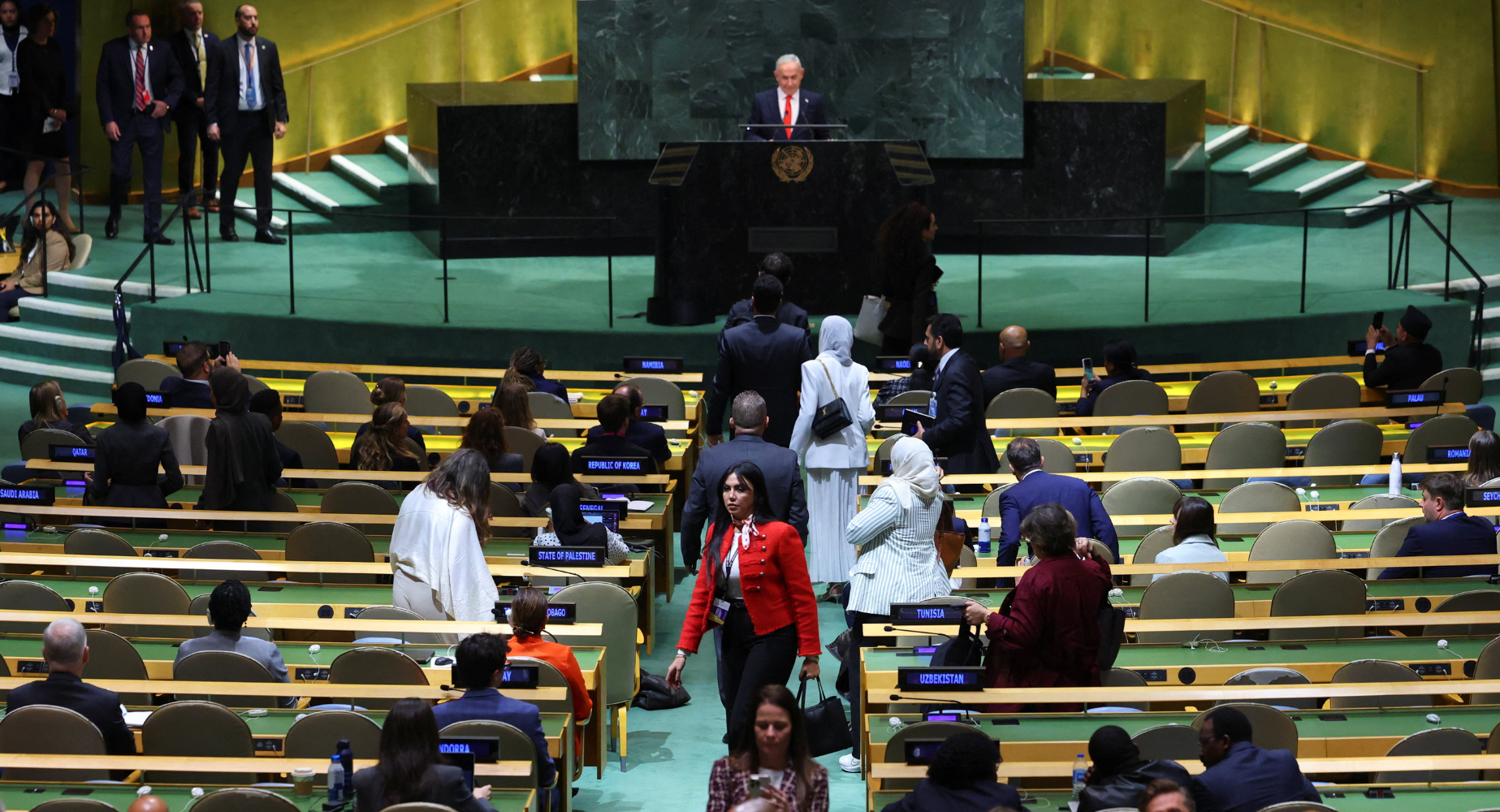
The PR war is lost. Owning it may be the strongest move Israel has left.
Late last year, Benjamin Netanyahu told a room of evangelical leaders in Palm Beach that Israel had fought on seven fronts since October 7, but that there was now an eighth: the war for Western opinion. Israel has since allocated more than a billion dollars to the matter and quadrupled its public diplomacy budget this year. It has hired influencers, chartered delegations, bought placements in conservative media, and, most inventively, got Donald Trump’s former campaign manager—at $4.5 million a month—to publish articles. The pieces aren’t for us humans; they are for the machines, peppered across the internet so that ChatGPT, Claude, and Gemini absorb it. So when a college freshman asks about Gaza, the answer comes out a shade friendlier to Jerusalem. At $46.5 million, it is the largest active Israeli contract on file under the Foreign Agents Registration Act. This eighth front is the only one Israel is decisively losing.
American opinion has not shifted so much as collapsed. In February, for the first time in twenty-five years of asking, Gallup found that Americans no longer sympathize with Israel over the Palestinians; among those under 35 it isn’t close. Opposition to the alliance is now a basic litmus test in Democratic primaries. And last week, Britain banned trade with Israeli settlements, with France and Canada following the same day, and nine more European governments endorsing the measure.
Among Israel’s defenders this has produced a sizable hysteria. I have been part of it, as an Israeli in America watching the sea change in how my country is discussed.
But perhaps the panic is unwarranted. Perhaps, instead of scrambling for the next inventive fix, Israel should lay down its hasbara weapons and raise the dreaded white flag. And perhaps doing so, publicly and unequivocally, would do more for Israel than every dollar it has spent trying not to.
The Enemy’s Wager
Israel’s enemies can fairly be called many things: barbaric, fundamentalist, genocidal. “Stupid” is not one of them. They long ago realized they cannot beat the IDF head-on. The years since October 7 have proved them right with Hezbollah decapitated, Hamas reduced to tunnels, and Iran’s Supreme Leader killed in the opening salvo of the war that followed. No one on the other side believes the tank column is coming for Tel Aviv anytime soon.
So they went looking for a front they could win. Clausewitz taught that every belligerent has a center of gravity, the hub on which everything else depends, and that the art of war lies in finding it. Israel’s enemies believe they have found Israel’s, and it is not the IDF. It is Israel’s standing in the capitals of the West, and above all in Washington. Cut that, and the rest follows: the money, the weapons, the diplomatic cover, and eventually the qualitative edge that makes the IDF unbeatable in the first place. You do not need to defeat an army you can arrange to have starved.
They have invested accordingly. Yahya Sinwar told an Italian journalist in 2018 that Hamas makes headlines only with blood: “no blood, no news.” Six years later, in private messages reviewed by the Wall Street Journal, he called Gaza’s civilian dead “necessary sacrifices.” Iran’s Revolutionary Guard and intelligence ministry run dedicated cyber units in support of Hamas; Microsoft documented a surge in Iranian influence operations after October 7, including fake personas posing as Jewish peace activists, and Khamenei wrote an open letter welcoming American campus protesters into the “Axis of Resistance.” Qatar bankrolls the Arab world’s most influential news network and a good share of the English-language commentary on the war.
This is a coordinated, well-funded, professionally executed campaign to malign Israel on the world stage. But crucially, it rests on one major assumption: that should Israel be alienated from the West, from its allies, and above all from America, it is game over for the Zionists.
It also happens to be patently wrong.
Helpful ≠ Indispensable
No serious person disputes that Western cooperation helps Israel. The United States sends $3.8 billion a year in military aid, resupplies interceptors mid-war, parks aircraft carriers offshore, and wields a veto at the Security Council. Germany builds Israel’s submarines and corvettes. Europe buys nearly a third of Israel’s goods exports. All of that is valuable. But “helpful” and “indispensable” are two different words—a distinction the campaign against Israel depends on ignoring.
Right now, Britain, France, and Canada banned goods from the settlements alone—a rounding error in Israel’s trade—while goods from Israel proper flow on untouched. But suppose Europe someday means it. Israel’s own numbers already show what substitution looks like. Europe’s share of Israeli defense exports fell from 54 percent in 2024 to 36 percent in 2025. Total exports rose 30 percent to a record $19.2 billion, with Asia’s share climbing to 32 percent. Markets that close get replaced by markets that open. That is what happens when you sell something people need.
Europe is the easy case. America is the hard one. Israel could lose Brussels, the argument goes, but Washington? Its greatest ally? That is the question underneath the panic: can Israel really survive without America by its side?
We don’t have to wonder. It already did, and in far worse shape. Washington imposed an arms embargo on the region in December 1947 and held it through Israel’s War of Independence. Eisenhower forced Israel out of Sinai in 1957 by threatening sanctions. The first meaningful American arms sale—a battery of Hawk anti-aircraft missiles—came under Kennedy in 1962; the first combat aircraft under Johnson in 1966; the strategic relationship as we know it took shape only after 1967. At the start of that stretch, the state was eight hundred thousand people on ration books, invaded by five armies. No peace with Egypt or Jordan—two of its most formidable enemies. No natural gas. No Silicon Wadi. No Iron Dome. And more importantly, no America by its side. It survived.
Undoubtedly, Israel benefits from its current relationship with the U.S., and many Americans would say the benefit runs both ways. But American aid is not Israel’s lifeblood; it is a supplement. Three-point-eight billion dollars is less than one percent of a $600 billion economy and under a tenth of Israel’s defense budget. Without it, Israel would be worse off. Its economic engine might miss a beat, but it would not seize. Its military would take a hit, but bounce back, the way it always has. Its geopolitical standing would edge closer to that of a pariah state. But even pariahs don’t cease to exist. They persevere, especially when cutting them off entirely becomes too costly for the countries that condemn them ad nauseam in the public forum.
Build What They Can’t Quit
Every shekel now aimed at the eighth front is better spent on the reason the world can’t quit Israel. Israel is called the startup nation for a reason. It spends 6.3 percent of GDP on research and development, the highest share on earth and nearly double the American figure. It has more high-tech startups per capita than any country and the fourth-most Nasdaq listings, behind only the United States, Canada, and China. About one in six prescription medicines dispensed in Britain comes from Teva. Israeli Trophy systems armor Germany’s Leopard tanks, and Britain has chosen them for the Challenger 3; Israeli Arrow interceptors now form the top tier of Germany’s air defense and, through it, Europe’s Sky Shield.
There is a reason the rhetoric and the behavior diverge so sharply. Pedro Sánchez calls the war a genocide and boasts of a total arms embargo. The Centre Delàs, a Barcelona peace institute that is itself no friend of Israel, found that his government awarded 46 contracts worth over a billion euros to Israeli defense firms after October 7; his own Defense Ministry conceded that cutting Israeli technology out would be “complicated,” because so much of Spain’s cybersecurity and artificial intelligence runs on it; and Spanish customs data show military imports from Israel rose in 2025, embargo law and all. Slovenia was the first EU state to ban arms trade with Israel; its new government lifted the ban in its first week in office. The Netherlands, which bans settlement goods, is Israel’s largest foreign investor. The countries that malign Israel and capitulate to the mob are the same countries that can’t get enough of it.
In public they won’t be seen with it. In private they can’t do without it.
Consider China. Beijing runs internment camps in Xinjiang that the U.S. State Department has called genocide, crushed Hong Kong, props up Russia’s war economy, and menaces Taiwan weekly. The West’s considered response has been a phrase: “de-risking, not decoupling.” Roughly two billion euros in goods cross between Europe and China every day. Countries are, at base, self-interested. They do what serves them first and moralize second. Milton Friedman observed in Capitalism and Freedom that an impersonal market separates a man’s economic activities from his political views, and that Hollywood’s blacklist collapsed “precisely because the market made it costly” to maintain. The self-interest of nations is colorblind in the same way. It doesn’t care what the students chant. It cares what the pill costs.
The lesson for Israel is straightforward. The more Israel invests in itself, the more it becomes a hub of hyper-competence, the more costly it makes cutting ties with it beyond the lip service. Israel’s public diplomacy budget for 2026 came to NIS 2.35 billion. Its national supercomputer—the machine meant to anchor Israeli AI research—was built for NIS 160 million and holds about a thousand GPUs. (Frontier labs train on tens of thousands.) Israel is spending roughly fifteen times as much to teach chatbots to like it as it spent building a computer of its own.
Our Panic is Their Thesis
The obvious objection is that this is complacent. Lip service today becomes policy tomorrow; the under-35 numbers are a foreboding forecast, and a generation that comes to power believing Israel is a criminal enterprise will legislate accordingly. Grant all of it. Grant that the cognitive battlefield is exactly as decisive as Israel’s enemies believe. It still does not follow that Israel should fight there, for the fighting is what keeps the battlefield alive.
The propaganda war exists in its current, lavish, orchestrated form because its authors believe Israel will not survive the loss of the West. Every dollar Israel spends fighting it confirms them. Every rebuttal props the opposition up. A country that hires Trump’s campaign manager to seduce chatbots is announcing that it needs Western opinion the way a fish needs water. The more Israel flails, the more it shows that it cares, and the more it reifies the premise that American public opinion is an indispensable asset it cannot survive without. Failed hasbara is not neutral. It is a signal the enemy reads.
Now imagine the opposite. Israel stops splashing around, cuts its losses, and simply survives and prospers anyway, in the way it knows how and has done before. In June 1948 Stalin sealed every road and rail line into West Berlin, expecting hunger to deliver two million people into Soviet hands. The Allies did not contest the blockade, negotiate it, or argue about it. They flew over it, and by the following spring were landing more cargo per day than the railways had ever carried. Eleven months in, Moscow lifted the siege, having proved only that the city could be fed over its head. The blockade was never broken; it stopped mattering. A campaign built on the premise that Israel cannot live without Western approval has nothing left to do once Israel demonstrates that it can. The narratives keep coming; they just stop biting. And propagandists, unlike true believers, keep books. A billion-dollar strategy that produces no strategic effect eventually loses its funding.
Let the Ship Sink
Great commanders know which battles to lose. In September 1812, Kutuzov gathered his generals at Fili and chose to abandon Moscow to Napoleon without a fight, on the reasoning that the loss of Moscow was not the loss of Russia. The city burned. Napoleon sat in the Kremlin waiting for a surrender that never came. By winter, his army was gone.
Israel, for all intents and purposes, has lost the PR war. Nearly three years after October 7, it is probably too late to undo the damage. People have made up their minds, and politics has grown tribal enough that a position on Gaza is now a marker of identity; once a belief is fused to identity, there is little anyone can do to change it. What you can change is your strategy. Let this ship sink and put the rest of the fleet to better use. And perhaps, in owning that defeat, Israel would be displaying a triumph of a stranger kind: proof that the loss was never fatal, and the war fought over it never worth the money. Perhaps the white flag is the biggest “so what” Israel could ever pull.