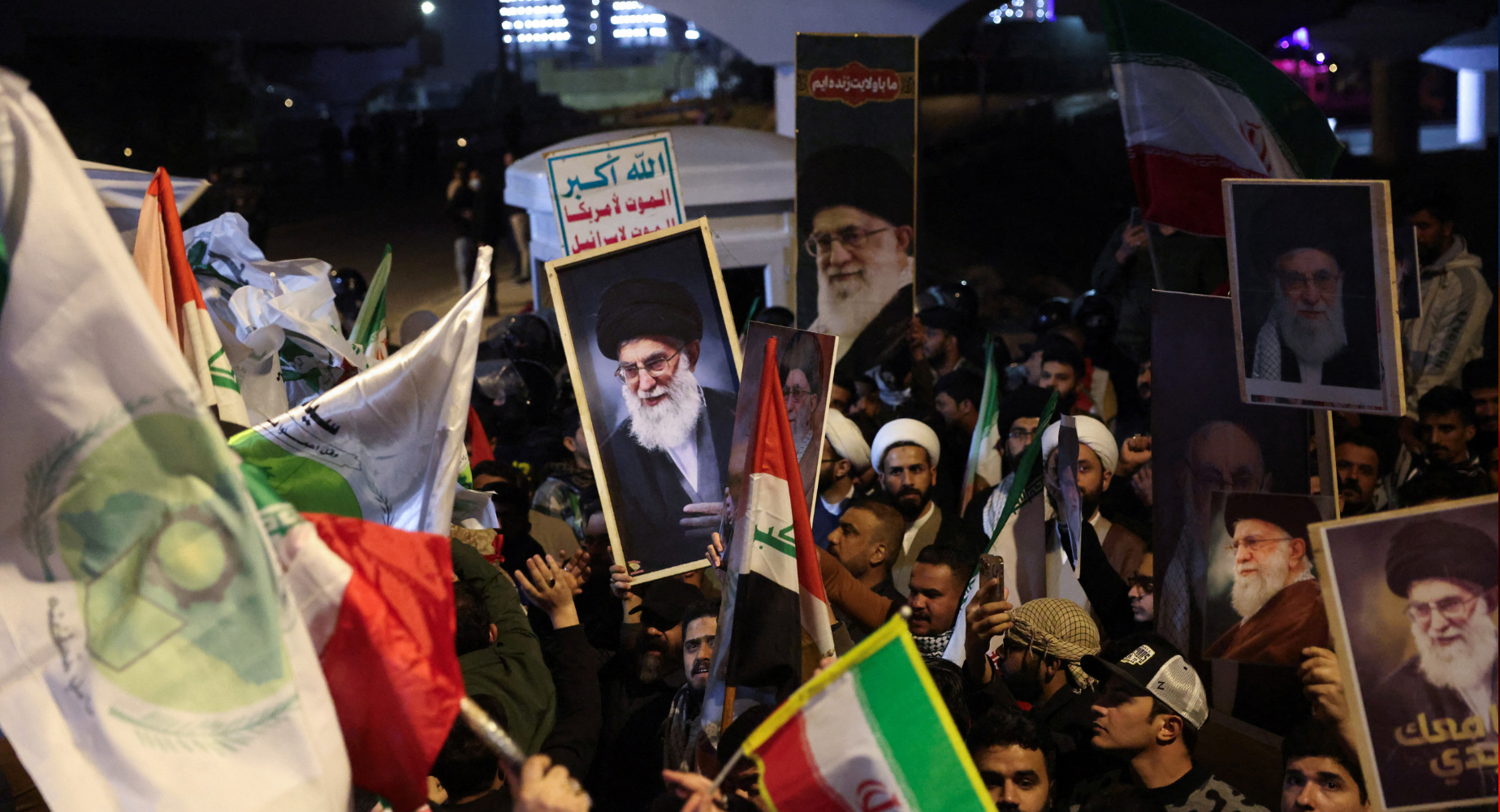
The post-2003 order in Iraq has rested on a fragile and unstable balance of power. The political dominance of Shi’ite political parties and their militias has been underwritten by powerful Iranian support and influence, a semi-autonomous Kurdish north, and residual U.S. ties that coexisted uneasily with Tehran’s outsize role. The eventual collapse of the Islamic Republic under sustained U.S. economic and military pressure will dramatically change the Iranian role in this volatile political order, brutally exposing Iraq’s sectarian and institutional weaknesses.
After the U.S.-led coalition overthrew Saddam Hussein in 2003, elections and a new constitution produced governments led by Shi’ite parties, many of them with longstanding organizational and ideological links to the Islamic Republic. The Islamic Dawa Party, the Islamic Supreme Council of Iraq, and other factions tied to the Sadrist movement and the Coordination Framework competed for power, but the center of gravity remained parties that had operated in exile or in the underground with Iranian assistance during the Baathist era. These parties used their control of ministries, the judiciary, and the security apparatus to enrich, empower, and entrench themselves. Iran’s influence was never total, but it was structurally predominant.
The Kurdistan Regional Government (KRG) retained formal autonomy under the 2005 constitution, financed largely by oil exports from fields around Kirkuk and Erbil. Its autonomy has fluctuated, influenced by Baghdad’s willingness to transfer budget shares, and by conflicts over disputed territories. In September 2017 the KRG held a referendum in which roughly 93 percent of Kurdish voters opted for independence. Baghdad, backed by Iran and Turkey, responded with military moves, the closure of Kurdish airspace, and the recapture of Kirkuk by Iraqi forces and Popular Mobilization Forces (PMF) units. Iranian media and officials framed the referendum as a threat to regional stability; Arabic outlets close to the Iraqi government treated it as an unconstitutional challenge. The episode demonstrated both Kurdish organizational capacity and the limits imposed by neighbors, who viewed the prospect of an independent Kurdistan with trepidation.
Iran’s most direct instrument has been the network of militias later formalized as the PMF (Arabic: al-Hashd al-Shaabi). Formed in 2014 after Grand Ayatollah Ali al-Sistani’s fatwa against ISIS, the PMF incorporated pre-existing Iranian-backed groups such as the Badr Organization, Kataib Hezbollah, Asaib Ahl al-Haq, and Harakat Hezbollah al-Nujaba. Although placed nominally under the prime minister and the Ministry of Defense, these factions retained separate command chains, funding streams, and ideological loyalty to Iran’s Islamic Revolutionary Guard Corps–Quds Force. Iran provided these proxies with salaries, weapons, training, and political cover. Estimates of direct and indirect support have run into the hundreds of millions of dollars annually in peak years. Geopolitically, this arrangement left Iraq functioning in significant respects as an Iranian vassal, inter alia serving as a transit corridor for weapons to Syria and Lebanon, while still hosting some U.S. trainers and receiving American security assistance.
The coming collapse of the Islamic Republic will largely sever this patronage. The PMF’s core factions have depended on Iranian cash, precision munitions, and political protection for more than twenty years. Without them, payrolls, recruitment, and operational tempo will contract sharply. With respect to militia finances, it is well known that Iranian transfers supplement, and sometimes exceed, official Iraqi budget allocations. Their sudden end will force commanders to compete more ruthlessly for state resources, as well as turn to local extortion and smuggling. Some units might fragment or seek new external sponsors; others could attempt to seize entire ministries or revenue streams inside Iraq to compensate for lost revenues.
The resulting power vacuum will encourage other actors to try their chances. Sunni communities in Anbar, Nineveh, Salah al-Din, and Diyala have remained politically marginalized since 2003, with limited representation in the security forces and chronic grievances over displacement and collective punishment. Remnants of the Islamic State, still capable of guerrilla attacks, will naturally seek to exploit the disarray of the Shi’ite militias. ISIS cells have continued low-level operations in rural areas west and north of Baghdad. The weakening of the PMF and a distracted Iraqi army would lower the cost of reconstituting larger formations. Renewed fighting will likely concentrate along the historical fault line running from Mosul through the Tigris valley towns of Balad and Samarra, into Fallujah and the Baghdad belts, the same terrain contested in 2014–2017.
The KRG will face both opportunities and threats. Kurdish parties and the Peshmerga are better institutionalized, more pro-Western in orientation, and less dependent on Iranian funding than the PMF. The KRG’s administrative capacity is impressive, and it has a deep interest in expanding its control over disputed areas and local oil infrastructure. Following the collapse of the Islamic Republic, the KRG will almost certainly revive demands for greater autonomy, and even consider holding a new independence referendum, as Iran’s power in Iraq withers. ISIS, which has historically targeted Kurdish areas, will certainly renew its attacks on Erbil and the Nineveh Plain, testing the Peshmerga’s capacities precisely when the KRG seeks to project strength.
A further complication would be refugee flows from Iran itself. The Islamic Republic’s security apparatus — the IRGC, the Basij, the intelligence services, and judicial enforcers — has been responsible for mass arrests, torture, and executions for nearly five decades. As the Islamic Republic collapses, personnel from these organizations and their families will have few safe destinations. Iraq’s Shi’ite south will offer sectarian and geographic proximity, plus existing networks through the PMF and Shi’ite shrine cities. The rapid influx of tens or hundreds of thousands of former regime supporters will strain housing, public services, and local politics, while importing armed and organizationally experienced actors who could align with the residual pro-Iranian militias, or form new ones.
Iraq’s central government has been chronically fragmented, with caretaker cabinets, election disputes, delayed budgets, and competing power centers. It has been largely unable to assure physical security or deliver consistent public services. Under simultaneous militia infighting, Sunni mobilization, Kurdish assertiveness, and refugee pressure, it would likely lose effective control outside the government core in Baghdad. The Iraqi army and federal police, already uneven in cohesion and penetrated by militia loyalists, could split along ethnic and sectarian lines, with Shi’ite units refusing to carry out orders targeting PMF factions, and Sunni and Kurdish personnel defecting or standing aside. Kurdistan, though facing ISIS raids and possible border friction, will probably remain the most stable part of Iraq, preserving intact its oil revenue stream, basic administration operations, and external security partnerships.
Instability in Iraq will not stop at its borders. Large displaced populations may move toward Iraq’s borders with Jordan, Kuwait, and Saudi Arabia. Jordan already hosts large Syrian and Iraqi populations and has limited absorptive capacity, while the Gulf states have historically restricted Iraqi inflows on security grounds.
U.S. policy in this contingency should remain conservative and above all avoid the reintroduction of American combat forces. Direct technical assistance, including sensors, training, and intelligence sharing, for border security forces in Jordan, Kuwait, Saudi Arabia, and Bahrain will reinforce these important allies without committing U.S. troops inside Iraq. Parallel security assistance to the KRG, focused on counter-ISIS intelligence, Peshmerga logistics, and air-defense capabilities, will strengthen the most stable, pro-Western entity in Iraq. Limited non-lethal support and diplomatic engagement with any Baghdad authorities still willing to constrain militia remnants could preserve a degree of counterterrorism cooperation. The logic of this approach will accept the inevitability of Iraq’s internal balance shifting violently once the Islamic Republic collapses and its patronage and influence end, while limiting U.S. exposure to another open-ended ground commitment.