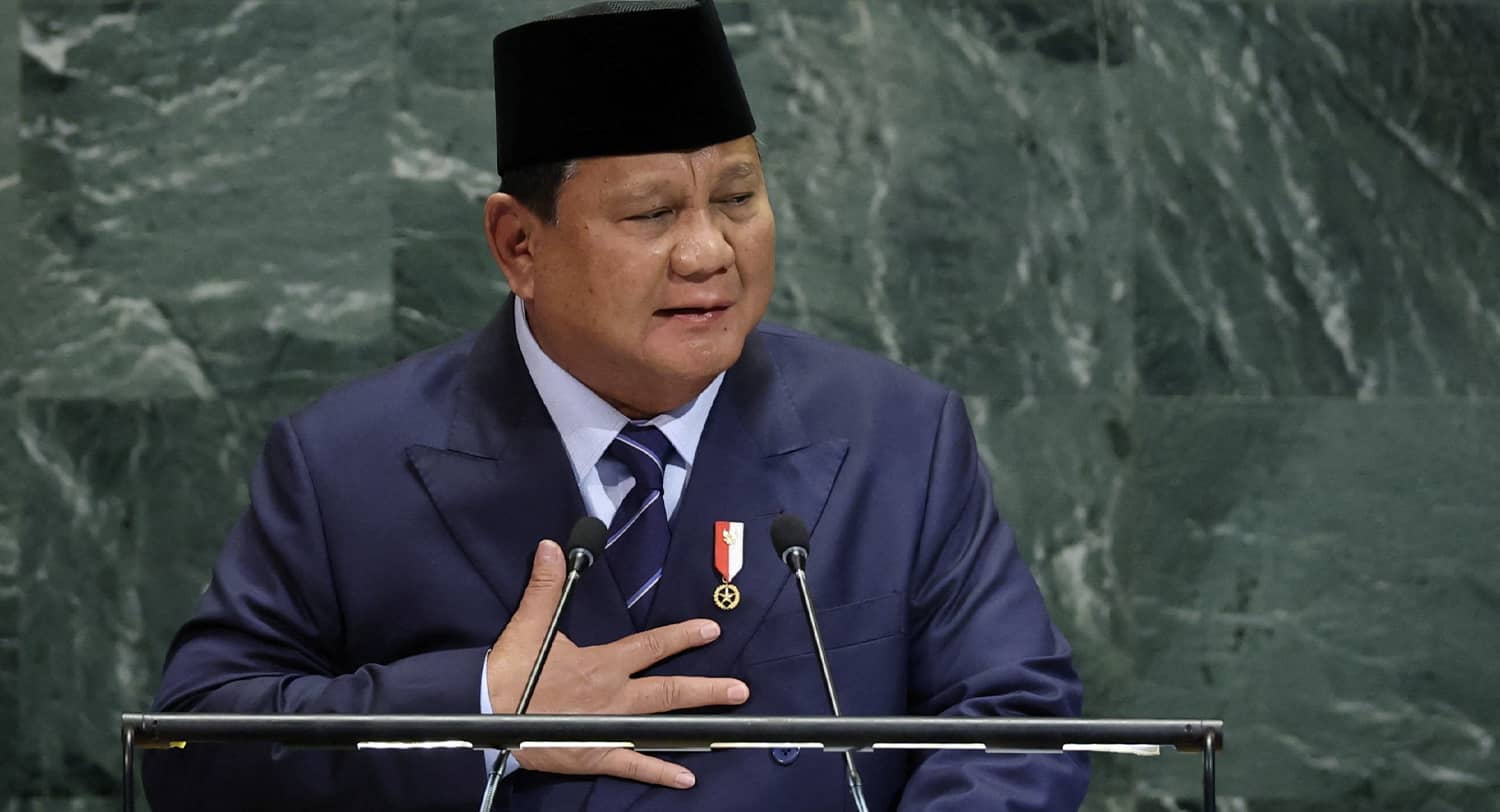
On September 23, 2025, Indonesian President Prabowo Subianto opened his address at the UN General Assembly in New York with a word no Indonesian leader had ever uttered publicly: “Shalom.”
The hall fell into brief, symbolic silence, then applause. Moments before, Prabowo had declared that “the world must guarantee not only the freedom of Palestine, but also the right of Israel to live in peace and security.”
Prabowo invoked the Abrahamic root of peace itself (shalom, salaam, shalem), a shared moral language that predates modern divides. This does not signal imminent normalization between Indonesia and Israel, but it does indicate a leader searching for the way forward towards a more balanced approach to the Israeli-Palestinian conflict.
Abrahamic Peace, Southeast Asian Style
Southeast Asia is often described as a mosaic of cultures and faiths. But at its moral core, it carries the Abrahamic imagination, the shared belief that humanity’s covenant with the divine demands responsibility toward one another and toward the Earth.
Islam, Christianity, and Judaism all have followers across Southeast Asia. Even where indigenous traditions prevail, the Abrahamic moral framework of justice, mercy, and stewardship continues to shape the region’s conscience.
Indonesia, home to the world’s largest Muslim population, has long practiced a diplomacy of balance: bebas aktif, or “independent and active.” Yet behind this principle lies something deeper, a spiritual pragmatism. In a region that has seen colonization, Cold War conflict, and modern polarization, diplomacy often takes the form of moral navigation. It is about preserving harmony, not domination; seeking peace that does not erase difference, but redeems it.
What Does it Mean?
This shift did not erase Indonesia’s commitment to Palestinian statehood. On the contrary, it gave that commitment moral depth. By acknowledging the dignity of both peoples, Prabowo placed Indonesia’s diplomacy back in its Abrahamic lineage, as a mediator, not a partisan.
For decades, Indonesia’s bebas aktif stance had meant nonalignment. Now, with the invocation of “Shalom” it begins to mean something more profound: active empathy, the ability to hold two truths in tension; to grieve for Gaza without hating Tel Aviv, to demand justice without denying existence.
And while Prabowo’s words startled some at home, they also resonated with a younger generation of Indonesians, Malaysians, and Filipinos, citizens shaped by pluralism and eager for moral courage that bridges rather than blames.
Three Trends in Indonesia
The internal reality of Indonesia has always been more diverse than most observers realize. In several regions, such as north Sumatra and parts of eastern Indonesia, the majority population is non-Muslim, and public sentiment toward Israel is significantly more open. North Sulawesi hosts one of the oldest synagogues in the country, a reminder of a quiet historical continuity between Indonesian and the broader Abrahamic world. These regional nuances contribute to a more textured national discourse, one that complicates the stereotype of a monolithic Indonesian position.
Within this broader shift, Indonesia’s potential outreach to Israel remains unofficial but evolving. Three quiet trends are visible:
Faith-based dialogue actors: A small but growing number of interfaith scholars and organizations, including segments of Nahdlatul Ulama (NU), Indonesia’s largest Muslim association, which promotes Indonesian Islam, have engaged in conversations with Israeli counterparts, rooted in a desire for dialogue, compassion, and mutual understanding. However, in Indonesia, NU is currently facing significant public criticism over internal governance controversies, a challenge that complicates its ability to lead such bridge-building efforts.
Strategic and diplomatic pragmatists: Within Indonesia’s defense and foreign policy community, especially under Prabowo’s pragmatic leadership, there is a subtle recognition that selective cooperation with Israel, particularly in security and technology, could serve Indonesia’s long-term global positioning. This logic remains unspoken, but increasingly acknowledged.
Ongoing public and political caution: At the societal level, sympathy for Palestine remains deeply embedded. Any premature normalization risks backlash, particularly amid heightened scrutiny of religious institutions and debates about moral legitimacy. As a result, what can be most effective in the Indonesian context is moral diplomacy rather than formal diplomacy: indirect, values-driven, and careful.
Conclusion
In Southeast Asia, peace is not the absence of conflict, it is the presence of conscience. Prabowo’s “Shalom” moment was more than a diplomatic first; it was a moral reawakening. A reminder that to speak peace, one must also make room for the other’s existence. Perhaps this is what the Abrahamic imagination was always meant to be: not an alliance of power, but a fellowship of compassion.