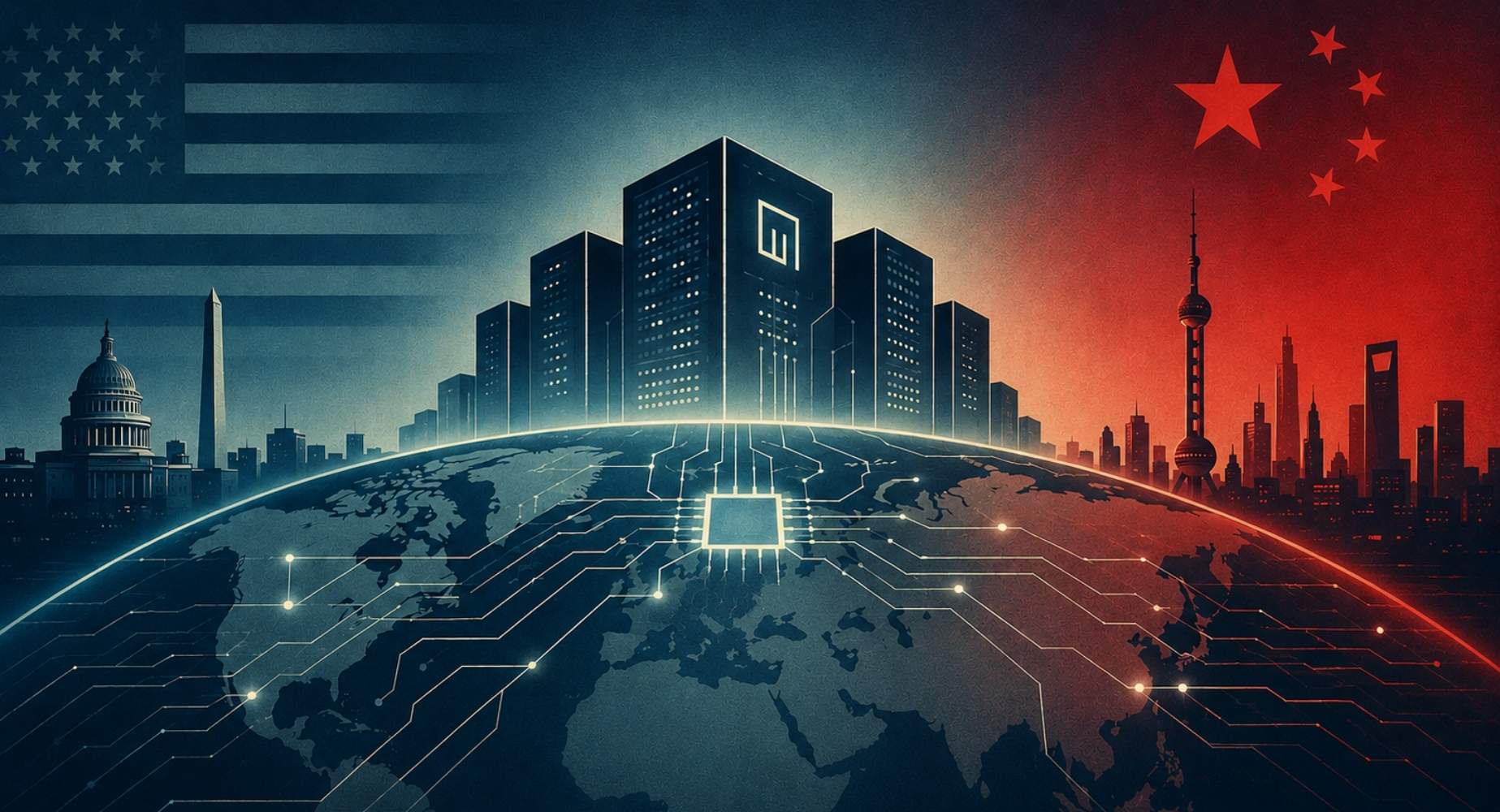
Artificial Intelligence is not merely the latest sector of industrial advancement. It is the architect of a new global paradigm — rapidly becoming the operating system of economy, politics, governance, and military force. The historical trajectory of human progress has always been dictated by the relationship between the tools of production and the structures of governance. The evolution of human societies has generally followed shifts in productive capacity — from slave economies and feudal systems to industrial capitalism and various socialist experiments. While this progression has never been universal or linear, technological revolutions have repeatedly forced political and economic structures to adapt. Today, we stand at the precipice of the next civilizational shift.
Artificial Intelligence is not merely the latest sector of industrial advancement. It is the architect of a new global paradigm — rapidly becoming the operating system of economy , politics, governance, and military force. This transition poses a fatal challenge to rigid, centralized systems of power. When massive technological leaps occur, flexible entities that respect iteration, user choice, and structural adaptability tend to gain ground. The current global rivalry between decentralized innovation ecosystems and absolute state control reveals the core friction of this new era — most vividly demonstrated by the strategic dilemma facing the Chinese Communist Party (CCP).
China’s AI Crossroads
For China to maintain its position as a dominant global pole, it must achieve supremacy in AI. Recent developments illustrate its immense capability in scaling technology — leveraging cheap energy for massive data centers, state-driven chip clustering (e.g., Huawei Ascend), and rapid diffusion of AI into industry and infrastructure. Despite Western export controls, China has narrowed gaps in specific model capabilities. However, AI development does not automatically require political liberalization. China has demonstrated that substantial progress can occur under authoritarian governance. The true structural test is long-term sustainability at the frontier.
Frontier innovation tends to benefit from environments that tolerate open experimentation, dissent, and unpredictable knowledge creation — areas where highly centralized systems face severe internal friction. The CCP’s foundational blueprint relies on absolute centralization, top-down control, and aggressive information filtering.
The CCP prioritizes political survival by imposing strict ideological alignment on algorithms and heavy content filtering. This risks choking organic, unpredictable breakthrough innovation, causing China to fall behind more fluid global networks. Economic and technological pressures fracture the rigid single-party apparatus. To avoid stagnation, the state may be forced to loosen controls, leading to competitive regional factions, greater private-sector autonomy, or multi-party-like dynamics that better mirror a complex, automated economy. Reality today appears as a managed hybrid: a form of “fragmented authoritarianism” that permits local experimentation and private-sector leeway while maintaining ultimate party oversight. This enables robust industrial deployment but risks limiting the wild-card breakthroughs required for definitive frontier leadership.
The Emerging Triangular Power Dynamic
Crucially, the emerging AI order is not simply a competition among nation-states. For the first time since the rise of the modern state, private corporations possess computational infrastructure, data ecosystems, and research capacities approaching strategic significance. Monolithic tech enterprises are no longer mere vendors to governments — they control strategic assets once monopolized entirely by sovereign powers. The future balance of power will therefore not be a traditional bipolar or multipolar state rivalry, but a complex triangular relationship among governments, corporate entities, and autonomous algorithmic systems.
The New Pillars of Statehood
Traditional political systems rely on slow, human-centric bureaucracy. AI introduces algorithmic governance—real-time resource allocation, predictive economic modeling, and instantaneous administrative decisions. A state shackled by rigid bureaucratic compliance and political vetoes cannot compete with adaptive, data-driven systems. China already deploys this aggressively through smart cities, predictive policing tools, and large-scale economic coordination. Democratic systems may suffer regulatory lag but retain long-term advantages in institutional adaptability and organic correction mechanisms.
Wealth and sovereignty are no longer defined primarily by physical labor pools or heavy industrial capital. In the AI world order, dominance belongs to those who achieve computational sovereignty— a foundational asset built upon four interdependent pillars: Compute, Data, Energy, and Talent. While geopolitical analysts often focus on semiconductors and raw compute power alone, the global race is increasingly bottlenecked by access to massive energy grids and the ability to attract and retain elite cognitive talent. The states and corporate ecosystems that master the alignment of all four pillars will command the new industrial base of the 21st century.
Modern warfare is shifting from mass mobilization toward autonomous systems, swarm tactics, and algorithmic decision-making. Yet the decisive factor may not be autonomous firepower itself, but the ability to compress the decision cycle — achieving absolute decision superiority. States and systems capable of deeply integrating AI into intelligence analysis, predictive logistics, battlefield simulation, and strategic planning will outpace opponents trapped in slower, human-bureaucratic processes. Future military advantage belongs less to those with heavier physical weapons and more to those with superior predictive systems.
Global Outlook: Adaptation Over Inevitable Collapse
Just as the Industrial Revolution dismantled absolutist kingdoms and birthed modern nation-states, the AI revolution is reshaping global authority. Rigid monopolies on power — whether authoritarian states or unchecked corporate giants — will face immense structural pressure to adapt, fragment, or give way. Yet outcomes are not predetermined toward full decentralization. Authoritarian systems can successfully harness AI to enhance surveillance, propaganda, and economic coordination, creating highly resilient forms of digital authoritarianism. The most successful models in this transition will likely be hybrids: state-guided direction combined with private-sector dynamism, massive compute and energy scale, and genuine institutional adaptability. The next world order will belong to those systems fluid enough to evolve alongside the technology they inhabit. In this hyper-connected reality, the ultimate advantage goes to those who can iterate fastest — blending computational power with human creativity, scale with openness, and efficiency with resilience.
The Realignment of Legitimacy and Reality Management
One final implication reaches beyond geopolitics into the very nature of political legitimacy. In previous world orders, legitimacy rested on visible foundations: divine right, constitutional law, electoral consent, or revolutionary ideology. These drew power from symbolic coherence and shared narratives. In the AI-mediated order, legitimacy risks becoming operational rather than symbolic. Systems may be judged less by how convincingly they are justified and more by how effectively they perform under real-world constraints. Governance begins to decouple from explanation: a regime or institution can endure not because its ideology persuades, but because its computational architecture reliably delivers stability, prosperity, and adaptive capacity. This does not eliminate the human need for meaning. Instead, meaning migrates — from formal institutions to the interfaces and predictive environments through which people increasingly experience reality. The most powerful actors will therefore be those who shape not only behavior, but perception itself. Beneath traditional geopolitical competition lies a deeper contest: the struggle over cognitive environment design. Whoever controls the informational and predictive spaces in which decisions are framed effectively sets the boundaries of what is thinkable and doable. In this sense, power shifts from commanding institutions to structuring the field of perception within which institutions operate. Thus, the AI epoch represents more than a change in economic or military organization. It marks a transformation in the architecture of reality management itself. The emerging world order will be defined not only by who governs whom, but by who defines the parameters within which governance becomes possible. Previous world orders were built upon land, labor, industry, and capital. The emerging order will be built upon intelligence itself. Nations that learn to govern this new resource will shape the century ahead; those that fail may discover that sovereignty in the AI age is no longer guaranteed by geography, population, or military size alone. The AI epoch has begun.