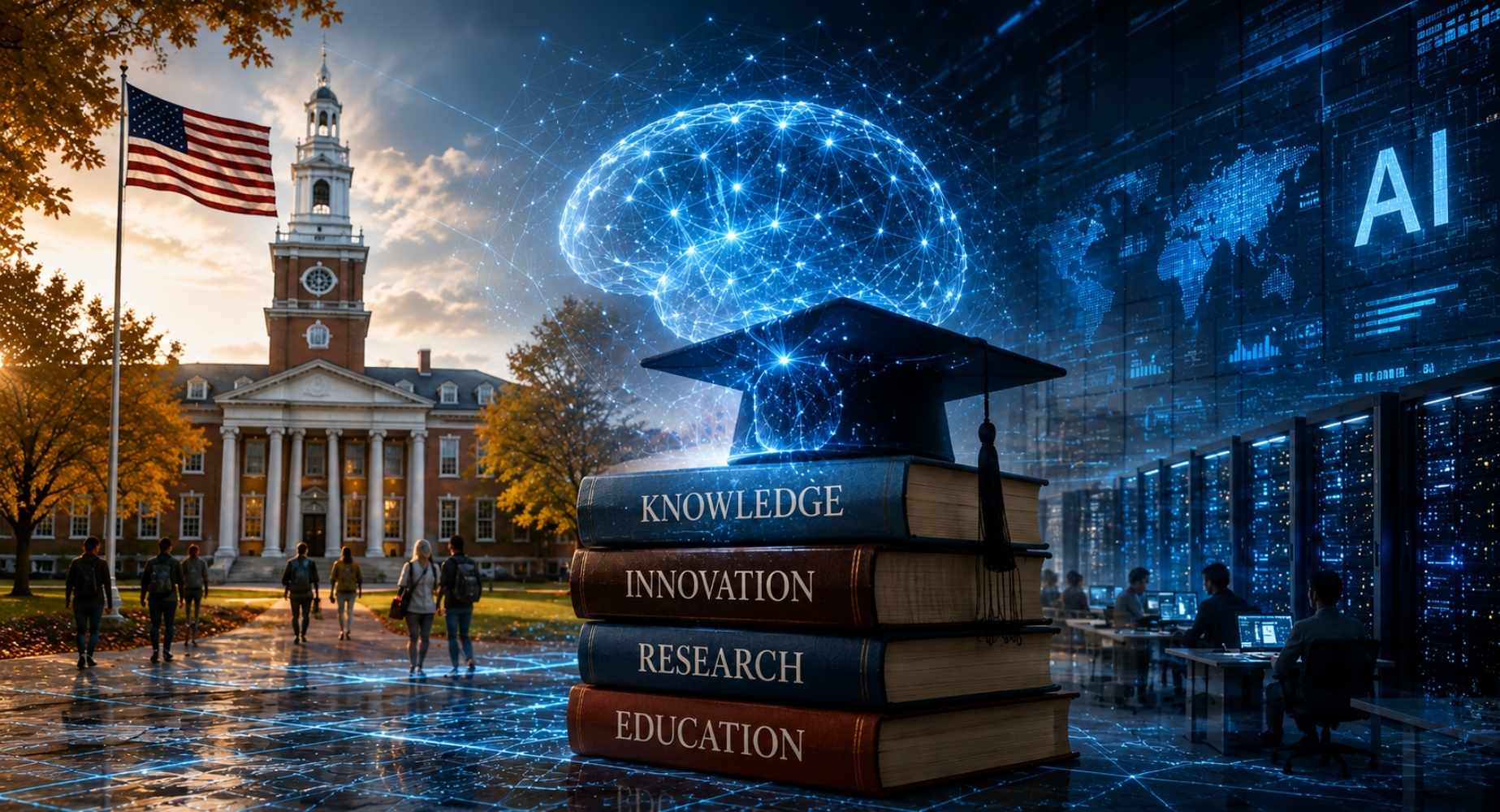
Knowledge is a power tool. It is arguably the most potent one in the human toolbox. As a global knowledge-leader, America’s knowledge ecosystem has allowed the United States to dominate world affairs for the past 80 years, but today our knowledge ecosystem is at risk, threatened by foreign adversaries as well as by domestic challengers. It is even threatened by the tool itself. How we respond to those challenges will have outsized impact on U.S. national security and America’s role in the world.
Since the democratization of knowledge began in Europe with the invention of the printing press, followed by the scientific revolution, the enlightenment, and eventually the industrial revolution, it has spread throughout the world. Initially throughout Europe, then to the Western Hemisphere, and parts of Asia, the information/communication revolution of the late 20th and early 21st centuries extended the democratization of knowledge globally. During that span human life expectancy has increased from around 35 to over 70 years. Literacy has increased from 10 to 90 percent. And human prosperity has increased from basic subsistence for the vast majority to over $12,000 per capita GDP per year. Never in human history has the human condition improved so rapidly or so dramatically for so many. Thanks to knowledge.
The United States has led that advance for the last century. Our foreign adversaries—particularly Russia, China, and Iran—recognize our knowledge ecosystem as a source of our strength and relentlessly attempt to neutralize it. They saturate our networks with synthetic content, bot-driven automated dissemination, and click-centered recommendation algorithms. Disinformation, misinformation, and deep fakes contaminate the internet with confusing messages that sow distrust in all media, inflame social conflict, and ultimately create doubt about the concept of objective truth itself. Our adversaries exploit all media with a tsunami of messages promoting self-serving narratives about world order while they manipulate our ecosystem to influence elections and both popular and leader opinions in their favor. Research by France’s VIGINUM agency and the Center for the Study of Democracy in Bulgaria has exposed Russian efforts to infect large language models with erroneous and misleading information to support the Kremlin’s strategic narratives resulting in pro-Russian outputs from supposedly neutral digital sources.
The threat to our knowledge ecosystem is not just external. American universities, laboratories, and research centers, homes to the world’s richest education, research, and innovation culture, have been the engines Western knowledge dominance. Today our leading universities are under attack. Anti-intellectual zealots have attacked Harvard, Columbia, Northwestern, University of California, and many others in retribution for teaching values they derisively refer to as wokism. Somehow diversity, equity, and inclusion have been twisted into terms of derogation. These attacks have cast a chill on academic freedom throughout the country. Universities, scientists, professors, and students have been put on notice that they are vulnerable to retribution from a vicious, virulent, and vindictive government.
The attack on America’s universities is accompanied by drastic cuts in government-funded research. Once the global leader in basic as well as applied scientific research, the Trump administration has proposed draconian cuts to NASA, the National Science Foundation, and the National Institute of Standards and Technology, among others; what Casey Dreier of the Planetary Society called “an extinction-level event for science.” Entire programs dealing with social, behavioral and economic sciences such as the Defense Department’s flagship Minerva Research Program established by former Secretary of Defense Rober Gates, have been shuttered. Many leading scientists have fled to other countries where their research is not threatened. According to Leigh Stearns of the University of Pennsylvania “This is how the U.S. loses its scientific leadership.”
Since the invention of the telegram communication machines have been messaging directly with other communication machines, but their interactions were content-neutral—they were conduits for humans passing messages to other humans. Today’s communications systems are dynamic and interactive learning machines. They are not merely communication platforms, but knowledge managers, knowledge analysts, and even knowledge creators. AI-driven knowledge machines have nearly instant access to vastly greater data and information resources than their human creators. Recent AI advancements have machines communicating primarily with other machines, with 24/7 data access, and relentless self-learning.
The machines are becoming smarter than their human handlers. In 2016 an AI named Alpha-Go defeated the world champion in a match of the highly complex game of Go—something previously thought to be impossible. AI systems routinely and consistently defeat human pilots in simulated dogfights due to their super-human reaction speed and ability to analyze vast quantities of data from diverse sources nearly spontaneously. Today AI-driven programs analyze and aggregate our preferences communicating them to other platforms within their networks with the result that we humans are now fed the preferences not of human beings, but the preferences of machines. Are humans still even in control?
To maintain an advantage in the increasingly competitive global cognitive domain the United States will have to meet these challenges head-on. Foreign attacks on our knowledge ecosystem must be detected, exposed, and countered, but the response must go beyond resilience. The United States must develop real deterrence by demonstrating the ability to inflict unacceptable punishment on its adversaries in the cognitive domain. Only the threat of real punishment will deter determined adversaries.
Ironically, however, it is our own intellectual auto-lobotomy that is the greatest threat to our knowledge ecosystem. While our academic and research institutions need reform and improvement, they do not need condemnation and punishment. We need to cultivate our knowledge ecosystem, better understand its potential, and be at the forefront of knowledge creation. We must master the emerging technologies of knowledge, information, and communication, and not let the technologies become our masters.
The world’s best scientists and researchers working at the cutting edge of emerging technologies including artificial intelligence, quantum sensing and communications, hypersonic delivery systems, and others will gravitate toward those countries and institutions where their work is supported, encouraged, and resourced free of political interference and ideological zealotry.
If a future administration wishes the United States to retain its position in the ever-intensifying geopolitical competition, a good starting point would be to restore the healthy partnership between the American knowledge ecosystem and the national security community. That could be a central tenet of a future National Security Strategy.