Dear Mr. Kushner,
You have once again demonstrated your ability to enter difficult negotiations and engage parties separated by profound distrust. Your recent discussions with Prime Minister Benjamin Netanyahu may have opened a path toward progress in Gaza. Now, as you play a central role in President Donald Trump’s efforts to end Russia’s war against Ukraine, Kyiv must be part of your peace diplomacy.
Reports indicate that you and Steve Witkoff have agreed in principle to visit the Ukrainian capital. That would be an important and welcome step. You have engaged directly with Moscow, but no negotiation intended to end this war can be complete without listening to the people who will be asked to live with its consequences.
Your family has already demonstrated compassion for Ukrainians. At the beginning of the full-scale invasion, Ivanka Trump helped mobilize humanitarian assistance, including food, medical supplies and generators. Ukrainians remember those who responded during their moment of greatest need, and we remain grateful to you and Ivanka for that support.
Today, however, Ukraine needs more than humanitarian assistance. It needs an honest peace—one that ends the killing without merely preparing the conditions for another war.
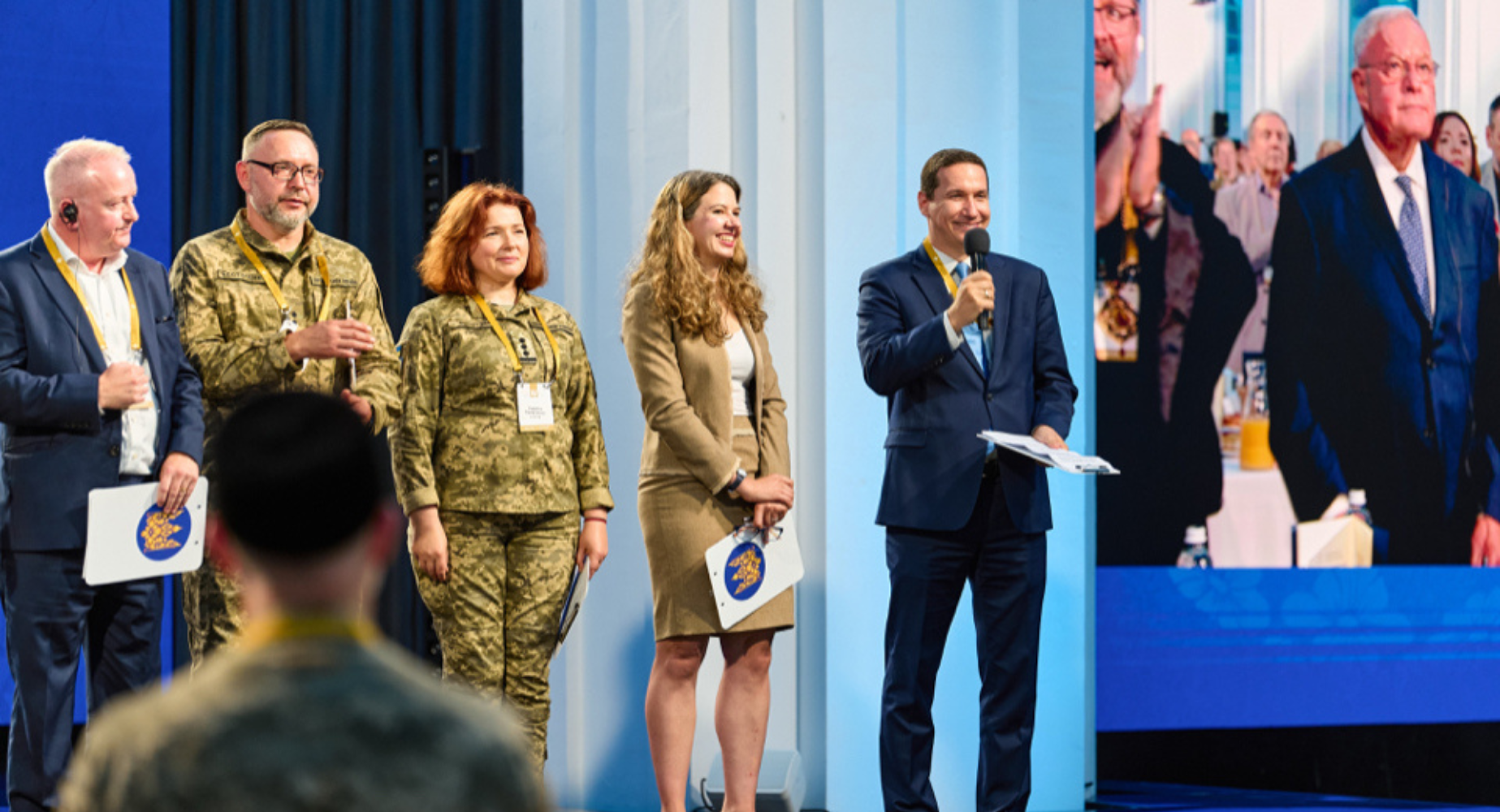
The National Prayer Breakfast of Ukraine, which will be held in Kyiv on August 23, would provide a meaningful occasion for you and Mr. Witkoff to visit. Last year, I participated in this remarkable gathering and saw Baptists, Jews, Catholics, Orthodox Christians, Muslims and members of other faith communities united by a common desire: to protect human life and achieve a durable peace.
Since Russia launched its full-scale invasion in February 2022, Ukrainians have endured extraordinary loss, displacement and fear. Nearly six million Ukrainian refugees remain outside the country, while approximately four million people are internally displaced. Behind every statistic is a family separated, a home abandoned or a future placed on hold.
The fate of Ukraine’s children deserves particular attention.
Ukrainian authorities have documented the deportation or forced transfer of nearly 20,000 children by Russia, although the true number may be considerably higher. Many were taken to Russia or Russian-occupied territories, separated from their families and subjected to efforts to erase their Ukrainian identity. Some were given new names, placed with Russian families or prevented from speaking their native language.
More than 2,000 children have reportedly been returned through the efforts of Ukrainian authorities, families and nongovernmental organizations, including Save Ukraine. Thousands more remain beyond the reach of their parents.
Their return must be treated as a central humanitarian obligation in any credible peace process—not as a secondary concession to be considered only after the political and territorial questions have been resolved.
I appeal to you not only as a negotiator, but also as a devoted father and a person of faith. The Jewish principle that saving one life is akin to saving an entire world carries particular meaning in a war in which thousands of children have been separated from their families.
When you come to Kyiv, please meet some of the children who have returned. Listen to what happened to them. Meet their families and the people who risked their lives to bring them home. Their experiences reveal a dimension of this war that cannot be understood from negotiating documents, intelligence assessments or maps.
You should also meet Ukraine’s Jewish communities. Jewish life in Kyiv, Dnipro, Odesa and Kryvyi Rih is vibrant and deeply woven into Ukraine’s national story. Ukraine’s religious diversity—including its Jewish, Christian and Muslim communities—is not incidental to the country’s identity. It is part of what Ukrainians are fighting to preserve.
Ukraine and Russia are still sometimes described as “brotherly nations.” That formulation obscures the fundamental reality of this war. Ukraine is an independent nation with its own language, political culture, religious traditions and national aspirations. Its people do not regard their sovereignty as a misunderstanding that can be resolved by rearranging borders.
A visit to Kyiv would allow you to experience this reality directly.
You will hear repeatedly that Russia’s war is not a property dispute. The occupied territories may appear on a map as areas that pragmatic negotiators could exchange for an end to hostilities. But territory is not an abstraction. It means communities, families, infrastructure, history and millions of human lives.
Nor can a durable settlement rest on political assurances alone.
Ukrainians view the failure of the 1994 Budapest Memorandum as a grave warning. Ukraine relinquished the nuclear arsenal located on its territory in exchange for security assurances from Russia, the United States and the United Kingdom. Those assurances ultimately proved incapable of deterring Russian aggression.
This history in part explains why Kyiv insists that any future agreement must include credible security guarantees and enforceable mechanisms. That insistence should not be dismissed as an obstacle to peace. For Ukrainians, it is the necessary condition for ensuring that a ceasefire does not become merely an interval during which Russia reconstitutes its forces and prepares for another attack.
Peace must be more than the temporary absence of fighting. It must give Ukrainians confidence that their children will not have to fight the same war again in five or ten years.
Kyiv will also challenge many assumptions about Ukraine. It is a modern European capital characterized by religious pluralism, intellectual energy, entrepreneurship and technological innovation. Ukraine’s achievements in digital technology and drone warfare have attracted international attention, but its greatest resource remains the determination and ingenuity of its people.
Ukrainian-born entrepreneurs have made extraordinary contributions to the American economy and technology sector. Jan Koum co-founded WhatsApp, Max Levchin co-founded PayPal, and Julie Smolyansky leads Lifeway Foods. Their stories reflect a culture that places a high value on education, mathematics, science and entrepreneurial initiative.
That energy will be essential to Ukraine’s reconstruction. When the war ends, rebuilding the country could become one of the most consequential economic and development projects in Europe. American investment, technology and strategic leadership can play a decisive role—but only if the peace that precedes reconstruction is credible and durable.
Mr. Kushner, you have shown that unconventional diplomacy can sometimes create openings where traditional approaches have failed. The Abraham Accords demonstrated the value of combining political imagination with economic opportunity and direct engagement. Ukraine presents a different conflict and a different historical context, but the need to understand the aspirations and security concerns of every party remains the same.
Coming to Kyiv does not require you to accept every Ukrainian position. Nor does listening to Ukrainians prevent you from maintaining channels with Moscow. Effective diplomacy requires engagement with all relevant sides.
But balance does not mean moral equivalence. Russia crossed an internationally recognized border and attempted to subjugate a sovereign country. Any peace initiative that overlooks this reality risks rewarding aggression and undermining the principles on which international security depends.
A durable peace cannot be designed through maps, intermediaries and negotiating documents alone. It requires understanding the people who will be asked to live with its consequences.
Come to Kyiv. Listen to Ukraine’s leaders, soldiers, entrepreneurs, faith communities, displaced families and returned children. See the country not simply as a problem to be resolved, but as a nation whose freedom, security and future will be determined by the choices now being made.
A visit will not resolve every disagreement. But it can help ensure that the pursuit of peace begins with a clear understanding of what is at stake.
I sincerely wish you wisdom and courage in the difficult work ahead.