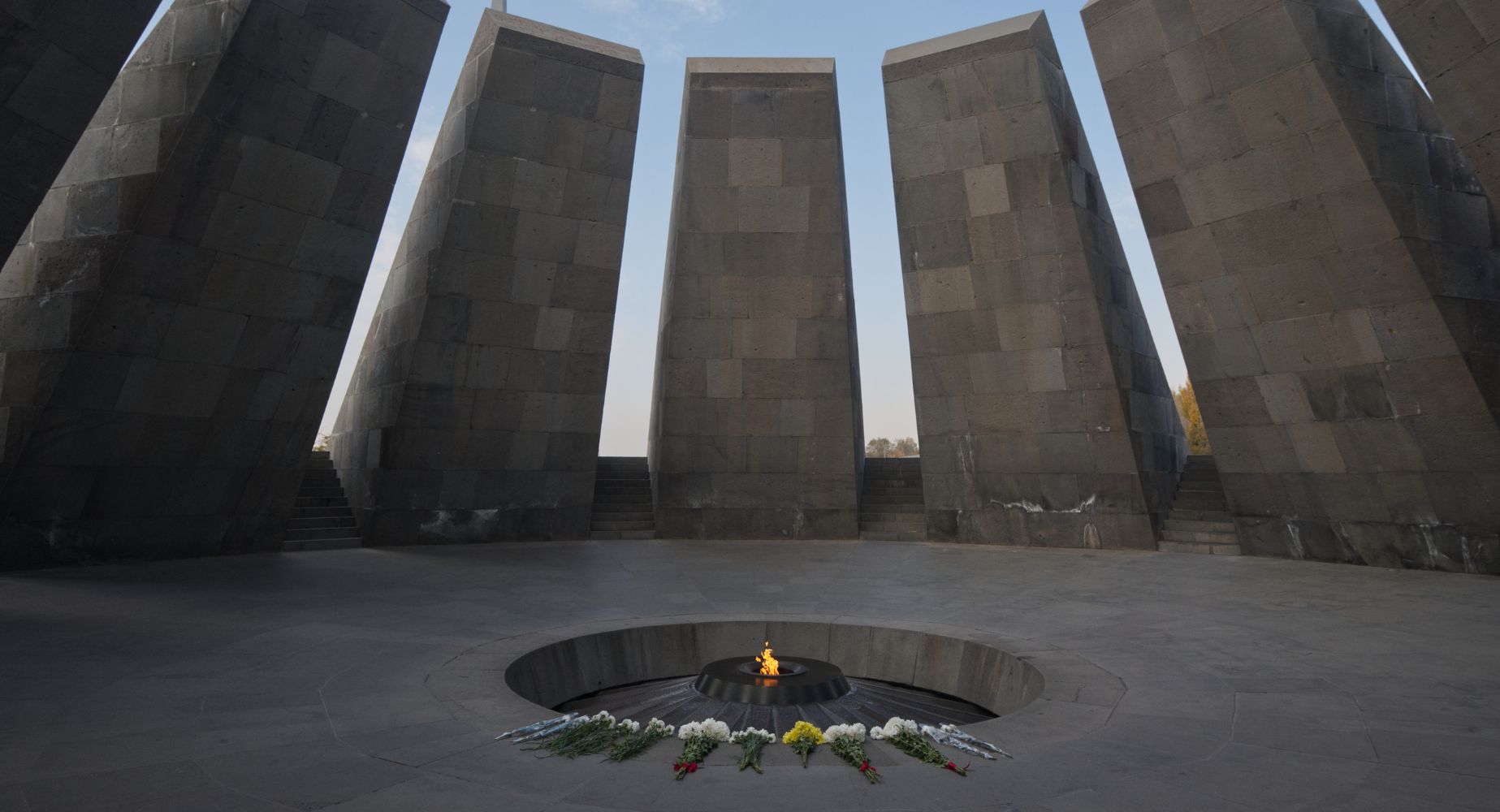
How the geopolitical tide can turn in thirty years! If 1996 was the high-water mark of Turkish-Israeli relations, 2026 is their lowest ebb: from a free-trade agreement to a trade embargo; from an Israeli tourism boom to virtually none; from close military cooperation under their landmark MOU to Erdogan’s threats of military confrontation; and from a strategic partnership against Syria, which harbored Hamas in the 1990s, to Syria’s junior partnership with Turkey, which harbors Hamas today.
Nothing dramatizes this reversal as clearly as the Israeli cabinet’s decision on June 28 to recognize the Armenian genocide. Since the late 1970s, Turkish sensitivities—and, at times, explicit threats—had kept Israel treading carefully around the genocide question and avoiding any misstep that could offend Ankara. But with little Turkish goodwill left to lose, Israeli Foreign Minister Gideon Sa’ar, already a supporter of recognition, saw opportunity in crisis and took his proposal for recognition to the cabinet.
For the first time in Israeli history, a government recognized the Armenian genocide—and unanimously. The cabinet’s decision revealed a stratum even beneath the presumed rock bottom of Turkish-Israeli relations. Sa’ar’s Turkish counterpart denounced Israel as a “burden that humanity can no longer bear.” But Turkey was not the only country unhappy with the decision. Armenia was unimpressed, the United States was annoyed, and Azerbaijan was aggrieved. The backlash, from Azerbaijan in particular, gave the Israeli government second thoughts. Instead of proceeding with the expected Knesset resolution that would have made recognition the official position of the Israeli legislature, Jerusalem shelved it, leaving the cabinet measure a half-measure.
Armenian Response
It may seem surprising that the government of Armenia, where more than half the population descends from genocide survivors, did not applaud the Israeli cabinet’s recognition. Indeed, Prime Minister Pashinyan condemned Israel’s “weaponization” of the genocide, referring, presumably, to the accusation that Israel is using recognition as a cudgel against Turkey. In the broader context of Israeli-Armenian relations, however, Yerevan’s reaction was, like Ankara’s, entirely predictable.
Armenia and Israel have never been close. To be sure, there is considerable Jewish sympathy for Armenians—sympathy born of empathy with a small, ancient, dispersed people that also lost a third of its number to genocide in the shadow of a world war. Popular support in Israel for recognizing the genocide has also been strong, from left to right. But in international relations, the sentimental rarely takes precedence over the strategic, and Israeli-Armenian relations are no different. Of Armenia’s neighbors, Iran—Israel’s greatest enemy—has been Armenia’s closest friend. Two other neighbors, Turkey and Azerbaijan, have been Armenia’s greatest enemies and Israel’s closest friends in the Muslim world. Besides their opposing regional alignments, their bilateral ties are thin. Israel has never maintained a resident ambassador in Armenia, no Israeli prime minister has ever visited the small, landlocked, resource-poor country, and annual bilateral trade is less than the cost of a single Iron Dome battery.
The economic relationship between Israel and Azerbaijan, by contrast, borders on interdependence. Almost half of Israel’s crude oil imports come from Azerbaijan while, until recently, more than two-thirds of Azerbaijan’s arms imports came from Israel. During the 2020 Armenian-Azerbaijani War, Armenia recalled its ambassador from Israel to protest continued arms transfers to Azerbaijan. Israeli-made loitering munitions in particular proved a force multiplier in that conflict, helping Azerbaijan recapture part of Nagorno-Karabakh and all seven surrounding districts. The war’s 2023 sequel ended Armenian control of Nagorno-Karabakh altogether, along with its ancient Armenian presence.
Armenia’s defeat by Azerbaijan and, since then, its pursuit of peace with Azerbaijan and Turkey have defined Pashinyan’s premiership. If the Israeli cabinet’s decision rankled in Yerevan, it was because, as Pashinyan sees it, Israel contributed to the first and is now complicating the second. An earlier Armenian government would have been more receptive, but this decade’s wars have changed the geopolitics of genocide recognition for Armenia no less than for Israel.
From 1998 until the fall of Nagorno-Karabagh in 2023, Armenia had treated international recognition of the genocide not merely as a central foreign policy objective, but also as a national security imperative. Pashinyan’s predecessor declared,“Supporting the international recognition of the genocide is part of our national security strategy” while Pashinyan himself, in a letter to Joe Biden in 2021, affirmed that “recognition of the genocide is a matter of….security to the Republic of Armenia.”
Since the defeats, however, Pashinyan has sought to change Armenia’s relationship with its past, including the genocide. To this end, he has championed what he calls “the demarcation between Real Armenia and Historical Armenia”—that is, between the Republic of Armenia within its internationally recognized borders and the much larger ancestral Armenian homeland that lies beyond those borders, primarily in eastern Turkey but also in Azerbaijan. Pashinyan argues that to hold on to “Real Armenia” (“the only guarantee for the lasting existence of the Republic of Armenia”), Armenians must let go of “Historical Armenia” (“a permanent guarantee of our enmity with a group of countries”). Along with renouncing “Historical Armenia,” Pashinyan has deemphasized genocide recognition. As he declared last year, “International recognition of the Armenian Genocide is not among our foreign policy priorities today.” Now his priority is peace with his neighbors, which he considers Armenian’s “most reliable guarantee of security.” Ironically, then, just as rupture with Turkey has made recognition less costly for Israel, rapprochement with Turkey has made it less valuable to Armenia.
Yet many Armenians believe Pashinyan has gone too far, arguing that the prime minister has gone from seeing genocide recognition as a foreign policy priority to seeing it as a political liability. Some of Pashinyan’s critics have even accused him of genocide denial. Among them is the Armenian Revolutionary Federation, the Armenian diaspora’s most influential party, which guardedly welcomed Israeli recognition. Even some of Pashinyan’s supporters have misgivings. His reelection last month may have been a vote of confidence in rapprochement, but it came by a narrower margin than in the last election. Israeli recognition, then, hit Pashinyan where he is particularly vulnerable.
American Response
Because the Trump administration shares Pashniyan’s commitment to peace in the South Caucasus, it also shared his displeasure with Israeli recognition. But in President Trump’s case, opposing recognition represents continuity, not change. In his first term, Trump, like every president since Reagan, opposed congressional recognition of the Armenian genocide. It was over his objections that Congress, amid a sharp downturn in American-Turkish relations in 2019, passed companion resolutions recognizing the genocide. Before Trump returned to office, Joe Biden became the first president to issue a statement on the Armenian genocide that used the word “genocide,” a declaration Trump has taken care not to affirm since returning to office.
.
Having endorsed Pashinyan’s reelection enthusiastically, Trump is not only committed to seeing peace in the South Caucasus, he’s also well positioned to broker it. No other leader, with the exception of the UAE’s Mohamed bin Zayed, is on friendly terms with the leaders of all three countries: Turkey, Armenia, and Azerbaijan. In August 2025, he hosted Pashniyan and Azerbaijani president Ilham Aliyev at the White House, where they initialed a joint declaration for peace, handing the president one of the signal foreign policy achievements of his second term. The framework provides for the creation of the “Trump Route for International Peace and Prosperity” (TRIPP), a 27-mile transit corridor across Armenia that connects mainland Azerbaijan with its detached territory of Nakhchivan. While the corridor would remain under Armenian sovereignty, it would be under American operational control, with the United States holding the development rights and subleasing them to a private consortium.
TRIPP appeals strongly to Trump because, besides bearing his name and promising a windfall for American firms, it is just the kind of low-cost, high-return initiative he favors. More importantly, TRIPP would represent a major geostrategic coup for Washington—at its adversaries’ expense. Tehran opposes it because it would plant the American flag on its northern border and bypass Iran, now the sole gatekeeper of overland access between Azerbaijan’s two disconnected territories. Moscow opposes it because it would clinch Armenia’s pivot away from Russia and establish the United States as the South Caucasus’ preeminent power broker, displacing Russia. It was no surprise, then, that Russia quietly welcomed Israel’s recognition, seeing it as introducing a useful irritant into the American-mediated peace process it opposes. As the director of the Kremlin-aligned think tank RUSSTRAT commented, “From Russia’s point of view, this is a tactically useful event. It complicates the Turkey—Israel—Azerbaijan link and gives Moscow the opportunity to remind Armenia again: on the issue of genocide, Russia was on the Armenian side long before Israel and the West.”
If anything showed that the Trump and Pashinyan administrations are on the same page when it comes to turning the page on Armenian history, it was Vice President J.D. Vance’s visit to Armenia in February, which produced parallel embarrassments for both governments. After Vance’s X account posted a message “to honor the victims of the 1915 Armenian genocide,” his office hurriedly deleted the post and blamed a staffer for the unauthorized message. That same day, the Armenian genocide Museum-Institute (Armenia’s equivalent of Israel’s Yad Vashem) announced that it had “presented J.D. Vance with books regarding the Armenian genocide and the Artsakh [Nagorno-Karabakh] issue.” For the unauthorized gift, Pashinyan dismissed the institute’s director.
Azerbaijani Response
Although Baku had reasons of its own for opposing the Israeli cabinet decision, the Azerbaijani foreign ministry’s response, in part, expressed what the Trump administration believed but did not say publicly: “Such actions do not contribute to reconciliation or mutual understanding. Instead, they deepen existing divisions and undermine efforts to achieve lasting peace and stability in the region.” According to the Israeli newspaper Maariv, Azerbaijani Foreign Minister Jeyhun Bayramov was more explicit about the American dimension when he spoke to Gideon Sa’ar two days before the cabinet vote. Bayramov cautioned Sa’ar that recognition could also undermine Washington’s peacemaking effort, effectively reminding his Israeli counterpart that Baku’s concerns were also Washington’s.
Although the Azerbaijani statement was measured, Baku’s public restraint belied its private displeasure, and Azerbaijani officials let their grievances be known in Jerusalem. Part of Azerbaijan’s displeasure sprang from a sense that the cabinet decision was an act of Israeli ingratitude. Throughout the war in Gaza, while most of the Muslim world was denouncing Israel and accusing it of genocide, Azerbaijan’s reticence was striking—all the more so given the contrast with Turkey, the first country to accuse Israel of genocide after October 7 and a co-applicant in South Africa’s ICJ case alleging genocide. Israel, Azerbaijani officials complained, did not reciprocate.
Azerbaijan’s opposition to recognition of the Armenian genocide may not seem as obvious as Turkey’s. After all, Azerbaijan was not yet a country during the principal phase of the Armenian Genocide and, except for two brief periods, its territory lay beyond the borders of Turkey’s Ottoman predecessor. The Azerbaijani connection to the genocide becomes clearer if Armenia’s relations with Turkey and Azerbaijan are seen as forming, not two separate bilateral relationships, but a single strategic triangle.
Turks and Azerbaijanis are kindred Turkic peoples, their languages mutually intelligible—”one nation, two states,” as former Azerbaijani President Heydar Aliyev famously put it. But the same close ties that bind Azerbaijan and Turkey entangle each in the other’s conflict with Armenia. It was Turkish solidarity with Azerbaijan, for example, that moved Ankara to close its border with Armenia in 1993 and never reopen it. It was also in solidarity with Azerbaijan that Turkey conditioned normalization with Armenia in 2009–2010 on progress on Nagorno-Karabakh, collapsing two separate diplomatic tracks into one, thereby collapsing the Turkish-Armenian peace process itself.
Nor does Azerbaijan see genocide recognition merely as an attack on its closest ally’s national legacy. It also sees it as a defeat in the narrative war that, alongside the kinetic one, Armenia and Azerbaijan have been fighting for decades. The narrative war centers on Nagorno-Karabakh—which people’s claim is stronger and whose suffering greater—but it reaches further into the past. Baku in 1918, for instance, figures very differently in Armenian and Azerbaijani collective memory. In Baku in March of that year, Bolsheviks and Armenian revolutionaries massacred Tatars, as Azerbaijanis were then known; then, in September, the Ottomans’ Army of Islam invaded the city and, together with Tatar volunteers, massacred Armenians. Whereas many Armenians regard the September massacre as a later, eastward extension of the Armenian Genocide, many Azerbaijanis regard it as retaliation for the March massacres.
That the Israeli government appeared surprised by Azerbaijan’s reaction is itself surprising. For the past 15 years, Israeli diplomats publicly and in Foreign Ministry documents have explicitly cited Azerbaijan as a reason not to recognize the Armenian Genocide. The timing is no coincidence. Around 2010, as Israel and Turkey began drifting apart, Israel and Azerbaijan drew closer, with Baku inheriting the distinction of Israel’s closest partner in the Muslim world. Around the same time, Israel’s decades-old shadow war with Iran intensified, and Baku emerged as Jerusalem’s most important partner after Washington in containing Iran.
The strategic partnership with Azerbaijan has given Israel, in effect, a forward position in its confrontation with Iran. Thanks to its 428-mile border with Iran (a fifth of which had been held by Armenia from 1993 to 2020), Azerbaijan has been indispensable for Israel in intelligence collection, covert operational access, and operational staging. The Mossad used Azerbaijan to spirit the Iranian nuclear archive out of Iran in January 2018 and, according to CNN, during the 2026 U.S.–Israeli War with Iran, Israel used Azerbaijan as a staging area for drone operations, combat search-and-rescue contingencies, and the operation that killed the head of the IRGC division responsible for attacks against Jewish and Israeli targets abroad. Since the late 2000s, Azerbaijani intelligence has foiled at least six such plots.
Recognition Stalls
On June 29, the Knesset Presidium—the body that sets the legislative agenda—approved an urgent motion scheduling debate on the recognition proposal for the following week. The next day, Gideon Sa’ar announced to the Knesset that the recognition proposal would “be brought to a vote in the Knesset plenum. I hope that as early as next week the debate will be held and the vote will take place.” Yet by July 9, once the Knesset’s sitting days during the week in question had passed, Azerbaijani outlets were already reporting that the vote had been canceled. That assessment was borne out on July 17, when the twenty-fifth Knesset completed its four-year term without the resolution ever reaching the floor.
The foregoing is all a matter of public record. What happened behind the scenes is less clear. Haaretz reported that Hikmet Hajiyev—one of Ilham Aliyev’s most trusted foreign policy advisers and a kind of Azerbaijani Ron Dermer—initiated back-channel diplomacy with Netanyahu’s office, prompting the government to abandon the effort to secure recognition by the Knesset. On August 4, Hajiyev corroborated the Haaretz report in an interview with the Azerbaijani-owned Turkish news outlet Haber Global: “As soon as the issue arose, on the instructions of our President, Azerbaijan also launched an intensive diplomatic effort. We conveyed our messages clearly to Israel….It is a positive thing—a very positive thing—that Israel took Azerbaijan’s messages seriously, and we believe that this prevented the matter from advancing any further.”
Maariv offered a different account, reporting that the leaders of Azerbaijan’s Jewish community activated their contacts within the two Haredi parties in the Knesset—Shas and United Torah Judaism—and prevailed on them to block the vote. Whether the Jewish leaders acted on their own initiative or at the Azerbaijani government’s behest is unclear. If the latter, it would recall a page from the playbook of the Turkish government. For years, the Turkish foreign ministry pressed the Turkish chief rabbi to lobby the Israeli government and American Jewish officials against genocide recognition.
Whatever happened, the Knesset is now in an election recess, during which parliamentary activity is even more restricted than during the ordinary summer recess. This means that if a proposal to recognize the Armenian Genocide is ever brought to a vote, it will not be in the current Knesset, and it will not be under the current government.
For Israel, few dilemmas have brought high ideals and hard interests into sharper collision than whether to recognize the Armenian genocide. When Israeli-Turkish relations were strong, the prevailing calculus was that recognizing the Armenian Genocide might be a Jewish victory, but it would also be an Israeli defeat. Realpolitik carried the day because Israel could not afford to alienate Turkey. Turkish goodwill no longer matters. Yet the events of the past month have shown that the breakdown in Israel’s relations with Turkey did not eliminate the obstacle to recognizing the Armenian genocide; it merely shifted it from Turkey to Azerbaijan.