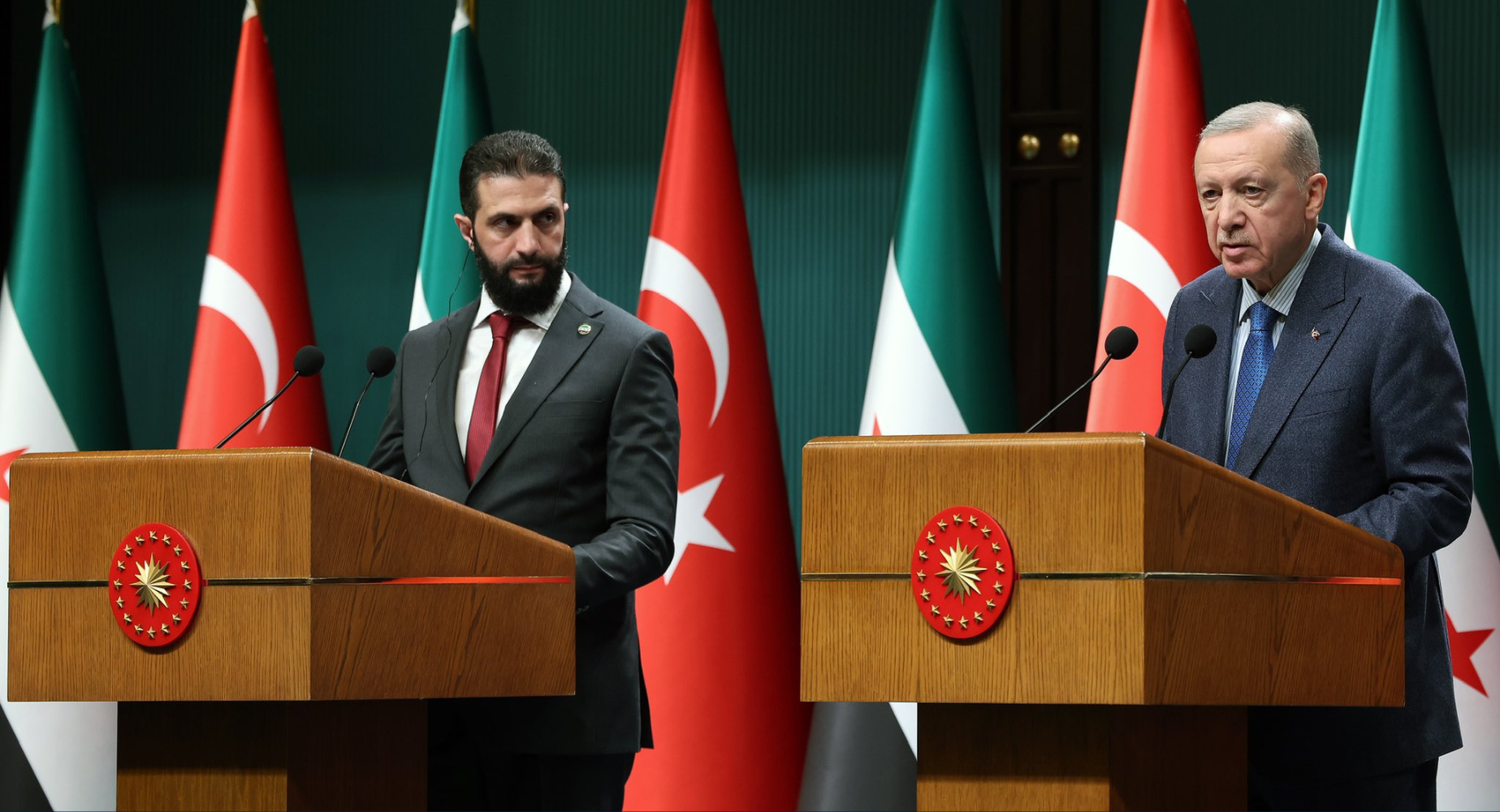
Syria is at a crossroads. President Donald Trump’s vow to do everything he can to help the wartorn country offers it a golden opportunity to wave goodbye to its dictatorial past. Unfortunately, Turkey’s regional ambitions are threatening to derail Syria’s rebirth.
One of the most striking features of post-Assad Syria is the speed with which the interim government has been able to claim international legitimacy. Regional and Western governments that once saw no future for Damascus are now tentatively re-engaging, hopeful that the post-Assad moment can be shaped into something stable and constructive. Trump has focused on promoting normalization and economic integration as the foundations of long-term stability.
A critical step to achieving that vision and meeting Trump’s objectives is reaching an agreement between Syria’s interim government and the Syrian Democratic Forces (SDF), which defended large portions of northern and eastern Syria throughout the conflict and built one of the most effective governance structures of the post-2011 era: the Autonomous Administration of North and East Syria (AANES). On March 10, 2025 SDF General Mazloum Abdi and Syria’s interim president, Ahmed al-Sharaa, agreed on a framework for talks which requires a detailed integration roadmap to be finalized by the end of December.
Among the main points the negotiations have to resolve centers on the future of the SDF. Roughly 100,000 fighters – men and women who have undergone years of US-backed training as part of the coalition’s campaign against the Islamic State – must somehow be integrated into a national army that itself is far from a coherent force. Equally contentious is the debate over Syria’s future political system. Negotiators from the AANES maintain that only a decentralized form of governance can reflect the country’s complex mosaic of ethnic and religious communities. By contrast, Damascus is insisting that this is a discussion that needs to be had further down the road, if at all.
For Syria’s interim president, incorporating the northeast through negotiation is a matter of survival. The institutions Al-Sharaa oversees remain brittle, and the forces under his command are a motley crew–an amalgam of militias whose record toward minority communities is deeply troubling. The state lacks the manpower, financial capacity, and political standing to capture and administer Kurdish-held areas through coercion. While a renewed civil war could theoretically dismantle the Autonomous Administration as a territorial entity, it would come at an enormous cost: investors would retreat; the government’s recently gained international credibility would evaporate; and external actors would find an opportunity to entrench themselves on Syrian soil. The result would be a level of fragmentation far worse than what any negotiated decentralized arrangement would produce.
That is why Ambassador Tom Barrack has positioned the United States as a facilitator between Damascus and the Autonomous Administration and urged the sides to engage in earnest. He is doing his best to convey no bias on the part of the Administration but mixed messages on decentralization in Syria have been confusing. Barrack is right not to seek to dictate the outcome of these negotiations but he should also not limit the scope and the vision of the peoples of Syria. Anything from a monarchy to federalism should be on the table–so long as the peoples of Syria reach their decision through peaceful and political dialogue.
Alas,, the pace of the US-facilitated talks aimed at integrating the Kurdish-led administration in northeast Syria with the country’s transitional government has slowed. The last high-level meeting took place in Damascus on Oct. 7, bringing together Mazloum Abdi, Ahmed al-Sharaa, US Syria envoy Tom Barrack, and CENTCOM commander Brad Cooper. The prospects for meeting the end-of-year deadline set for the talks are dim.
The problem is not with the substance of the negotiations. Syria’s interim government is not outright rejecting the idea of integrating the SDF or establishing a decentralized political structure that reflects the realities of the new Syria – an idea that President Trump’s Syria Envoy Tom Barrack has also endorsed. On the contrary, there is strong appetite for a deal that ends territorial fragmentation and brings key armed and administrative actors under a unified national framework.
Instead, the obstacle comes from outside of Syria. The SDF has long warned that Turkey is imposing a veto on any deal that would integrate the northeast into a new Syrian political framework. Indeed, Turkish infiltration of Damascus has shaped decision-making across multiple ministries and agencies. Anyone attempting to steer Syria toward a more inclusive political future finds themselves navigating a labyrinth of Turkish influence.
Ankara’s policies since 2011 have played a decisive and often destructive role in shaping the Syrian conflict. What began as political support for opposition activists to topple Assad quickly morphed into the systematic backing of jihadist armed factions fighting to prevent the emergence of any sort of Kurdish governed area in Syria. These groups (many linked to al-Qaeda or sharing its ideological foundations) benefited from Turkey’s permissive border policy, logistical support networks, and, at times, direct military patronage. The current Interim President Ahmed al-Sharaa and virtually all government officials in Damascus come from one such group–Hayat Tahrir Al-Sham, formerly the al-Qaeda affiliate in Syria.
With Assad’s downfall, one might have expected Ankara to support a new political arrangement that empowers the very Syrians who suffered under the old regime and fled the violence Turkey helped fuel. Instead, it is actively blocking the Syrian transitional government from reaching a deal with persecuted communities – particularly Kurds, Yazidis, Christians, and Arabs who live under the Autonomous Administration. Turkey appears unwilling to accept any new order in Damascus that does not adhere to its own narrow parameters, especially one that might embolden the Kurds of Turkey.
In Turkey, the Turkish government has taken a courageous step by engaging with the PKK and its leader Abdullah Öcalan as part of the peace process to resolve their own decades-old conflict, but it is yet to articulate how it intends to address its root cause: the Turkish republic’s constitutional eradication of Kurdish identity. Thus, three million Kurds enjoying broad constitutionally guaranteed rights in Syria just south of the Turkish border – at a time when 20 million Kurds in Turkey still cannot legally use the letter X (a letter absent from Turkish but present in the Kurdish alphabet) – is seen as a dangerous precedent before the anticipated drafting of a new constitution in Turkey.
As part of the process, the PKK announced a ceasefire in March, then dissolved in May, and later declared that it had initiated the withdrawal of its forces from within Turkey’s borders. Not satisfied with these historically significant steps, the Turkish government has moved the goalposts and is now slow-walking its own process with the PKK while preventing Damascus from moving forward with its negotiations with the SDF – essentially trying to turn the entire situation into a cross-border four-way trade. Ankara wants Öcalan to use his influence over the SDF to scale down their autonomy demands and disarm and disband along with the PKK. Ocalan is not relenting to this pressure, leading Ankara to essentially deadlock both processes in Turkey and Syria.
As of now, the front lines between the SDF and forces loyal to Syria’s interim government are still tense and have erupted multiple times over the last few months. The longer this deal takes, the more chances there are that the next flare up could result in Syria descending into civil war again. Recent Turkish military movements along the Turkey-Syria border and public threats made by government mouthpieces cannot be disregarded as mere bargaining tactics.
In my view, Turkey’s threats and obstructionism runs counter to the vision articulated by Trump for a more stable and secure Middle East. The United States should leave no doubt that renewed fighting in Syria is off the table. The bloody massacres in Suwayda and Latakia have already shown us how quickly armed groups loyal to the interim government in Damascus can revert to old habits. As Trump champions peace over new wars, the Turkish government should recognize that any move toward reopening the conflict would invite a strong White House response.
For the first time in years, Syria has a chance to rebuild. Turkey must not hold that hope hostage.