Can the Mecca Pact Reshape the Middle East?
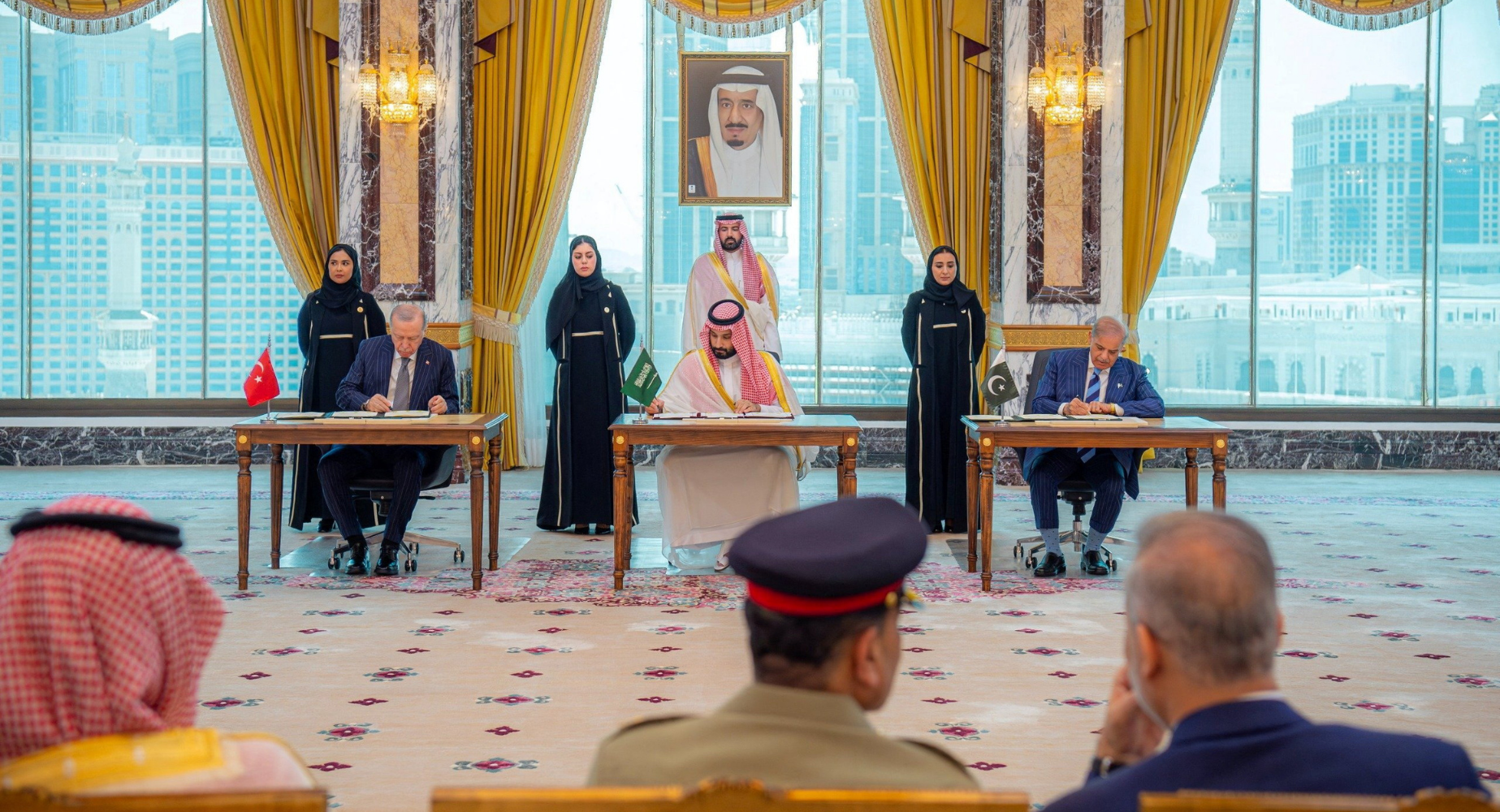
The Mecca Joint Defence Agreement between Saudi Arabia, Türkiye, and Pakistan has been presented as a historic step toward Muslim collective security. Signed on August 7, 2026, the agreement declares that an armed attack on one member will be regarded as an attack on all three. Yet the pact does not identify a specific enemy, nor does it clearly define the military obligations of each signatory. As reported by the BBC and Reuters, the agreement is significant in principle, but its practical military meaning remains uncertain.
That uncertainty is already beginning to narrow. Türkiye has indicated that the three countries intend to establish political and military coordination mechanisms, conduct joint exercises across land, sea, air, and cyber domains, and expand defense-industrial cooperation. Ankara has also stated that the pact is open to expansion, with Egypt mentioned as a possible future participant.
The Mecca Pact should therefore not be dismissed as symbolic diplomacy. It may become the foundation of a more independent regional security architecture. But independent from whom, and ultimately directed against whom?
Iran is the most immediate answer. Yet the deeper significance of the pact lies elsewhere. It may reveal the beginning of a Middle East in which regional states increasingly produce their own security rather than depending on outside powers. Its real test will not be whether it can confront the Islamic Republic today, but whether it can adapt to the Middle East that comes after it.
An Alliance of Contradictions
At first glance, the pact brings together three formidable Muslim-majority powers. Saudi Arabia contributes financial resources and strategic geography. Türkiye possesses a large conventional military and an increasingly sophisticated defense industry. Pakistan provides one of the world’s largest standing armies, extensive military experience, and nuclear capabilities.
But the alliance is built on considerable political, religious, and historical contradictions.
Türkiye’s ruling political establishment has historically maintained close relations with elements of the Muslim Brotherhood. During and after the Arab Spring, Ankara supported Brotherhood-affiliated political movements, placing it at odds with Egypt, Saudi Arabia, and the United Arab Emirates. A Reuters report on Türkiye’s position toward the Muslim Brotherhood illustrates the depth of this disagreement. Although Ankara later restricted some Brotherhood-affiliated activities as part of its rapprochement with Cairo and Riyadh, the underlying differences have not disappeared.
Saudi Arabia represents a fundamentally different political model: a hereditary monarchy whose religious establishment was historically shaped by Wahhabi or Salafi interpretations of Sunni Islam. For Riyadh, the Muslim Brotherhood’s transnational political activism has long carried the danger of challenging state authority.
Pakistan adds another complexity. It is Sunni-majority but contains competing religious traditions, a substantial Shia population, and powerful ethnic identities. It must balance its relationship with Riyadh against its rivalry with India, relations with Iran, and domestic pressures.
History also matters. The Ottoman Empire and the Saudi-Wahhabi movement were once direct opponents. A study of Turkey and Saudi Arabia as competing theopolitical actors illustrates how differently the two states have used religion and political influence.
The Mecca Pact is therefore not an expression of natural Islamic unity. It is an agreement among states whose interests currently overlap. That may be enough. Strategic arrangements do not require ideological unity. They require sufficient common interest. The question is whether that interest survives when the threat changes.
Iran, Israel, and Washington
Iran is the most obvious strategic concern behind the pact, even though the agreement does not formally name Tehran as an adversary. The Al Jazeera analysis of the Saudi-Pakistani-Turkish agreement notes that Iran and its regional network are widely viewed as central to its strategic context. The Reuters account similarly places the agreement within an environment shaped by concern over both Iran and Israel.
Yet the pact cannot automatically neutralize Iran. Tehran has accumulated extensive experience with missiles, drones, cyber operations, and proxy warfare. It does not need to defeat such an alliance conventionally to impose serious costs. This makes institutional coordination more important than declarations of solidarity. Türkiye’s announcement of political and military mechanisms, joint exercises, and defense-production cooperation suggests that the three governments understand this.
But Iran presents a deeper problem. An alliance can organize itself against a military threat. It has greater difficulty when the political nature of that threat itself may change.
If Iran is a principal concern, the exclusion of Israel creates an obvious contradiction. Israel possesses advanced intelligence, missile-defense systems, cyberwarfare capabilities, surveillance technology, and direct experience confronting Iran’s regional networks. Since the Abraham Accords, Israel and the United Arab Emirates have expanded security and defense cooperation, as Chatham House’s analysis of Israel-UAE normalization and research on UAE-Israel security and defense cooperation both describe.
Strategically, Israeli capabilities could strengthen Gulf defense. Politically, formal integration remains difficult. The Palestinian issue constrains the legitimacy of open Arab-Israeli military cooperation. Pakistan would face even greater domestic obstacles, while Türkiye would struggle to reconcile such an alliance with its present regional position. The Mecca Pact therefore offers an alternative route: Muslim states can increase strategic cooperation without making normalization with Israel a prerequisite, an argument developed further in Mecca Pact Implications for Israel and Washington.
But the contradiction remains. An Israeli-centered system constructed around containing Iran is incomplete. A Muslim security system constructed partly against Iran while excluding Israel is also incomplete. A permanent regional order cannot be built through permanent exclusion.
For Washington, the Mecca Pact is both an achievement and a challenge. American policymakers have long encouraged Middle Eastern allies to assume greater responsibility for their own defense, and Saudi Arabia, Türkiye, and Pakistan are now attempting to do precisely that, but increasingly on their own terms. This could allow Washington to reduce its military burden. Yet regional self-reliance cannot simply mean American abandonment. A sudden vacuum would intensify competition among Iran, Türkiye, Israel, Saudi Arabia, Russia, and China rather than create stability. The Atlantic Council’s assessment of the new defense pact suggests that Pakistan and Türkiye could provide additional security support to Saudi Arabia, while emphasizing the practical limits of treating the arrangement as an immediate substitute for American power.
The larger development is nevertheless significant. Regional powers are gradually attempting to become producers of security rather than permanent consumers of security guarantees, a transformation examined further in The Architecture of Power. The Mecca Pact belongs to that transformation. But its future depends upon a question receiving much less attention: what happens if Iran itself changes?
Two Futures for Iran
The Mecca Pact is being constructed under conditions created by the Islamic Republic. Those conditions should not be assumed to be permanent.
The first possibility is that the Islamic Republic survives. Survival does not necessarily mean continuation of its present relationship with Washington and the Arab states. A Trump administration, or a future American administration, could eventually redefine its relationship with Tehran if the regime accepted substantial limitations on its nuclear and regional behavior. That would create a strategic paradox. What happens if governments that built a defense architecture partly because of the Islamic Republic later decide that the same Islamic Republic can participate in regional security? It would be like creating a fire brigade because an arsonist keeps setting the neighborhood on fire, then offering him a seat in the fire station because he promises to stop carrying matches. The distinction is essential: Iran is not the arsonist. The political behavior of the Islamic Republic is. If that behavior changes, Saudi Arabia and Türkiye must decide whether the pact exists to contain a particular threat or to exclude Iran regardless of its behavior. Could the Islamic Republic eventually become associated with the pact? If yes, the Mecca Pact may be evolving toward something larger than an anti-Iranian arrangement. If no, its organizing principle becomes permanent geopolitical exclusion.
The second possibility is more consequential: the Islamic Republic does not survive.
Until recently, regime collapse could still be treated primarily as a strategic contingency. The events of December 2025 and January 2026 changed that calculation. The protests began on December 28 amid the collapse of the rial and rising food and energy prices. What began with shopkeepers in Tehran’s Grand Bazaar rapidly spread to universities and provincial cities. Within two weeks, the Institute for the Study of War recorded protest activity across more than 200 cities and all 31 provinces.
The crackdown that followed on January 8 and 9 was of extraordinary severity. Human Rights Watch documented evidence of countrywide massacres, while Amnesty International described the period as the deadliest repression it had recorded in decades of research on Iran. The government imposed an extensive internet blackout as the killing unfolded.
The final death toll remains contested. Iran’s government acknowledged 3,117 deaths; the Human Rights Activists News Agency verified several thousand more, with tens of thousands of additional cases still under investigation. Later reporting pushed the estimates higher still. The Guardian and Time reported figures approaching or exceeding 30,000 based on medical and local sources. Iran International, citing leaked Interior Ministry and IRGC Intelligence documents, placed the toll above 36,500. President Trump subsequently cited figures above 35,000 and later 42,000 to 45,000, though without providing supporting evidence. The Sunday Times reported Prince Reza Pahlavi’s estimate, based on activists, political prisoners, and medical sources inside Iran, at approximately 50,000. No independent institution has yet reconciled these figures, and the regime’s information blackout remains a central obstacle.
The precise number matters historically, but the strategic conclusion does not depend upon choosing the highest estimate. The scale and geographic breadth of the crackdown demonstrated that the crisis was national, not local.
Something else also became visible. During the blackout, Iranian state television was hacked to broadcast Prince Reza Pahlavi calling on security forces to break with the Islamic Republic and side with the population, according to Fox News and the Associated Press. Demonstrations invoking his name and displaying the Lion and Sun flag also appeared inside Iran and across major diaspora communities. This does not establish Iran’s future constitutional order. It does establish that mobilization around a post-Islamic Republic alternative, including a monarchist one, can no longer simply be dismissed as a diaspora abstraction.
Regime change in Iran therefore cannot be discussed only as a theoretical possibility. War, economic exhaustion, institutional fragmentation, succession crisis, erosion within the coercive apparatus, or some combination of these forces could produce a vacuum in which the political order established in 1979 can no longer reproduce itself. What follows would not be predetermined. But neither would every possible successor begin with equal political weight.
Prince Reza Pahlavi has become one of the most recognizable figures associated with a post-Islamic Republic transition. The January uprising, the hacked broadcasts, monarchist slogans, the Lion and Sun flag, and large diaspora mobilizations gave that political current a visibility that strategic analysis cannot simply ignore. None of this proves that monarchy will return. Mobilization during a national crisis is not the same as settled constitutional consensus. Iran’s eventual political order would require legitimacy from Iranians themselves. But under conditions of regime collapse, particularly where institutional continuity and rapid stabilization become urgent, Prince Reza Pahlavi and a constitutional monarchy could emerge as a serious contender for the successor order.
That possibility matters beyond Iran. If a secular and legitimate Iranian state emerges, whether as a constitutional monarchy or another constitutional system, the strategic foundations of the Mecca Pact would change almost overnight. Saudi Arabia would no longer face a revolutionary Shia state organized around exporting political Islam. Pakistan would have little structural reason to treat Iran as an adversary. Türkiye would face a more complicated reality: the disappearance of the Islamic Republic would remove an important source of instability, but the return of a legitimate, economically recovering, strategically capable Iran would restore a major historical competitor across the Middle East, Caucasus, and Central Asia. Israel would face perhaps the most dramatic transformation of all, the possibility of ending one of the region’s most destructive geopolitical confrontations.
The disappearance of the Islamic Republic would not end the balance of power. It would change its character. And the question for the Mecca Pact would become unavoidable: what is the alliance for once the political Iran it was partly created to contain no longer exists?
Egypt, India, and the Limits of the Pact
Türkiye has indicated that the Mecca Pact could expand and has specifically identified Egypt as a possible participant. Cairo’s inclusion would fundamentally change the agreement. Egypt is not simply another military power. It is the most populous Arab country, controls the Suez Canal, occupies a strategic position between the Mediterranean, Red Sea, North Africa, and the Arab East, and carries political weight that neither Pakistan nor Türkiye can substitute for within the Arab world.
But Egypt’s own trajectory, examined in From El-Sissi’s Egypt to the End of Political Islam, points the other way. Cairo’s containment of political Islam has aligned it consistently with Israel and the UAE rather than with Ankara’s more permissive history toward Islamist movements. On balance, Egypt is more likely to remain outside the Mecca Pact than to join it, leaving the arrangement short of the wider Arab architecture Ankara has floated.
Pakistan extends the problem beyond the Middle East. The collective-defense principle states that an attack on one member will be considered an attack on all, and Turkish officials have compared its technical principle to NATO’s Article 5. India therefore cannot regard the language as irrelevant. What happens during another serious India-Pakistan confrontation? Would an Indian strike against Pakistan activate Saudi and Turkish obligations? Would Riyadh be expected to regard India, one of its major economic partners, as an aggressor against Saudi Arabia itself? Or does collective defense apply only to threats arising within the Middle East? Unless those boundaries are clarified, the pact risks importing South Asian rivalry into Middle Eastern security.
This demonstrates why the emerging architecture cannot ultimately be built around religious identity alone. Pakistan brings considerable military power and nuclear capability, but also its own strategic conflicts. Every additional member expands the pact’s power and its contradictions in equal measure, the same instability that runs through its membership runs through the question of Iran as well.
Toward a Cyrus Accord
For nearly half a century, much of Middle Eastern security policy has been organized around the behavior of the Islamic Republic. Tehran has used ideological movements, proxy forces, missiles, drones, and political networks to project power beyond Iran’s borders. But a regime should not become a permanent geopolitical category. The Islamic Republic is not Iran. Governments change. Political ideologies collapse. Geography remains.
A post-Islamic Iran would still command the northern coast of the Persian Gulf. It would still connect the Arab world, Central Asia, the Caucasus, South Asia, and Türkiye. It would retain one of the region’s largest populations, substantial energy resources, military capabilities, human capital, and a civilizational identity extending far beyond the state created in 1979. Iran’s strategic weight would survive the Islamic Republic. A legitimate, recovering Iran would not cease to be a rival to Türkiye simply because Tehran’s ideology had changed; a structural rivalry rooted in capability, geography, and centuries of competing influence would remain. The same applies, in some measure, to Saudi Arabia and the wider Gulf, whose wariness of Persian power predates the Islamic Republic. What could disappear is not Iran’s capacity to compete, but the revolutionary purpose for which its power has been used: ideological export, proxy warfare, and regional domination.
An alliance designed partly to contain the Islamic Republic may therefore be rational under present conditions. A regional architecture designed around the permanent containment of Iran would not be. If Iran ceases to be a revolutionary state, the strategic question changes from how to contain Iran to how to reintegrate Iran without allowing Iranian domination, and without assuming that a post-Islamic Iran would have no ambitions of its own. A secular, recovering Iran will still have interests in the Gulf, the Caucasus, and Central Asia. Reintegration is not the management of a passive state. It is the construction of equilibrium between an ambitious one and its neighbors. That requires a different architecture.
This is where a Cyrus Accord becomes strategically necessary. The historical and philosophical foundations of the idea were explored in Abraham, Cyrus, and the New Middle East. But the problem raised by the Mecca Pact is more immediate and institutional.
There is precedent for such a transition. Postwar Europe faced a comparable structural problem: how to reintegrate a transformed Germany without either excluding it permanently or allowing its power to dominate its neighbors again. The answer developed through economic integration, security institutions, and eventually a broader framework for coexistence among former adversaries. A Cyrus Accord would follow the same strategic logic: reintegration through interdependence and institutional participation rather than a declaration of trust.
Some components can begin below the level of grand diplomacy. A proposed economic corridor anchored in Sanandaj, in Iranian Kurdistan, envisions industrial, logistics, and trade links through Iraqi Kurdistan to Iraq, Türkiye, Jordan, and eventually Israel. Such projects illustrate how regional reintegration could be built outward from economic participation rather than imposed from above.
A Cyrus Accord would not be another military bloc, nor an alliance against Saudi Arabia, Türkiye, Pakistan, Israel, or any other regional power. Nor would it depend upon whether Iran ultimately chooses monarchy or republic. Its purpose would be to provide the framework through which a post-Islamic Iran could return to the regional system as a legitimate state rather than as a revolutionary project.
Legitimacy here means more than regime change. A successor state capable of durable regional reintegration would require the primacy of civic law over theological authority, equality of citizenship regardless of religion, ethnicity, or sex, and the removal of confessional status from the legal relationship between citizen and state. Suppressing political Islam while leaving theological authority embedded in the state does not resolve the underlying problem; it merely manages it.
The principle is simple: containment of the Islamic Republic cannot become permanent exclusion of Iran. Such an arrangement would require recognition of sovereignty and territorial integrity, non-interference, abandonment of proxy warfare, economic integration, and mechanisms for managing conflict without turning every dispute into an existential confrontation. Iran would not have to become an ally of Saudi Arabia or Israel. It would not have to accept Turkish leadership, and none of those states would have to accept Iranian leadership. The objective is not unity. It is equilibrium.
The Cyrus Accord would therefore address the question the Mecca Pact cannot yet answer: how to move from an architecture constructed for containment to one capable of coexistence once the political source of the threat changes.
Who would help build such a framework is not settled, but the question is already present in Washington. Conservative foreign policy increasingly contains competing instincts: one associated with Secretary of State Marco Rubio, emphasizing forward deterrence and sustained American power; another associated with Vice President JD Vance, emphasizing restraint, burden-sharing, and narrower commitments. Different as they are, both confront the same underlying problem: how to produce a regional balance that does not require permanent American management. A future Cyrus Accord would have to operate within that changing American strategic environment.
The Real Test of the Mecca Pact
The Mecca Pact should neither be exaggerated nor dismissed. Saudi Arabia is seeking strategic autonomy. Türkiye wants a larger role in shaping the regional balance. Pakistan sees an opportunity to deepen its military and economic position in the Gulf. Egypt may eventually join the architecture. India must consider its implications. Israel must calculate how a powerful Muslim security framework affects the regional integration begun through the Abraham Accords. And Iran remains the unresolved question.
If the Islamic Republic survives but changes its regional behavior, would the pact eventually accommodate it? If it survives without changing, can the pact deter it without creating another permanent regional confrontation? If the Islamic Republic collapses and a legitimate post-Islamic state emerges, what becomes of an alliance constructed partly in response to the old regime? Egypt’s own trajectory suggests it is unlikely to join; if it did, the pact’s claim to represent a wider Arab architecture would have to be taken seriously. And if Pakistan’s conflict with India activates collective-defense obligations, where does the Middle East end and South Asian rivalry begin?
These questions determine whether the Mecca Pact is an alliance for one historical moment or the beginning of something capable of surviving that moment. The region does not need another permanent bloc confronting another permanent bloc. It needs an architecture capable of recognizing that enemies change, regimes disappear, alliances evolve, and yesterday’s threat can become tomorrow’s partner.
The Mecca Pact may be necessary to confront the strategic conditions created by the Islamic Republic. But the future of the Middle East cannot be built on the assumption that the Islamic Republic will exist forever. The January uprising has made that assumption more difficult to sustain. If Iran changes, the region must be ready to change with it. That is the strategic necessity of a Cyrus Accord.
For nearly half a century, the Middle East has been forced to ask how Iran should be contained. It must now begin preparing for the question that may define the next regional order: what happens when Iran returns?