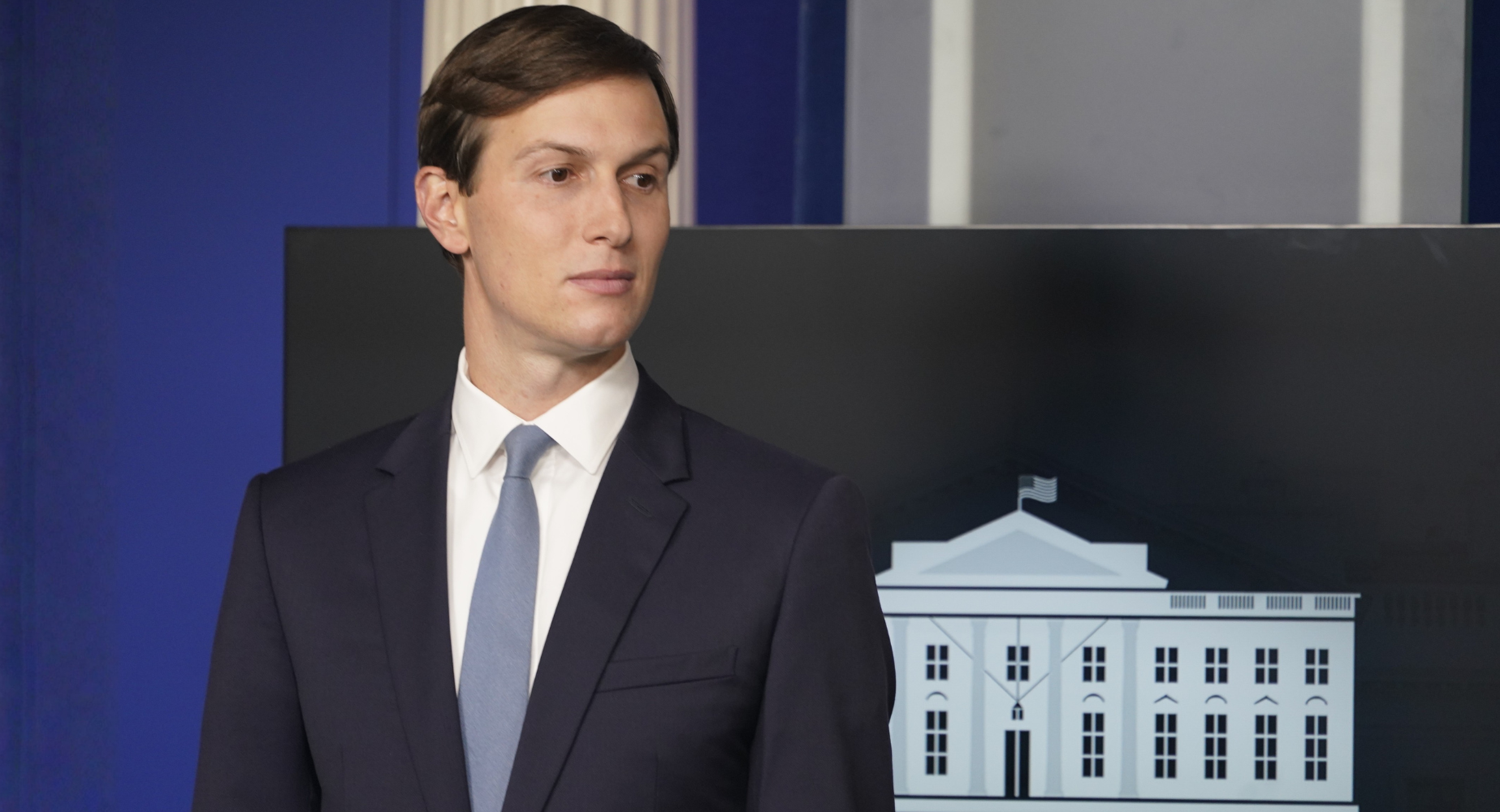
I went to present Jared Kushner with the Abraham Shield Award 2026 because of what he had achieved. I left thinking even more deeply about who he is.
We spoke for nearly an hour. There was no ceremony in his manner, no distance and none of the self-importance that so often accompanies power. He was relaxed, warm and remarkably down-to-earth.
He asked questions—not the questions of someone waiting for his turn to speak, but those of a man genuinely seeking to learn. He listened carefully. He tested ideas. He wanted to understand.
What struck me most was his humility.
Here was a man who had sat with presidents, kings and prime ministers; who had been entrusted with one of the most intractable conflicts of modern history; and whose work had helped alter the political landscape of the Middle East. Yet he carried none of the weight of his résumé. He seemed far more interested in the work still ahead than in the credit already earned.
Then he told me something simple: he would not give up.
There was no drama in the words. They were an expression of conviction—the promise of a man who believes that the next generation deserves a different future. Those words remained with me.
Behind them lies a disarming optimism: a belief that history is not a prison and that the failures of one generation do not have to become the inheritance of the next. Jared believes that young people across the Middle East deserve more than the old vocabulary of grievance, suspicion and war. They deserve the opportunity to meet, build, trade and prosper—and, through shared success, to discover one another as human beings.
I also came to understand something essential about both the man and his method: Jared is not a prisoner of Republican or Democratic orthodoxy.
He listens to both, but belongs intellectually to neither. He refuses to allow inherited doctrines to place artificial barriers in front of necessary initiatives. His first question is not, “What is our side supposed to believe?” It is a more demanding one: “What does reality require—and what can actually work?”
This is not an absence of conviction. On the contrary, it takes conviction to resist the comfort of a ready-made political answer. His independence enables him to see possibilities that partisan reflexes often conceal. It also explains how he could challenge decades of diplomatic convention without becoming doctrinaire about his own alternative.
For him, a method has value only if it produces results—if it brings people closer to peace, dignity and a better life.
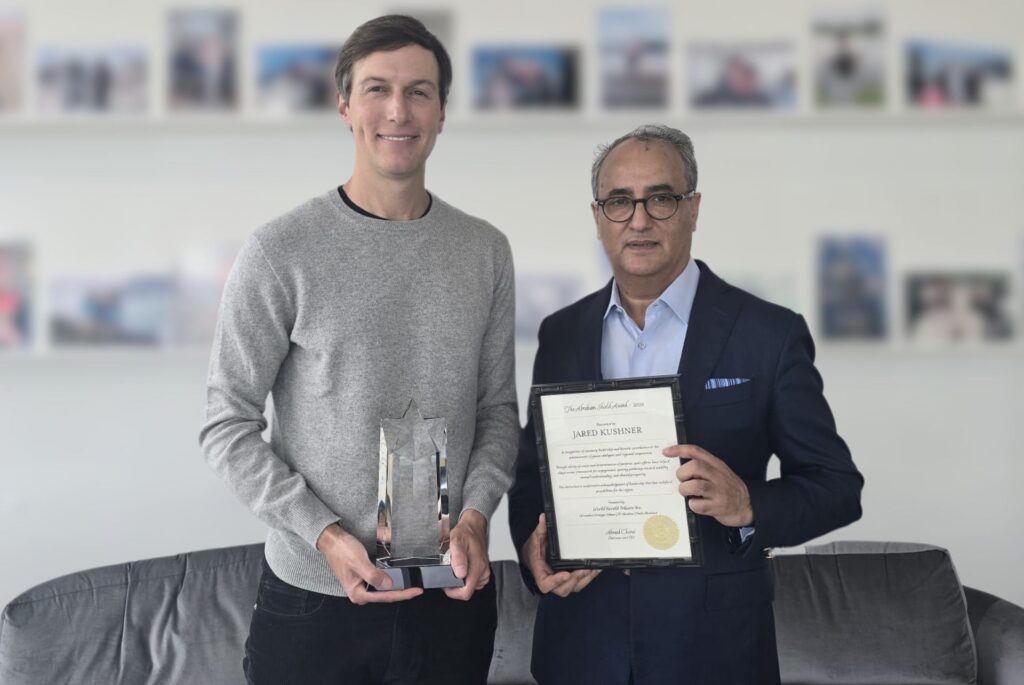
This is why World Herald Tribune chose to present Jared Kushner with the Abraham Shield Award 2026.
The award does not recognize one agreement, one photograph or one moment at the White House. It honors a body of work pursued with extraordinary consistency from 2017 until today. Through political transitions, wars, personal attacks and repeated declarations that peace was dead, Jared remained committed to one essential idea: the peoples of the Middle East are not condemned to permanent conflict.
His achievement began with an act of intellectual courage.
For decades, much of Washington’s foreign-policy establishment approached peace through doctrine. Negotiations began with final borders, historical claims, ideological formulas and comprehensive political settlements. Economic cooperation was treated as secondary—a benefit that might follow once every political disagreement had been resolved.
To speak of transactions or common interests was sometimes regarded as intellectually unsophisticated, even morally suspect, as though practical benefit somehow diminished the dignity of peace.
Kushner challenged that assumption.
He did not invent the connection between commerce and peace. His innovation was to place economic cooperation, human exchange and shared prosperity at the center of the diplomatic architecture—not to postpone them until after a final political settlement.
He understood that trade is not merely the movement of goods and capital. Business creates habits of trust. A contract requires reliability. Investment requires confidence in a shared future. A joint enterprise turns a distant stranger into a partner whose success becomes connected to one’s own.
Over time, these relationships move beyond companies. They reach communities, universities, families and future generations. Common interests can become shared achievements, and shared achievements can produce human understanding.
This was more than a negotiating technique. It represented a different way of constructing peace.
In Kushner’s vision, peace would not remain an agreement signed by governments and protected by protocol. It would become a lived relationship sustained by flights, investment, technology, tourism, education and personal encounters.
Prosperity would not simply be the reward for peace. It would become one of peace’s foundations.
At first, this approach shocked many observers. It was dismissed as “transactional,” as though transactions were inherently unworthy. But there is dignity in two people freely choosing to build something together. There is moral value in creating opportunity where ideology has produced only sacrifice. And there is wisdom in giving peace a constituency—not only among diplomats, but among entrepreneurs, students, families and young people who can experience its benefits directly.
The approach worked.
The Abraham Accords changed what the region believed was possible. They demonstrated that Arab nations and Israel could move beyond inherited paralysis and build open relationships based on recognition, security, opportunity and mutual respect.
They replaced an abstract promise of eventual reconciliation with the concrete experience of cooperation.
The world has changed since 2017, and so has our understanding of peace. We now see more clearly that peace cannot survive on signatures alone. It must create movement, opportunity and hope. It must improve lives. It must give people a personal stake in one another’s stability and success.
This is the transformation Jared Kushner helped set in motion.
The Abraham Shield Award 2026 therefore recognizes more than a diplomatic achievement. It honors persistence: the patience to carry an unconventional idea through ridicule and resistance; the discipline to translate vision into detailed agreements; and the courage to continue when violence tempted the world to abandon the possibility of coexistence.
But no individual can deliver peace alone, and Jared has never claimed to be a savior.
He has done his part—and more. He opened a door that conventional diplomacy had left closed. He built a framework and demonstrated that another future was possible.
The responsibility now belongs to the leaders of the region.
They must place the interests of their countries above their personal or political calculations. They must decide whether they will remain captive to slogans that have failed their people or choose security, dignity and prosperity.
They cannot ask one American envoy, one administration or one set of agreements to substitute for their own courage. Peace requires partners willing to defend it, expand it and translate it into everyday life.
This is especially true after the tragedy of October 7 and the devastating war that followed.
In such a time, pessimism can masquerade as realism. It is easy to declare that hatred has won, that trust has become impossible and that those who tried to build bridges were naïve. It is much harder to insist that the answer to catastrophe cannot be the permanent surrender of the future.
Jared refuses that surrender.
Perhaps the source of his resilience lies partly in the personal history that shaped him. His family knew persecution, survival, hardship and rebuilding. As a young man, he found himself carrying responsibilities that would have overwhelmed many people twice his age.
Life taught him early that circumstances can change without warning, that public judgment can be merciless and that a family name can become a burden before it becomes a legacy.
He did not allow that chapter to define the limits of his life. He worked. He built. He endured.
I believe the experience gave him something more valuable than hardness: an instinct for renewal. That may help explain why he looks at the Middle East differently.
Where others see peoples permanently imprisoned by the past, he sees societies capable of beginning again. Where others see an immovable wall, he searches for the first door. Where others speak only of managing conflict, he continues to imagine peace.
During our meeting, I sensed that this cause now transcends politics for him. It is not merely a chapter from his years in government. It has become personal—a passion grounded in the conviction that another generation must not be sacrificed to the failures of those that came before it.
That is the man we wanted the Abraham Shield Award 2026 to recognize.
Not a man without critics. Not a man claiming perfection. And not a man asking to be celebrated as the solitary author of history.
Rather, a builder who challenged an exhausted orthodoxy; a negotiator who understood the human power of shared prosperity; and an optimist who, after every setback, returns to the work.
A shield is an ancient symbol of protection. The Abraham Shield represents the defense of a fragile but revolutionary idea: that the children of Abraham can secure their future not through endless confrontation, but through courage, common purpose and peace.
In presenting the Abraham Shield Award 2026 to Jared Kushner, we honor what he has already built.
We also recognize the promise he continues to keep.
He will not give up. Neither should we.