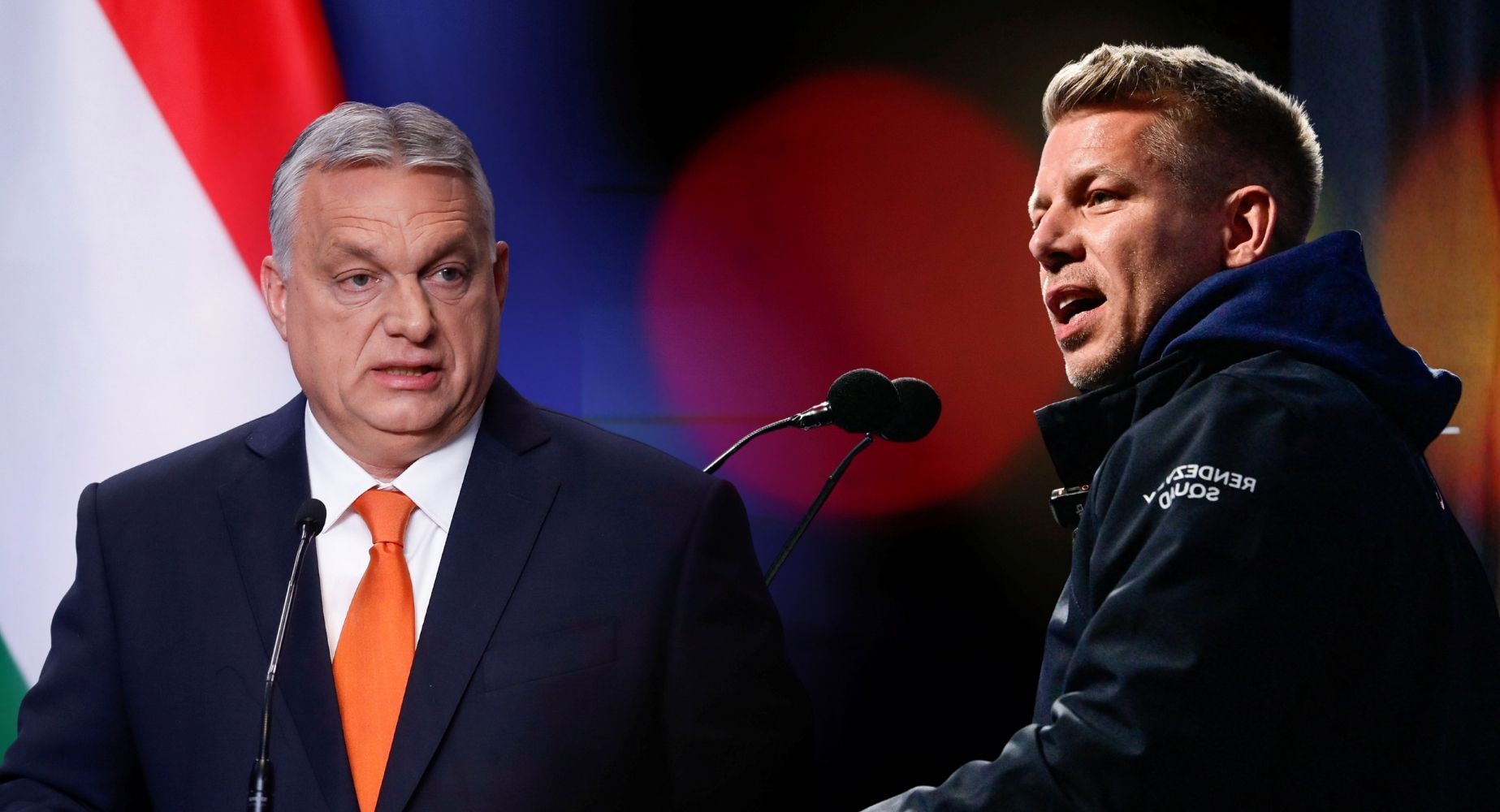
“We have replaced the Orbán regime and liberated Hungary,” exulted a triumphant Péter Magyar, who was until just two years ago a staunch supporter of former Hungarian prime minister Viktor Orbán and an insider of the country’s long-governing Fidesz Party. On April 12, Magyar’s recently founded Tisza Party decisively won national parliamentary elections and secured more than two-thirds of the seats in Hungary’s parliament. Magyar, who campaigned promising political, economic, and anti-corruption reforms, will command a mandate strong enough to change Hungary’s constitution and alter or undo measures introduced by Fidesz to strengthen what Orbán has described as an “illiberal democracy.” Magyar has pledged to improve Hungary’s relations with the EU, recenter its engagement with Russia, and remove Orbán acolytes across government, business, and media.
Liberal critics of Orbán swooned in delight, celebrating Hungary’s emergence from what they long supposed was an “authoritarian” regime. Many suggested that Orbán’s defeat was an irresistible surge in a small stream of defeats for the European right and hoped that it will lead to even greater international refutations of his national populist brand of politics.
Their optimism is as misplaced as their analysis. To begin with only the most obvious flaw in their thinking, Orbán’s willingness to accept defeat in what observers have uniformly called a “free and fair” election smashes to atoms the notion that he is or ever was an “autocrat,” “authoritarian,” “fascist,” a “dictator,” or whatever other epithets the international left wanted to throw at him. Autocratic authoritarian fascist dictators rarely if ever concede elections, especially not with results that hand the opposition constitutional supermajorities.
More astute critics have argued that the election results prevented Orbán from any further “drift” toward ending Hungarian democracy. But if any such “drift” really were underway, it would have been underway for sixteen years since Orbán took office in 2010, and in the additional four years of his oft-forgotten first term as prime minister, from 1998 to 2002. Autocratic authoritarian fascist dictators, moreover, generally do not hold back from seizing full control, especially not when available authorities give them the legal means to do so. Mussolini ensconced himself in virtually unchallengeable office after just 26 months of political brinksmanship. Hitler secured the power to rule by decree just 53 days into his mandate as a democratically appointed chancellor. Unlike weak and self-effacing traditional conservatives, Orbán used the powers at his disposal to implement transformational policies that he was freely elected to implement. But as the world saw on April 12, he never obstructed the fundamental bases of democracy. When he lost, he politely called to congratulate his opponent and said he would continue to pursue Fidesz policies in legal opposition to the new government.
What Orbán will do in opposition is anyone’s guess. As few international observers realize, Péter Magyar himself in most ways remains a committed national conservative, and the Tisza Party is an explicitly right-wing political formation. Magyar’s beef with Orbán stemmed from a 2024 domestic political scandal in which Hungary’s former president, an Orbán ally, pardoned a convicted child sex offender who enjoyed Fidesz protection. Under Hungarian law, the pardon was countersigned by the country’s justice minister, who only a few months before had been divorced from none other than Péter Magyar, whom she has accused of domestic violence and since called a “traitor.” The scandal forced the resignations of both the minister and the president, soured public opinion amid an already embittering national economic malaise, and set Magyar on what appears to have been a personal crusade against Orbán, which he easily framed around a grassroots desire to clean up perceived ethical failings in Hungarian politics.
Apart from Magyar’s personal soap opera, his campaign was helped by revelations suggesting further government corruption, undisclosed coziness with Russia, and an alleged plot to fake an assassination attempt to drum up sympathy for Orbán. At the same time, Magyar’s prior lifelong commitment to Fidesz shielded him from accusations of being a foreign stooge, an allegation Orbán had successfully landed on earlier opponents but one that just did not ring true when applied to someone so close to him for such a long time. Heavy hitting visits to support Orbán from U.S. Secretary of State Marco Rubio and Vice President JD Vance paradoxically struck many Hungarians as evidence of the very foreign influence that the former prime minister had long excoriated. They obviously neither swayed voter sympathy nor saved Orbán. Fidesz’s campaign was reduced largely to warnings about domestic cultural change, a topic on which Magyar appears to agree, and the war in Ukraine, in which Magyar says he does not favor Hungary’s involvement.
Much of what will unfold in Hungarian national politics going forward seems likely to emerge along the lines of “Orbánism without Orbán,” a phenomenon not dissimilar from the “Trump without the Baggage” trope in which some America First conservatives indulged around 2022, when they saw Florida Governor Ron DeSantis as a credible alternative to Donald Trump. Although Magyar has said he will carry out reforms to adhere to EU institutional standards, and thereby gain release of some $18 billion in suspended EU funds, most aspects of his policy platform resemble that of his predecessor. Indeed, in the European Parliament, where Tisza has held seats since the EU elections of 2024, it has almost always voted with Fidesz on matters of national concern to Hungary and nearly half the time overall.
Like Orbán, a poster of whom reportedly adorned the wall of Magyar’s childhood bedroom, Hungary’s new prime minister appears strongly inclined to continue a national conservative agenda. His campaign suggested respect for national traditions, pro-family policies, law and order, and Hungary’s fundamentally conservative public ethos. He has been conspicuously silent on education, gender, and sexuality issues, which drew much criticism to Orbán. Magyar opposes EU migration mandates and says he will maintain Orbán’s highly effective border fence and continue to resist EU demands that Hungary accept migrants. Indeed, he has pledged to go even further to the right than Orbán on migration by eliminating the country’s foreign guest worker program, an Orbán initiative that is widely perceived as having taken skilled jobs away from Hungarians. No liberal sentimentalist, Magyar has pledged to expel foreign workers currently in the country under the program’s auspices. Magyar shares Orbán’s aversion to involvement in the war in Ukraine, to accelerating Ukraine’s entry into the EU, and to ending Hungary’s continuing near-term consumption of Russian energy products, which he only plans to phase out by 2035. Magyar may be more inclined to approve EU aid packages to Kyiv, but with one very recent exception Orbán has also ultimately approved them.
In opposition, Orbán can bask in what in many ways remains a successful and enduring legacy. In all the election euphoria, observers have missed the crucial point that the left as an organized political force simply no longer exists in Hungary. More than 95% of Hungarian voters cast their ballots for the conservatives of Fidesz, the slightly more moderate conservatives of Tisza, or the extreme-right “Our Homeland” party, which won just under six percent of the vote. While Hungarian leftists may have voted for Tisza as the likeliest way to defeat Orbán, they are a demoralized force and have articulated no alternative program of their own or infiltrated any appreciably leftist or anti-conservative ideas into Tisza’s program. The country’s main social democratic party, established to oppose Orbán in 2010, won just 1.6% of the vote. After sixteen years of Fidesz, in other words, the Overton Window of Hungarian politics is now defined by a near-unanimous commitment to some form of national conservatism.
Far from delegitimizing national populism elsewhere, the Hungarian example lives powerfully on as a successful blueprint for the new right. When Orbán returned to office in 2010, he could boast that his government was unique among nations and represented a fundamentally new and different phenomenon in the history of right-wing politics. In a broader international context, he could claim to be “Trump before Trump” and assume an outsized mandate for practical and ideological leadership in an international conservative populist movement that was only then beginning to emerge. Regardless of how closely Magyar adheres to that legacy in Hungary, it is no longer alone. As Orbán leaves office sixteen years after his solo debut, freely elected conservative nationalist governments with similar ideals hold power in Italy, Finland, Croatia, Switzerland, the Czech Republic, Slovakia, Georgia, Japan, Argentina, Chile, Peru, Paraguay, Bolivia, Ecuador, El Salvador, Honduras, Panama, and of course the United States, with major advances elsewhere in recent years. Polling in elections to be held within the next three years suggests additional national conservative victories in France, Germany, Austria, Brazil, and the United Kingdom, among other places. April 12 may have been a sad day for Fidesz, but the groundwork Viktor Orbán laid will endure.