The infatuation with international institutions deserves more critique and criticism. The belief that they are a critical and necessary component of global affairs is debatable. The list of international institutions who have either outlived their purpose, remain ineffective or are essentially hollow seemingly grows.
The violence and instability in the Middle East reveal the latest and an egregious example of institutional impotence or pointlessness—the Organization of Islamic Cooperation (formerly the Organization of the Islamic Conference). Decades-old members of the Organization of Islamic Cooperation (OIC) have been in violent conflict for months while the institution remains largely on the sidelines. The OIC’s relative absence is outrageous given that the Islamic Republic of Iran has repeatedly attacked civilian areas and economic infrastructure of non-belligerent fellow OIC members and continues to work to undermine their economic well-being.
In 1969, 30 predominantly Muslim countries (including Iran) met in Morocco and founded the Organization of Islamic Cooperation. The summit occurred in the wake of violence perpetrated by an Australian Zionist fanatic at the Muslim holy site of Al-Aqsa in Jerusalem. Founding members believed the event demonstrated the need for a Muslim institution that can internationally protect and advance the interests of the Muslim world. Today, the OIC has grown to 57 members, second only in membership size to the United Nations.
Like other international institutions, the charter of the OIC is replete with standard international ideas and objectives—greater peace, security, harmony and prosperity. The sovereignty of states is respected. Inter-state relations are promoted. Greater economic cooperation is desired. Membership and participation in the OIC are meant to cultivate and deepen ties, inculcate and universalize institutional Islamic beliefs and values. The organization provides a forum for the discussion of problems and disagreements. Meetings, committees, organs and specialized institutions are opportunities for members to engage, familiarize and resolve outstanding issues.
The actions, principles and objectives are purposeful. The OIC wants to unify and strength the international voice of the Muslim community. A united voice brings greater legitimacy to the organization and the overall Muslim community. Legitimacy makes the institution and the Muslim community a more effective and respected international political force.
Since February 28, the standards preached, the practices upheld and the goals striven toward by the OIC suffered a punch to the gut or were always just a mirage. The institution’s credibility took a hit. Its raison d’etre and influence are (at best) questionable.
Somehow an American and Israeli attack on Iran warrants the immediate dissolution of fraternal Islamic bonds and Muslim unity by no less a founding member of the institution. In the wake of the attacks, Iran attacked at least nine non-belligerent OIC members. Did Iran lose respect for the sovereignty of its fellow OIC members in a matter of hours?
The examples of abhorrent behavior by the Islamic Republic of Iran that grossly defies the OIC’s charter grow by the month. An Iranian drone attack on Kuwait’s international airport killed one, injured dozens, damaged a public air terminal and temporarily closed the airport. The act of terror follows a list of deadly and destructive attacks that include Abu Dhabi’s airport and nuclear plant, Bahrain’s telecom network, Dubai’s hotels, Oman’s commercial port, Qatar’s Ras Laffan gas facility and Saudi Arabia’s Ras Tanura oil refinery.
At other times, Iran’s scions in Iraq and Yemen do the Republic’s bidding. The Houthis in Yemen launched a drone at Mecca (the holiest site in Islam) on September 15 and executed deadly attacks on its civilian airports. The Iranian armed organization commits acts of aggression and piracy in and around the Bab al-Madhab. The Popular Mobilization Forces (PMF) in Iraq attempted to strike Saudi petrol facilities on at least two occasions.
The terror compounds the economic costs inflicted on the non-belligerent OIC countries. Events like the Grand Prix of Bahrain and Grand Prix of Saudi Arabia were cancelled. Trade and transport have been disrupted, and export revenue fell. Iran’s attempts to close the Strait of Hormuz, assertion of its ownership and talk of imposing a toll to navigate the waterway puts the economies of at least five OIC members in a seemingly precarious state for the foreseeable future.
Eight months have passed since the outbreak of violence, dozens of deaths, billions of dollars in destruction and losses and the disruption of international waterways. During that time the OIC’s response (at least publicly) has been limited and somewhat muted. On occasion, the institution issued press releases condemning Iran’s behavior. For example, on February 28, the OIC’s General Secretariat issued a statement denouncing Iran’s use of ballistic missiles against six OIC members, urged restraint and called for a cessation of violence. Several days later the OIC’s General Secretariat condemned the launching of an Iranian ballistic missile at Turkey.
At other times the OIC’s statements are ambiguous about the acts of aggression directed at members. While condemning a drone attack on Abu Dhabi’s Barakah Nuclear Power Plant, there is no mention of the culprit. The OIC’s General Secretariat made a similar statement about the violation of Saudi airspace by three drones on May 17. On two different occasions, the announcements condemning attacks on Kuwait are missing any mention of a perpetrator. Puzzling. Is there another malevolent actor targeting OIC civilian and economic areas during the month of May that the world is unaware of?
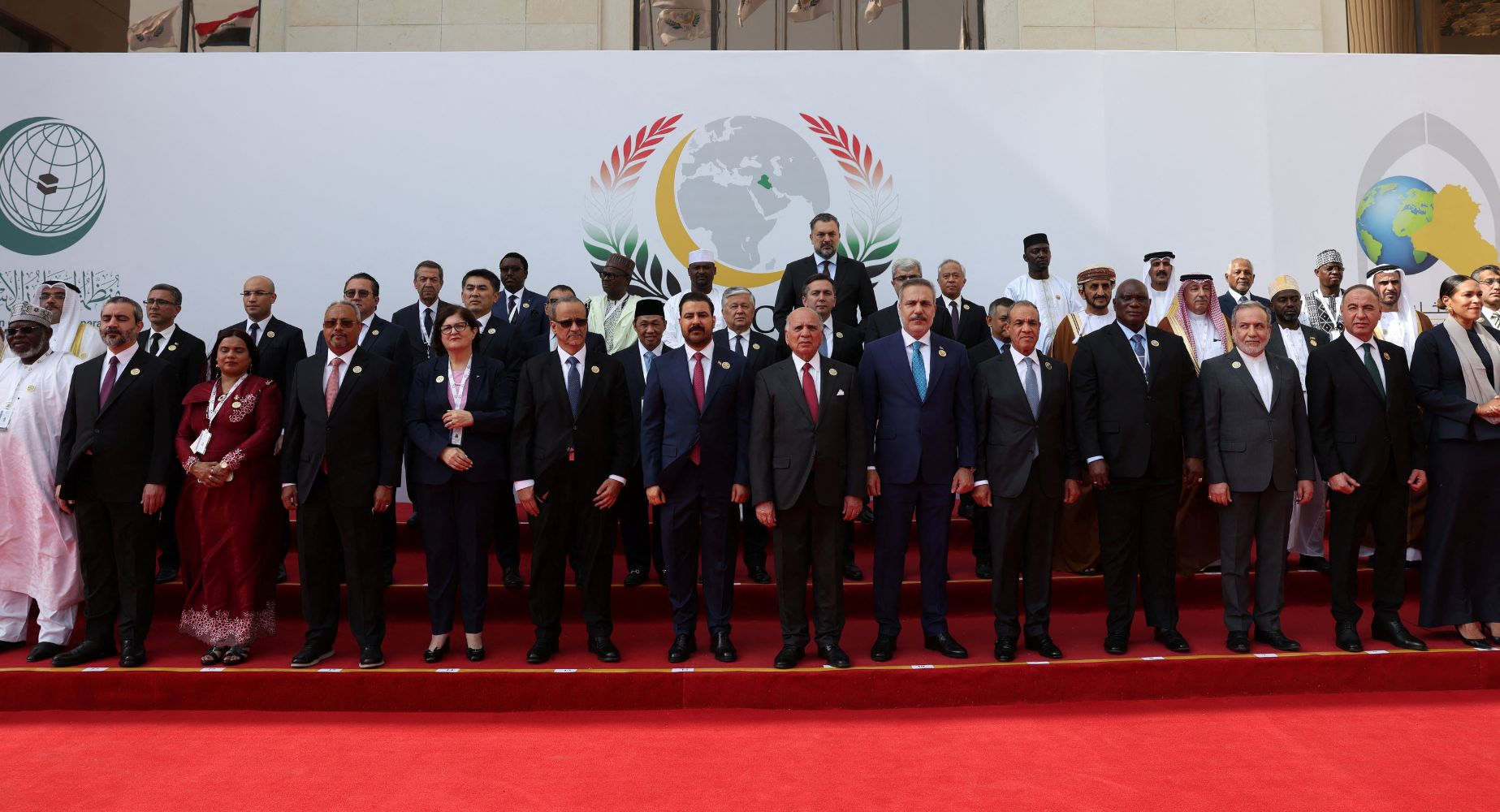
Even the OIC’s 52nd session of the Council of Foreign Ministers held in Baghdad from October 17-18, was incredibly vague about the conflict consuming the Muslim community. Note the adoption of the “Baghdad Declaration” with the theme of “Dialogue and Solidarity, Two Fundamental Pillars for Promoting Peace and Sustainable Development” by the session. After recognizing the election of the OIC’s new secretary-general, the declaration makes thirteen points about Palestine and Israel before ambiguously addressing Iran’s aggression by affirming the institution’s commitment to respecting the sovereignty of member states and ensuring the freedom of navigation. In fact, Iran’s name is absent from the entire 12-page declaration.
Statements of condemnation and adopting declarations only go so far. They ring hollow if they are not eventually followed up by further action. However, the OIC appears compelled to do little else. The institution is intent on largely ignoring the elephants in the room—a divided Muslim community, disdain for its charter and members willing to engage in open conflict with other members that repeatedly violates the most basic international law.
No emergency meetings have been convened during eight months of conflict. One would think that armed conflict between institution members is of paramount importance to the OIC. The OIC should be the location for members to resolve their disputes. It should demonstrate the OIC’s importance and essentialness. If the OIC cannot address and resolve one of its fundamental precepts, what is the point of the institution?
It is telling that within days of a 2025 Israeli attack on a Hamas office in Doha, the OIC (along with the Arab League) was galvanized to convene an emergency meeting. But disrupting the maritime traffic of an international waterway by an OIC member for months does not? Repeated attacks on oil, gas, nuclear facilities, maritime ports and airports are minor issues? A drone attack on the holy city of Mecca is meaningless?
It is also rich that for years, the OIC has repeatedly condemned Israel for its actions in the West Bank, Gaza and against OIC members. They draft resolutions on the Jewish state for various matters and monitor Israel’s daily actions by regularly publishing reports about its violations. The Oct 17-18 session in Baghdad did issue a resolution calling for Iran to terminate contact with the Houthis (which the Iranians opposed), but nothing about Iran’s aggression against Iraq, Kuwait, Jordan, Qatar, Saudi Arabia, the UAE and Turkey. No regular monitoring of Iranian violations. The inconsistency is difficult to ignore.
And what about the OIC’s institutional instruments like the Standing Committee for Economic and Commercial Cooperation, the Department of Political Affairs or the Islamic International Court of Justice? They are seemingly inept, willfully silent or mere facades. An attack by one member on an international air terminal of another member should warrant referral to the OIC’s International Court or extensive dialogue at the Department of Political Affairs. Is the closure of the Strait of Hormuz by Iran an urgent matter for the Standing Committee for Economic and Commercial Cooperation? If not, what is the point of these institutional instruments?
Despite its atrocious non-OIC behavior, Iran remains a member of the organization. No evidence exists of members openly calling for Iran’s suspension or expulsion. Is Iran entitled to lifetime membership just because it identifies as Muslim? What does this say about the significance of the principles and Islamic values propounded by the OIC? The terms of its membership? Its charter and international presence?
Add the Organization of Islamic Cooperation to a growing list of failing international institutions. Include the OIC in discussions about whether certain institutions serve a compelling reason to exist. The OIC’s shortcomings with Iran’s contemptable behavior may not have the international repercussions of the World Trade Organization (WTO)’s inability to reign in China’s defiant behavior. The future of the OIC may not garner the public attention surrounding discussions about the fate of NATO. However, the events of the last eight months in the Middle East clearly tarnish the image, attack the credibility and question the purpose of the second largest international institution. The OIC is MIA (missing in action) at a critical time for the Muslim and international worlds.