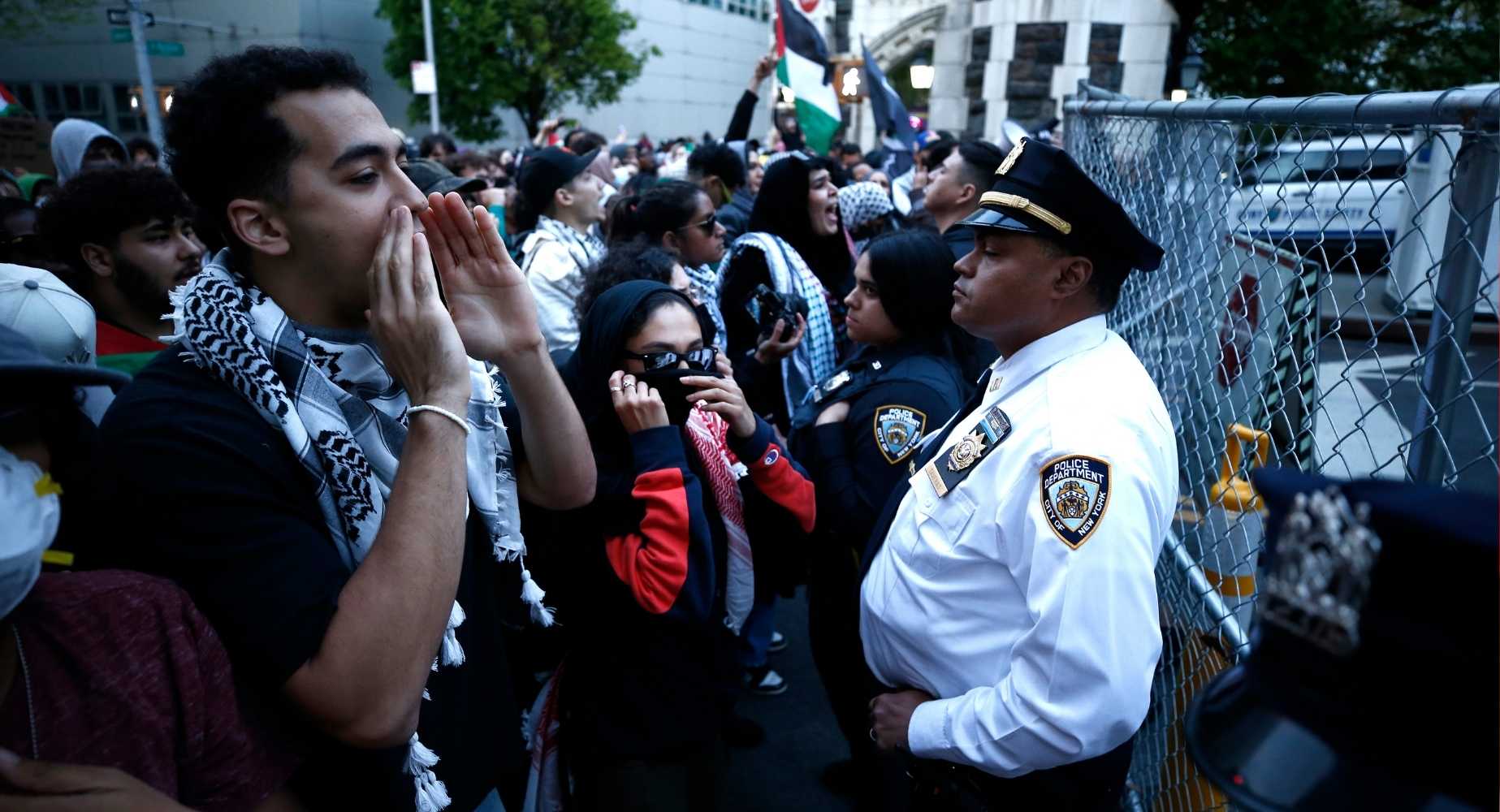
What is it about the end of the school year that brings Israel-bashing on campus to the fore? Since the beginning of May alone: the New School’s student government voted to outlaw their Hillel chapter, Swarthmore College was vandalized with hundreds of anti-Israel slogans spray-painted across campus property (including Hamas-inspired inverted red triangles), the Chair of the University of Michigan’s Faculty Senate openly praised pro-Palestinian campus protesters for their actions over the past two years (and in his university commencement address no less), and Cornell University student agitators harassed the university’s Jewish president as he was trying to leave a campus debate.
These recent events contrast with the Anti-Defamation League’s annual antisemitism audit which reported a sharp drop in campus-related antisemitic incidents. While the frequency of the most visible forms of anti-Zionist hate – encampments, blockage and occupation of public spaces on campus, disruptive protests – has indeed declined since its peak activity towards the end of the 2024 academic year, the examples above show that anti-Israel sentiment remains strong on American university campuses.
So, what has happened at American universities since the spring of 2024? As the ADL notes, university administrations have adopted much stricter policies governing protest on campus. Known as “time, place and manner” restrictions, these policies are meant to allow students the right to free expression while preventing them from gathering at disruptive times or locations – for example outside classrooms while lectures or exams are in process – and also from blocking community access to public spaces (including walking routes across campus). University enforcement of these rules is a good thing.
While time, place and manner rules have lessened the most visible forms of Israel-bashing on campus, a closer look at what is happening at universities shows that anti-Israel sentiment has not lessened. For example, the past year at Yale has witnessed student petitions to divest from companies specifically because of their ties to Israel, a campaign to censure Yale for enabling a donor-advised fund to pass-through a $1 million donation to the Friends of the Israel Defense Forces (recognized by Charity Navigator with a 4-star rating, placing FIDF in the top 2% of charities in the United States), and an election for student government where candidates campaigned for the removal of time, place and manner restrictions while also voicing support for both the divestment and anti-FIDF initiatives above. Combined with myriad other anti-Israel actions on campus, the difficulty facing Jewish and Israeli students and faculty looms large.
Perhaps even more troubling is the following simple fact: given that newly arriving undergraduates spend four years on campus until graduating, this normalization of anti-Israel hostility is creating a dangerous institutional memory lapse. We are fast approaching a point where the entire undergraduate student body will have no memory of a university campus free from the current brand of agitation. For them, the “new normal” will simply be normal. The baseline of campus life will include a pervasive anti-Israel sentiment.
Indeed, Israel-bashing and antisemitism on campus has been displaced in ways that are difficult for an outsider to see. There has been no attempt to address the underlying ideology that leads to anti-Israel hatred on campus. Rather, in a remarkable confusion of two related concepts – freedom of speech and academic freedom – over many years, anti-Israel sentiment has found its way into the very halls of academia under the guise of academic freedom.
As explained by Yale’s former Law School Dean Robert Post, public free speech as assured by the First Amendment to the US Constitution was designed to protect an individual’s right to express themselves in the public square. On the other hand, academic freedom exists to advance a university’s core mission: the creation, preservation, teaching, and dissemination of knowledge. Unlike free speech, this mission requires academic discipline-based evaluative judgments. Professors grade papers, tenure committees evaluate scholarship, and admissions offices select students. In each case, speech is judged for its quality, rigor, and contribution to knowledge. Yet Israel-bashing persists on university campuses in the form of seminars, conferences, and projects all argued as protected by academic freedom.
Nowhere is the misuse of academic freedom more concrete than in the curriculum itself. As an example, this past semester, Yale offered a course titled “Between the Body and the Body-Politic in Palestine.” The course description is a case study in prejudice presented as pedagogy:
“This seminar explores the intimate entanglements between the body and the body-politic in Palestine, examining how bodies are produced, disciplined, injured, and mobilized within settler-colonial structures of occupation and violence…the course interrogates concepts such as necropolitics, biopolitics, debility, and resistance to understand how incarceration, restricted mobility, surveillance, and gendered violence shape corporeal life.”
This is not a description of an academic inquiry; it is the summary of a political verdict. The framework of “settler-colonial structures,” “occupation,” and “necropolitics” is not presented as a theory to be tested but as an incontrovertible truth upon which the entire course is built. There is no room for questioning the premise. Students are not being taught how to think, but what to think. They are being trained in the language and application of a specific ideology, not in the critical analysis of a complex geopolitical conflict. This is a profound abuse of the academic enterprise. True academic freedom would protect a professor’s right to research and teach controversial topics with rigor and intellectual honesty, not their “freedom” to run a semester-long political workshop based on unexamined assumptions. This is not a course description. It is a political manifesto formatted as pedagogy.
The distinction between free speech and academic freedom matters enormously. Academic freedom, properly understood, protects a professor’s right to follow evidence wherever it leads, to challenge received wisdom, and to explore uncomfortable hypotheses. A course designed to guide students toward specific political conclusions about an ongoing geopolitical conflict — one with profound implications for the safety and dignity of Jewish and Israeli students on campus — fails any serious standard of scholarly rigor and has no legitimate claim to the protections of academic freedom. It also contributes to an environment where Israel-bashing is both common and banal.
Given how universities fail to distinguish academic freedom from free speech, the way forward is not simple. A wrong approach would be to advocate for censorship or create lists of forbidden topics. That would be abandoning academic principles. A better approach would be to advocate that courses, seminars, and projects within the university be judged by their contribution to education and scholarship. It means demanding more focus on academics, and granting less freedom to ideologues of all stripes. Most fundamentally, it means restoring a clear-eyed understanding of what academic freedom actually protects. When academic freedom persists as a cover for the opposite of scholarship — for predetermined conclusions, political recruitment, and the systematic marginalization of Jewish and Israeli voices — it corrodes the university’s defining mission to create, preserve and disseminate knowledge.