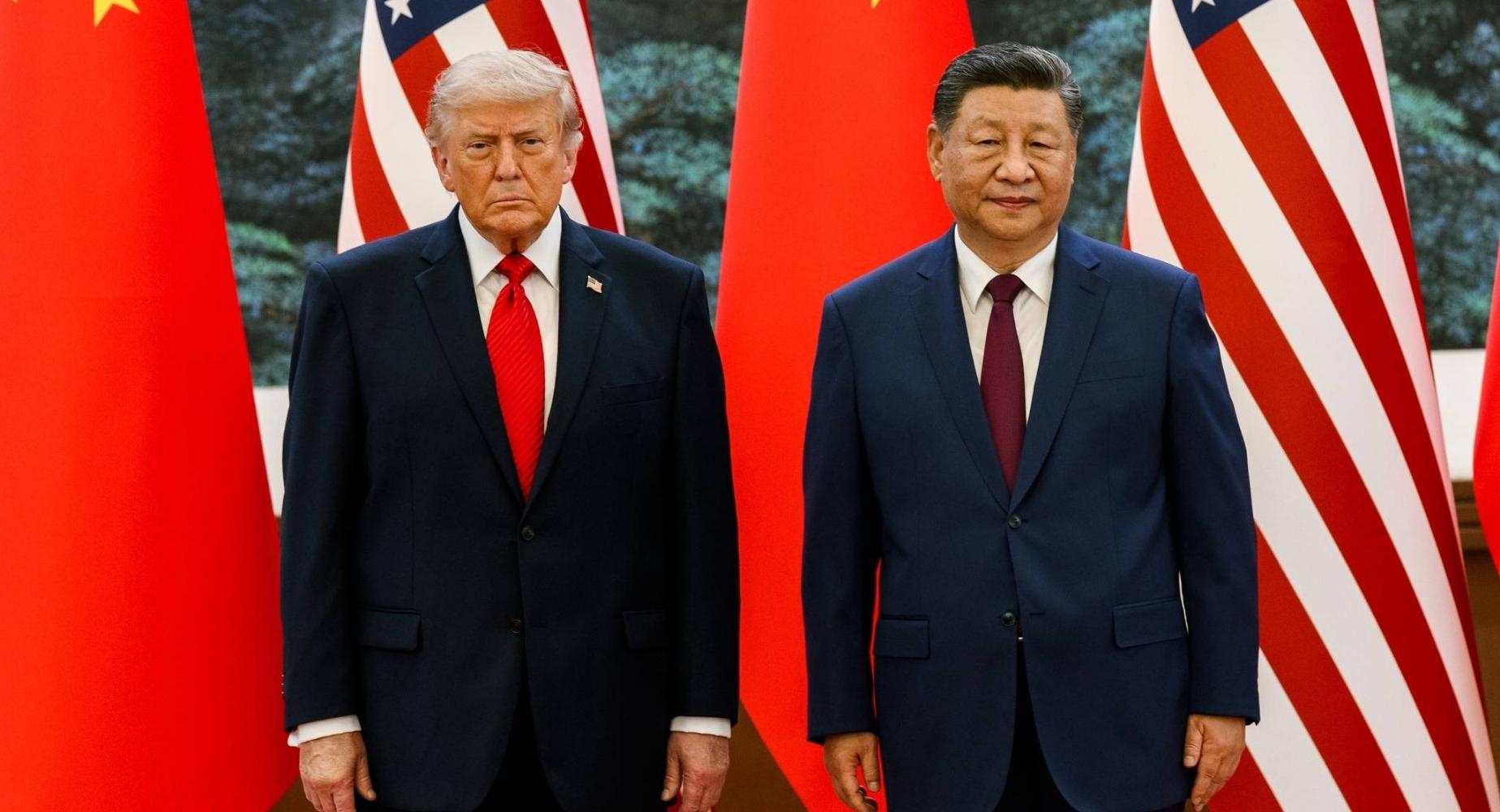
How President Trump’s China visit may open a new era of managed rivalry, strategic respect, and American-led realism.
President Donald Trump’s visit to Beijing should be understood not merely as a diplomatic episode, but as a strategic signal. It revealed something essential about the future of the international order: the relationship between the United States and China can no longer be managed by illusion, slogans, or the comfortable assumptions of the past.
Trump understood a fact many in the Western establishment were slow to accept. China cannot be reduced to a commercial competitor. Nor can it be treated only as an ideological adversary. It is a great power with civilizational confidence, a disciplined state structure, and a long-term vision of its role in the world. To recognize this is not to surrender to it. It is to begin from reality.
That is why Trump’s respect for China matters. It is not sentimental respect. It is not admiration without judgment. It is the respect a serious leader gives to a serious rival. Trump understood that China cannot be humiliated, ignored, or caricatured if the goal is to shape a stable balance between the two most powerful countries on earth. But he also understood something equally important: respect without leverage is weakness. Respect backed by American strength becomes an instrument of statecraft.
The Beijing encounter revealed not friendship, but reciprocal realism: two leaders who understand that power must be respected, rivalry must be managed, and national interest cannot be disguised by diplomatic language. President Xi Jinping represents a China that thinks in decades, perhaps in centuries. President Trump represents an America determined to recover the habits of strength, industrial confidence, and strategic self-respect. That is not a small matter. It may be the beginning of a more honest language between Washington and Beijing.
For decades, Western policy toward China was shaped by the assumption that economic engagement would eventually transform Beijing into a political and strategic partner of the West. That assumption has failed. China entered the global economy, expanded its industrial base, absorbed technology, strengthened its military capacity, and extended its influence across Asia, Africa, the Middle East, and the infrastructure of advanced economies.
China did not become weaker through globalization. It became stronger.
Trump saw this earlier than many others were prepared to say openly. His tariffs, trade renegotiations, and insistence on correcting imbalances were criticized as disruptive or protectionist. But behind the disruption was a strategic insight that is now unavoidable: economic security and national security are inseparable. A nation that loses control of its industrial base, supply chains, technological edge, and strategic infrastructure cannot pretend to remain fully sovereign.
This is why the Beijing visit matters beyond its immediate deliverables. High-level diplomacy between superpowers should not be measured only by signed agreements. Sometimes the achievement is the creation of a channel where dangerous issues can be discussed before they become uncontrollable crises. The true question is not whether America and China will compete. They will. The question is whether that competition will be organized through strength, rules, deterrence, and communication — or left to drift toward miscalculation.
This should not become a new G2 in which Washington and Beijing divide global influence between themselves. American leadership must remain anchored in alliances, democratic confidence, technological superiority, and the security of its partners. The United States is not merely another great power. It remains the indispensable power because its leadership, when exercised with clarity and discipline, gives structure to the international system.
But leadership does not mean refusing to recognize the weight of others. True leadership means seeing the world as it is, not as we wish it to be. It means knowing when to confront, when to negotiate, when to apply pressure, and when to keep a door open.
The hierarchy of issues matters. Trade disputes can be negotiated. Technology competition can be managed, though never ignored. Iran can be treated as a security dossier where pressure, sanctions, energy flows, and diplomatic influence all matter. Taiwan, however, belongs to a different category. It is a question of identity, sovereignty, credibility, deterrence, and the future balance of power in Asia.
For Israel, the Gulf, and the wider Middle East, the U.S.–China relationship is no longer distant diplomacy. It touches Iranian oil, sanctions enforcement, nuclear proliferation, maritime security, and the stability of the Strait of Hormuz. China has influence with Tehran. It has economic channels Washington does not possess. If American diplomacy can use China’s influence to restrain Iran’s most dangerous behavior, that is not weakness. It is strategic intelligence.
Taiwan is even more delicate. It cannot be treated as a rhetorical slogan or as an instrument for provocation. President Trump’s recent remarks made clear that his approach does not encourage unilateral independence, but neither does it accept instability or coercion. This is the essence of strategic ambiguity: preserving deterrence while preventing reckless escalation. Taiwan is connected to American credibility in Asia, the security of Japan and South Korea, the balance of power in the Pacific, and advanced semiconductor supply chains. But precisely because it is so sensitive, it must be handled with discipline, restraint, and direct communication.
In the long run, the Taiwan question can only be addressed through a peaceful understanding between Chinese leadership and the people of Taiwan, supported by a responsible American role. The United States should not impose a political outcome, nor should it permit force to decide the future. Its role should be to preserve stability, discourage unilateral moves from either side, and help create the conditions in which dialogue remains possible. That is not weakness. It is the highest form of strategic responsibility.
Here again, Trump’s instinct is neither naïve nor reckless. Deterrence requires military, technological, and diplomatic credibility. But avoiding unnecessary war also requires discipline, timing, and the ability to speak directly with a rival. His willingness to speak respectfully to President Xi does not mean softness toward China. His openness to negotiation does not mean acceptance of Chinese dominance. It reflects a very American instinct: enter the room with leverage, defend the national interest, and seek agreements only when they strengthen the United States.
China will pursue its interests. That should surprise no one. The responsibility of an American president is to pursue America’s interests with equal seriousness.
There are two forms of naïveté to avoid. The first is to believe that engagement alone will moderate China. The second is to believe that confrontation alone will discipline it. Serious strategy requires something more difficult: pressure, dialogue, deterrence, and selective cooperation.
The world is not entering the end of diplomacy. It is entering the end of naïveté. Moral lectures alone will not contain China. Trade alone will not moderate China. Military deterrence alone will not stabilize the relationship. What is required is a new architecture of realism: competition where interests collide, cooperation where stability demands it, and leadership where American power remains indispensable.
President Trump’s visit to China should be understood in that spirit. It was not a capitulation. It was not a celebration of China’s rise. It was an acknowledgment that the world’s two most powerful countries must find a way to compete without losing control of history.
That may be the beginning of a new era: not peace through illusion, but stability through strength; not partnership without rivalry, but rivalry without catastrophe.
In an age when decisions made in Washington and Beijing can shape the security of nations, the price of energy, the future of technology, and the safety of millions, such realism is not only necessary. It is responsible.