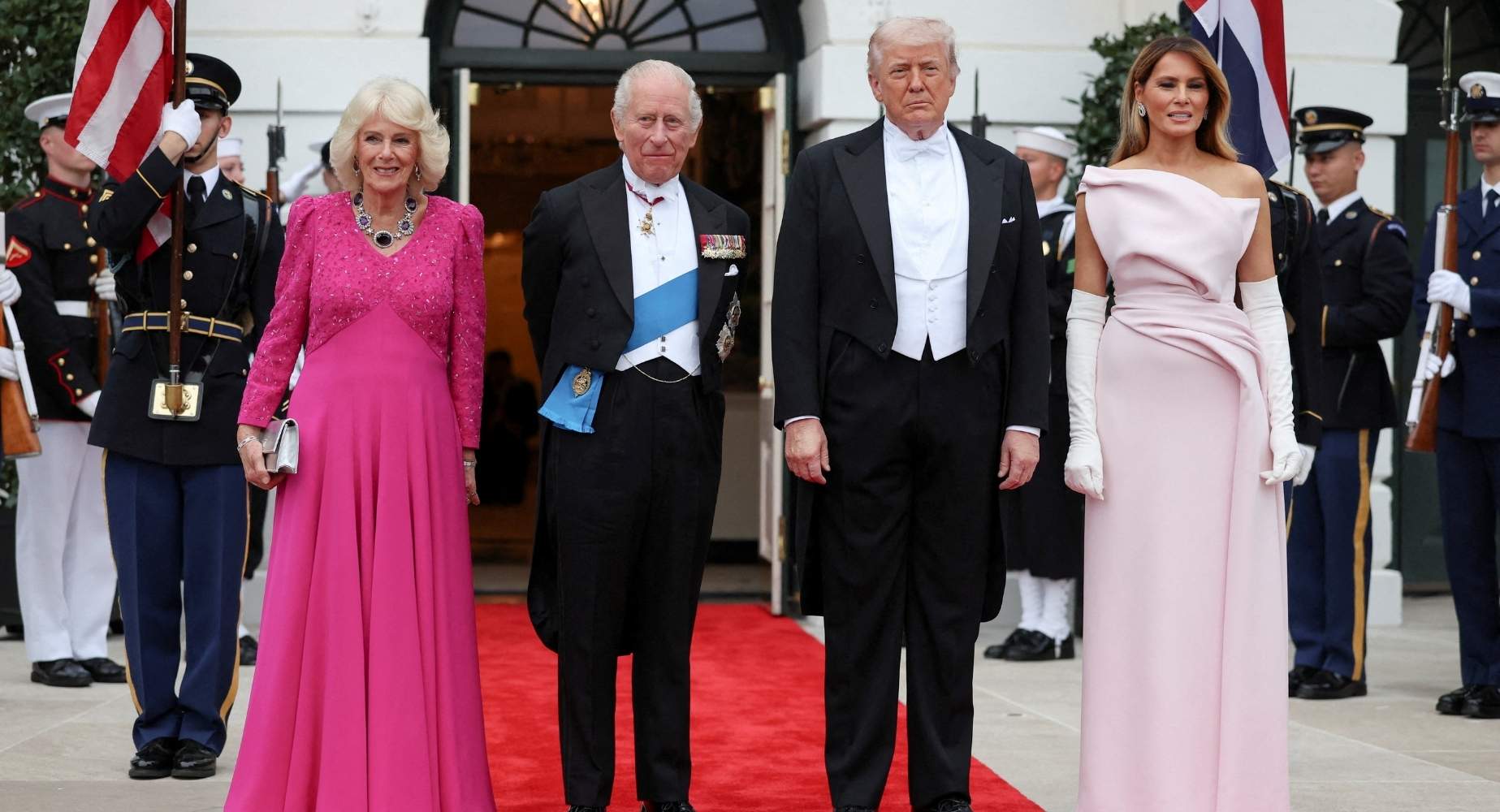
There are moments in diplomacy when ceremony is not decoration, but strategy by other means.
King Charles III’s visit to Washington belonged to that category. It came not at a quiet moment in Anglo-American relations, but at a moment of visible strain between Washington and London — above all over Iran, the Middle East, and the question of Western resolve.
The State Visit was therefore more than a royal occasion. It became a mirror. It revealed the enduring strength of the Atlantic alliance, but also the unease beneath it: the concern that parts of the West have become too cautious in naming the nature of the threats they face.
At the White House state dinner, President Donald Trump brought Iran directly into his remarks, insisting that the regime must never be allowed to obtain a nuclear weapon. King Charles, by contrast, did not address Iran publicly, consistent with his constitutional role as a non-political sovereign.
That distinction is essential.
The King did not come to Washington to conduct policy. He came to embody continuity. He did not negotiate, threaten, or speak as a partisan actor. Instead, he gave presence to something older than government: the nation’s memory, dignity, and moral character. And that is precisely why his visit mattered.
The question is not whether the British monarch should replace the government. He should not. The question is whether, at a time when the West is confronted by terrorism, tyranny, nuclear intimidation, and the suffering of innocent people, the Crown’s moral voice can still remind Britain — and the world — of the principles that stand above the calculations of daily politics. It can. And it should.
The Iranian regime is not a normal state pursuing normal interests. It is a revolutionary system built on coercion at home and intimidation abroad. It imprisons, tortures, executes, and kills its own citizens. It threatens dissidents beyond its borders. It arms proxies across the Middle East. It menaces Israel. It destabilizes its neighbors. It uses diplomacy when useful, violence when possible, and ideology always.
Its danger is not confined to Tehran, Gaza, Lebanon, Yemen, Syria, Iraq, or the Gulf. It reaches into Europe. It reaches into Britain itself.
The recent conduct of the Iranian embassy in London should have shocked every serious observer of Western security. When a foreign embassy uses the language of martyrdom and seeks to mobilize Iranians living in Britain, it is not practicing ordinary diplomacy. It is projecting intimidation onto British soil.
This is not diplomacy. It is intimidation by another name.
No sovereign democracy should tolerate a foreign regime attempting to turn diaspora communities into instruments of ideological warfare. No serious government should treat a regime that glorifies martyrdom, threatens dissidents, arms terror networks, and brutalizes its own people as merely another difficult interlocutor. This is where moral clarity matters.
Peace is not silence before terror. Peace is not the avoidance of difficult truths. Peace is not asking democracies to restrain their language while tyrannies unleash violence, repression, and fear.
Peace without justice is not peace. It is postponement.
The Iranian people understand this better than anyone. They have paid the price in blood, prison, exile, and silence. Thousands have been killed, detained, disappeared, or condemned by a regime that fears its own citizens because it knows they carry the legitimacy it lacks. The women and men who rise against the rule of the mullahs are not asking the West for poetry. They are asking not to be abandoned.
Abandonment does not always arrive loudly. Sometimes it arrives through ambiguity. Sometimes it arrives through diplomatic language so carefully balanced that it loses all moral meaning. Sometimes it arrives when leaders speak of stability while ignoring the victims of the system they are trying to stabilize.
That is why this moment matters for Britain.
Prime Minister Keir Starmer’s government must understand that the Iran question is not only a nuclear question. It is not only a regional question. It is not only a matter of alliance management with Washington. It is a civilizational question.
Can Britain, with its history, its sacrifices, its constitutional inheritance, and its moral authority, speak clearly when confronted by a regime that represents the negation of everything Britain claims to defend?
Britain cannot be eloquent in Washington and hesitant before Tehran. It cannot invoke the memory of Churchill while appearing uncertain before a regime that despises liberty under law, pluralism, religious tolerance, and the dignity of the individual.
The issue is not whether Britain should act rashly. Serious states do not confuse strength with improvisation. The issue is whether Britain can still speak with the moral clarity required by the moment.
Here, the role of the Crown is delicate — but not irrelevant. The monarchy does not direct policy. It does not issue ultimatums. That would be neither constitutional nor wise. But the Crown can remind policy of its moral purpose.
King Charles’s address before Congress was dignified precisely because it did not descend into partisan argument. He spoke of friendship, shared inheritance, democratic responsibility, and the dangers of an uncertain world. Yet one may respectfully hope that the same moral vocabulary — peace, service, duty, human dignity, and the rejection of violence — will be heard with equal force when the world speaks of Iran.
That is not a criticism of His Majesty. It is a recognition of the weight his voice carries.
The King’s voice matters precisely because it is not partisan. When he speaks of peace, he does not speak as a tactician. When he speaks of service, he does not speak as a candidate. When he speaks of dignity, he speaks from the moral altitude of an institution that has survived precisely because it stands above the noise of politics. That voice is needed now.
It is needed for the Iranian people. It is needed for the victims of terrorism. It is needed for dissidents, exiles, women, minorities, and young people who know that silence from the free world strengthens their oppressors.
The Crown does not govern. But it can illuminate. It can remind Britain that policy is not merely the management of interests, but the defense of principles. It can remind the world that peace is not passivity before terror, and restraint is not the same as silence.
King Charles did not come to Washington to rule. He came to represent. And in representing Britain, he also represented a deeper tradition: continuity without domination, authority without partisanship, and peace without surrender.
At its highest purpose, the Crown gives voice to the moral continuity of the nation — reminding Britain, America, and the wider world that peace without courage, conscience, and human dignity is only the postponement of disorder.