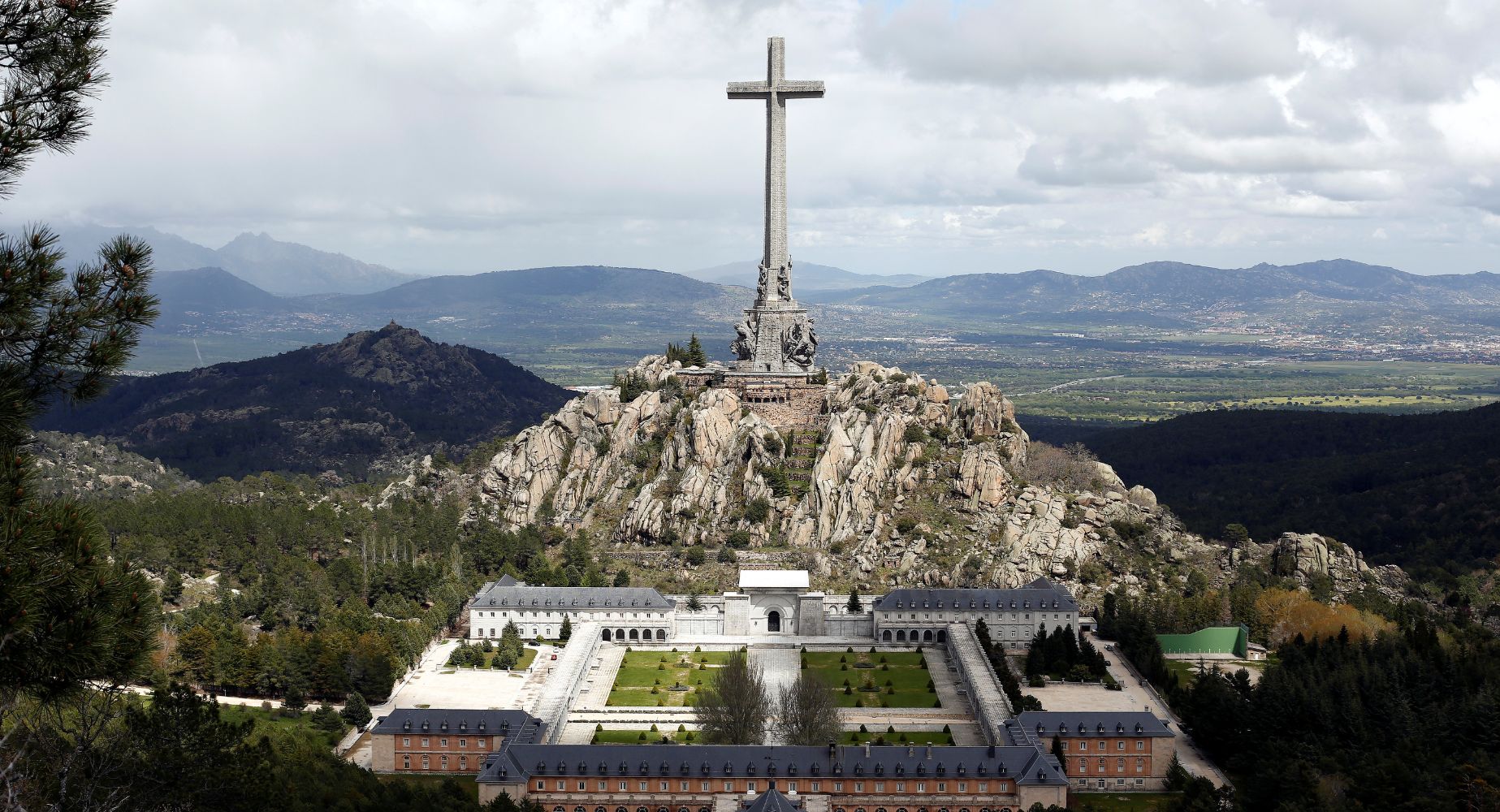
Ahead of his June visit to Spain Pope Leo XIV was pressed by conservative Catholic groups to visit the Valley of the Fallen, the massive memorial complex in the mountains near Madrid built during the Franco regime. While it is dedicated in theory to all who died in the country’s civil war, this memorial is seen by many as an expression in stone of fascist and clericalist ideology. Leo unsurprisingly passed on the idea of such a visit to the politically charged site.
The effort to entice the Pope to visit the Valley was part of a campaign opposing major architectural changes at the monument which Spain’s Socialist-led government is undertaking that are aimed at reinterpreting the visitor experience to avoid any glorification of Franco’s victory. It comes at a time when, ninety years after Spain’s civil war began, a new hard right is pushing back against the left’s approach to Spain’s history which it sees as one sided and aimed at political gain.
A Bitter War, a Huge Memorial
The civil war broke out in 1937 as an attempted military coup against the democratically elected government of the Spanish Republic, which had been created after the abolition of the monarchy in 1931. The Republic’s government was led by Socialists, but included participation from the Communist Party in a “Popular Front.” The uprising failed to gain complete support within the military and morphed into a grinding war for territory. The rebels, who called themselves “Nationalists,” adhered to a mixture of monarchism, ultra-conservative Catholicism, and Italian-style fascism. They benefited from direct military support from Hitler’s Germany and even more so from Mussolini’s Italy.
The war lasted three years; as the democratic powers, Britain, France, and the United States, stood aside, the Republic accepted support from the Soviet Union, which inevitably gained ever greater political influence within it. However, Stalin, who had become more concerned with arming his own country against the German threat, eventually ceased aid, leading to the 1939 victory of the Nationalists, led by General Francisco Franco. Massacres and executions were common on both sides, with the Nationalists responsible for up to 150,000 deaths and the Republicans up to 55,000.
The peace that followed was marked by extensive repression, including the murder or imprisonment of many who had served the losing side. After his victory, Franco ordered the construction of a massive monumental complex in the rugged Guadarrama mountains northwest of Madrid, which were the site of bitter fighting during the war. Termed the Valley of the Fallen, it was nominally a memorial to all who had died in the war, but in every way it hewed to the Nationalist vision.
It lies at the base of a mountain on top of which a 490 foot-high cross, the largest in the world, was erected. At the cross’s base are enormous statues of the four evangelists. Other statues include one of Mary with the fallen Jesus, as well as of archangels, martyrs and representations of Catholic virtues. It includes a huge plaza, an underground basilica and a Benedictine abbey. The bodies of 34,000 persons from around the country are buried in a common grave there, having been removed from other mass graves without efforts to identify them individually. (These likely include victims of executions as well as those who died while fighting.)
The architecture of the complex is in an austere style that inevitably evokes comparison with similar works of stripped down classicism built in Nazi Germany and fascist Italy. Its construction was undertaken at least partially by political prisoners who were offered reduced sentences in exchange for their labor. After its completion in 1958, José Antonio Primo de Rivera, the founder of the Falange, the Spanish version of fascism, was buried in the basilica, as was Franco himself following his death in 1975.
Socialists Refuse to Forget…
While the Valley was seen by many as a glorification of Franco’s victory, its status was left in abeyance during the early years of Spain’s transition to democracy in the late 1970’s and early 1980’s, as were other issues related to the civil war and the following repression, under an informal understanding within Spain’s political class, both on the left and the right, known as the “Agreement to Forget.”
However, over time, this approach was progressively abandoned. In 2007, during the Socialist-led government of José Luis Rodríguez Zapatero, the “Law of Historical Memory” was enacted which formally condemned the Francoist state, called for the removal of objects such as statues which exalted it, offered state assistance in identifying and eventually exhuming the bodies of persons buried in mass graves during the war, and forbade political events at the Valley of the Fallen.
The memorial was closed in 2009, with the reason given being the need for major repairs to some of the statuary after masonry had fallen, putting lives at risk. Conservative and Catholic groups protested this decision, asserting that the Government’s real aim was to close it permanently. It was re-opened when the center-right People’s Party took over the government in 2012. It had opposed the Law of Historic Memory, seeing it as a divisive and partisan measure.
However, with the return to power of a Socialist-led coalition, this time headed by Pedro Sánchez, in 2018, the fate of the Valley again became a front burner issue, as the new government sought to imprint its vision of the civil war and its aftermath on the site. A “Law of Democratic Memory” was passed in 2022 which gave the state full responsibility for exhumations from mass graves. An effort was made to remove the bodies of both Primo de Rivera and Franco, which ultimately proved successful, after complex negotiations with the families. The Valley of the Fallen officially reverted back to its original name of the “Cuelgamuros Valley.”
… and Seek to “Resignify”
The Sánchez government also sought the expulsion of the small community of Benedictine monks who resided at the memorial complex. The strongly laical convictions of the Spanish left and its bitterness for the support lent by much of the Spanish Church to the military rebellion and the subsequent regime likely figured in the government’s insistence. As the minister in charge of dealing with the future of the memorial said: “We want them to go,” adding that the monument “must be a secular center that serves to explain the war and what came next. They cannot stay.”
However, this move was opposed by the Church hierarchy, which had certain legal rights over the management of the memorial. It was ultimately abandoned; the government also committed itself to maintaining the enormous cross on top of the mountain. However, the prior of the community, who had been a candidate for political office for a far right party before he joined the Benedictines, and who had opposed the exhumations, was replaced. A small number of exhumations have in fact gone forward.
In addition, the Spanish government held a contest for architects to propose changes in the memorial. The winning proposal, approved in 2025, aimed to “resignify” the memorial, reshaping the visitor experience through the creation of a large architectural fissure in the main plaza, leading visitors into an open air space intended to symbolize dialogue, plurality and democratic coexistence. The fissure will break the strict symmetry of the plaza, symbolizing the historical divisions in Spain. An exposition regarding the causes and consequences of the civil war is to be built. (What it will say about this traumatic event is yet to be determined but is sure to be controversial.)
The Pope Stays Away
In June, some initial geological soundings for the work were begun. They were briefly halted by an injunction (ultimately lifted) obtained by the “Association for Reconciliation and Historic Truth,” an organization which had opposed both the Law of Historical Memory and the Law of Democratic Memory and which has links to far right entities such as the Francisco Franco Foundation (which the government is taking steps to ban). It had also opposed the exhumation of bodies from the grave at the Valley; another of its preoccupations has been preserving the “Pyramid of the Italians,” a memorial near Burgos dedicated to the soldiers sent by Mussolini to fight for the rebels.
In an effort to resist the plans to resignify the Valley, two highly conservative Catholic organizations, “Abogados Cristianos” (Christian Lawyers) and “Hazte Oir” (Make Yourself Heard), had urged Pope Leo XIV to visit the Valley during his June 6-12 trip to Spain, in order to aid in keeping it from being “profaned.” Although he had actually briefly visited the site once before in 2003 when, in his role as head of the global Augustinian order, he was participating in a youth conference which was being held nearby, he unsurprisingly chose to stay away from the Valley and its controversies during his trip as Pope.
The debate over the Valley of the Fallen comes at a time when in Spain new hard right forces are coming to the fore, challenging the view on the left which seeks to wall off the Franco era as an illegitimate period of Spanish history worthy only of condemnation. Although its main focus is on current issues (notably immigration), the new ultra-conservative party Vox has not been shy in defending the Franco period, with one of its deputies stating: “Thanks to the (internet) networks, young people are discovering that the post-civil war period was not a dark period, as the government is selling to us, but one of reconstruction, progress and reconciliation to achieve national unity.”
Who Controls the Past?
But even more measured figures such as the intellectual David Jiménez Torres raise the question as to what extent the broad campaign of anti-Franco “historical memory” of which the plans for the Valley of the Fallen are only a part, has been a political maneuver which aims “to detract attention from the weakness of the government—an unstable left wing coalition… and the accusations of corruption in which it was embroiled” while seeking to broadly delegitimize Spain’s right.
Of course Spain is hardly alone in facing a struggle between left and right over how to commemorate the politically sensitive past. In Germany, the Memorial for the Murdered Jews of Europe and the so-called “stumbling stones,” small brass-plated cobblestones embedded in sidewalks which commemorate individual victims of Nazi tyranny, have been denounced by the far right Alternative for Germany (AfD) party as a “dictatorship of memory.”
In Argentina the former Naval Mechanics’ School, used as a center for detention, torture and murder during the military regime, which was made into a “Museum and Site of Memory” during the leftist Peronist government of Cristina Kirchner, has been criticized on the right for not also commemorating those killed by Marxist guerrillas. And in the United States, the issue of what to do with the statues of Confederate generals in public squares and the army bases named for them has become yet another element in its never-ending “culture wars.”
In his novel Nineteen Eighty-Four, George Orwell, who fought in Spain’s civil war, attributes to the ruling party the slogan: “Who controls the past controls the future. Who controls the present controls the past.” In Spain, as elsewhere, the struggle over history goes on.