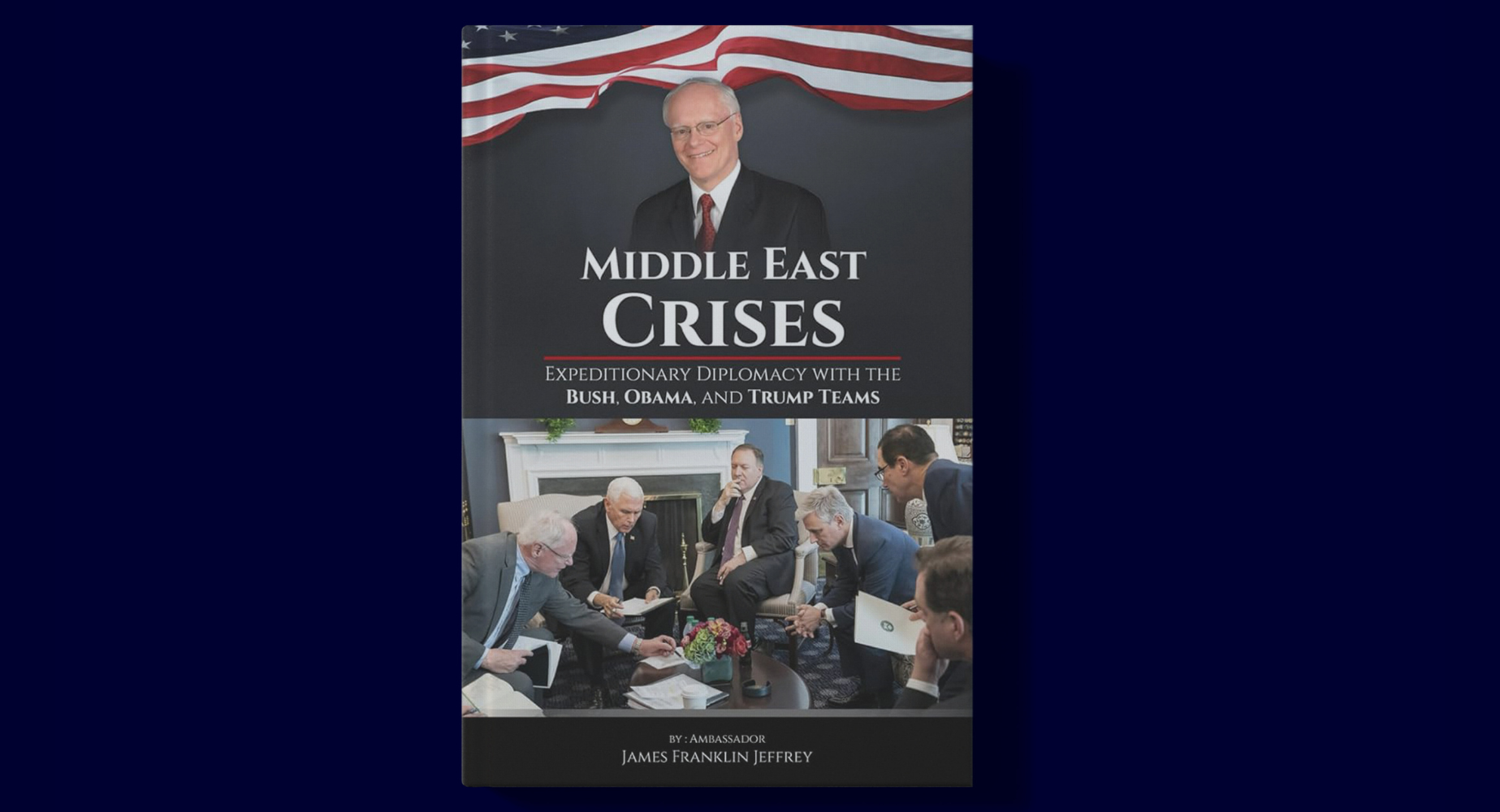
James Franklin Jeffrey, Middle East Crises: Expeditionary Diplomacy with the Bush, Obama, and Trump Teams,
The Book Publishing Pros, 2025
It is a truth seldom acknowledged that the United States has conducted a successful foreign policy since the end of World War II. Over the last eight decades – with, of course, conspicuous exceptions – the world has enjoyed more consistent peace and greater prosperity than in comparable periods in the past; and that peace and prosperity owe a great deal to American policies. It is a related truth, almost never acknowledged because largely unknown to the general public, that the success of the nation’s foreign policy owes a great deal to the people charged with carrying it out, the nation’s professional diplomats who work for the Department of State.
Most accounts of America’s foreign policies attribute them to presidents and occasionally to cabinet officers, who indeed make the major decisions about these policies and bear ultimate responsibility for them. They rely, however, on the country’s diplomats to supply them with the information on which they base their decisions and to carry those decisions out once they are made. Moreover, the highest officials cannot possibly decide all relevant issues, or even all consequential ones. The responsibility for most of America’s relations with the rest of the world falls to the men and women below the leaders at the top of the governmental hierarchy, who are sometimes known collectively as the “working level” of government.
Just what those at the working level do is vividly described in the memoir Middle East Crises: Expeditionary Diplomacy With the Bush, Obama, and Trump Teams, by former ambassador James Franklin Jeffrey. The book provides a good sense of the texture of foreign policy – how it is made and implemented. Most books about American foreign policy convey a bird’s-eye view of it. Jeffrey’s account offers the view from the ground level. It also gives the reader an appreciation of the contributions that America’s professional diplomats make to the nation’s well-being.
Ambassador Jeffrey began his career as an Army infantry officer, including a tour of duty in Vietnam. He then joined the Foreign Service and served as the American ambassador to three countries: Albania, Turkey, and Iraq. He held other responsible positions as well, among them deputy chief of mission in Iraq and deputy national security advisor in the administration of George W. Bush as well as special envoy to Syria in the first presidency of Donald Trump.
While much of his career took place in, and much of the book is therefore devoted to, the Middle East, he also served in Europe and has pertinent observations about American policy there. In particular, he witnessed the shift from the post-Cold War European policy of the administration of George H.W. Bush, which sought to include post-communist Russia in a new continental security architecture, to the approach of the administration of Bill Clinton, which “reverse[d], deliberately or inadvertently, most of the strategic Europe architecture of the Bush administration.” As a result, Russia felt – not altogether wrongly – excluded, which bred a resentment that contributed to the aggressive Russian policy toward its neighbors undertaken by Vladimir Putin that has thus far culminated in the full-scale invasion of Ukraine in 2022.
From Jeffrey’s account of his experiences as a mid-level officer in Europe, and then an increasingly high-ranking official working in and dealing with the Middle East, emerges a number of lessons about American foreign policy as it actually unfolds.
1. The job is a difficult one.
Foreign Service officers need to have a variety of difficult-to-master skills. They have to speak the language of the place where they are posted. Jeffrey, for example, learned Turkish, one of the languages most distant from English and thus hardest for an English-speaker to learn. They have to be familiar with the politics and economics of the countries in which they serve, which means that they have to have some knowledge of the country’s history and culture; and over the course of their careers, they typically serve in several countries. They have to be able to explain, clearly and persuasively, the local conditions to Washington while at the same time explaining Washington’s policies to the officials of the country in which they serve.
They must also undertake sometimes large and complicated tasks of management. As ambassador to Iraq, Jeffrey had to supervise the transfer to the jurisdiction of the embassy of the many functions the American military had been performing in that country since the early months of the 2003 war there. This involved, among other things,
doubling embassy size to between fifteen and eighteen thousand personnel, obtaining a huge budget of $6 billion annually, and taking over the military’s key equipping and advising functions with the Iraqi military as well as most of the fourteen hundred discrete tasks the military was doing, often with nonmilitary elements of the Iraqi government and society.
Few are the occupations that have such broad and taxing requirements.
2. Bureaucratic skills matter.
The American foreign policy apparatus necessarily includes a multitude of large and complicated organizations. The successful practitioner must be able to navigate between and among them. This requires knowing the various agencies and understanding their particular responsibilities, their strengths, and their weaknesses. It involves negotiating with other State Department officials, with the Pentagon, and with other agencies. Jeffrey, like other Foreign Service Officers, spent a good deal of his time on these mundane and often frustrating but also indispensable activities. A contemporary of his used to boast that he had “a black belt in bureaucracy.” In his memoir Jeffrey does not toot his own horn – and indeed he writes candidly and thoughtfully about policies in which he was involved that failed – but he clearly possessed formidable bureaucratic skills.
3. Diplomacy and military force are inevitably intertwined.
While responsibility for the two enterprises officially resides in separate departments – State and Defense respectively – they are not separate in practice. Especially in the Middle East during Jeffrey’s time there, the American political initiatives in which he was involved had a military component to them. He served in Iraq during a bloody insurgency aimed at, among others, the Americans in the country. As special representative for Syria he operated in the context of the ongoing civil war there. In pursuing his diplomacy, he also had to take into account the small American military detachment dedicated to fighting the Islamic fundamentalist group ISIS that was deployed in the northwest of that country. In these circumstances, a diplomat needs some familiarity with military affairs and the capacity to deal effectively with his American and foreign counterparts in uniform. Here Jeffrey’s experience in the United States Army served him well.
4. Alliances and allies are crucial — and frustrating.
The author identifies the basis of the successful post-World War II foreign policy of the United States as a “global collective security system.” The far-flung American system of alliances has helped keep the peace that the world has enjoyed since then, and if it has scarcely prevented all violence over the past eight decades it has surely helped to limit the scope of armed conflict, which has happily never attained the magnitude of the two world wars.
Jeffrey spent more of his career dealing with America’s friends and allies than with its adversaries, but the management of alliances hardly qualifies as easy, straightforward, or even pleasant. Allies have their own interests and perspectives, which all too often differ from those of the United States. They also have their own domestic politics, which can interfere with American designs. Much of his time as ambassador in Baghdad was taken up with the attempt to bring together enough of the quarreling factions in the Iraqi parliament to assemble a functioning government there. Winston Churchill has been quoted as defining an alliance as “an exercise in mutual recrimination.” America’s diplomats have to absorb recriminations both from allied countries and from Washington. The alternative to frustrations and recriminations is for the United States to conduct a foreign policy without allies, which might make diplomats’ lives easier but would also undoubtedly produce far poorer results.
5. The Middle East is a hard place in which to conduct diplomatic business.
With the end of the Cold War, American foreign policy came to devote more time and attention to the Middle East than it had previously done because that region turned out to be less stable than the traditional centers of American attention, Europe and East Asia. It is no accident that talented diplomats of Jeffrey’s generation spent much of their careers working in and on that region. What has made the Middle East turbulent and thus prominent has also prevented the achievement of the most ambitious American goals there. Jeffrey writes that the United States and its partners “have succeeded decade after decade in keeping the region out of hostile hands and putting out specific regional ‘fires,’ but not in the . . . longer-term mission of permanent stability.” The lesson he draws from his and America’s experience there over the last three decades is that the United States “cannot itself fix the region; rather, its population themselves must undertake their own salvation, albeit with US help, beginning with buttressing security.”
While Ambassador Jeffrey and his former colleagues who make the great machinery of American foreign policy operate remain largely anonymous, in this populist era they have gained, in some sectors of the body politic, an unfavorable reputation. They are seen as stalwarts of the “deep state,” part of the “permanent government” that subverts the interests of the American public in favor of their own self-interested designs. As is the case with all organizations, not all members of the foreign service are selfless, shrewd, and effective. By and large, though, the charges against them are unfair and untrue. As James Jeffrey’s memoir shows, most of the country’s diplomats work long and hard, sometimes in dangerous conditions, on behalf of the United States, whose citizens, and indeed the citizens of other countries, have good reason to be grateful to them.