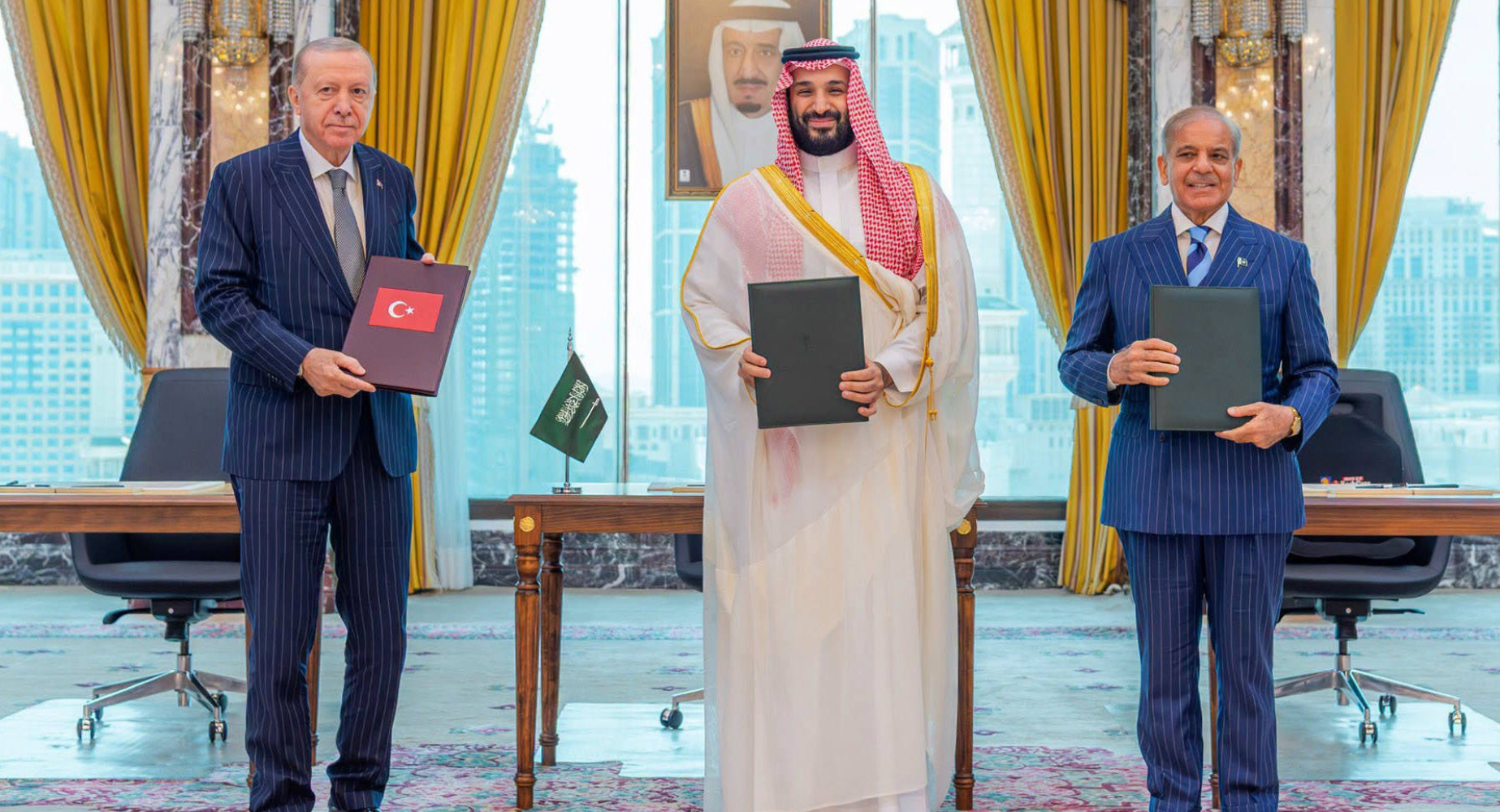
The Middle East has rarely had so many partnerships, strategic agreements, and security arrangements, and rarely has it been so unclear who would fight for whom. The wars that followed Hamas’s October 7, 2023, attack exposed a basic weakness in Middle Eastern politics. The region is full of partnerships, strategic agreements, summits, and security arrangements, but remarkably few reliably produce collective action when a crisis becomes costly. The problem is not the absence of alliances. It is the gap between the language of solidarity and the willingness to accept the risks that genuine collective defense requires.
For decades, Middle Eastern governments have sought security through the US, regional organizations, ideological camps, and bilateral understandings. However, the wars since October 2023 have shown how conditional many of these relationships remain. Gaza and the conflict’s spillover into Lebanon, Syria, Iraq, Yemen, and the Red Sea did not reveal a region without partners. They revealed a region of what can be called “alliances without obligation”: relationships that provide diplomatic support, economic benefits, intelligence cooperation, or deterrent signaling, but leave governments considerable freedom when supporting a partner becomes dangerous.
The Illusion of Regional Solidarity
The Arab and Islamic response to Gaza illustrated the problem. Emergency summits, condemnations, humanitarian initiatives, and demands for a ceasefire demonstrated political concern, but they did not create a common strategy capable of changing the military balance or imposing a settlement. The same limitation was visible when Israel attacked Doha while targeting Hamas’s political leadership. Even an attack on the territory of a key Gulf mediator drew condemnation rather than a coordinated regional response that would carry substantial political, economic, or military costs.
This was not simply a failure of solidarity. Egypt was concerned with preventing Palestinian displacement into Sinai and protecting its border. Jordan had to balance domestic pressure with regime stability and its role in Jerusalem. Gulf governments sought to manage public anger without sacrificing economic transformation or strategic ties with Washington. Qatar preserved its mediation role, Türkiye adopted a more confrontational public position, and Saudi Arabia suspended progress towards normalization with Israel while avoiding direct confrontation. Each government acted according to its own interests. Collectively, however, these choices demonstrated the absence of a regional strategic center.
US’s Architecture: Powerful but Not Regional
The US remains the principal external military power in the Middle East. Its network of bases and access arrangements, intelligence and command-and-control capabilities, integrated air and missile defense assets, naval forces, logistics infrastructure, and arms partnerships continue to underpin much of the region’s security architecture. The wars that followed Hamas’s 7 October 2023 attack again demonstrated that no other external actor could readily replicate this combination of rapid reinforcement, intelligence support, air and missile defense, maritime power, and sustainment capacity.
However, American predominance should not be equated with a Middle Eastern collective-defense system. US security relationships in the region are principally bilateral, asymmetric, and politically contingent; most do not entail NATO-style treaty obligations to treat an armed attack on one partner as an attack on all. Washington can defend selected partners, deter adversaries, and shape escalation, but it cannot automatically reconcile partners’ divergent interests or transform them into a unified regional coalition.
China’s Partnerships: Influence Without Security Guarantees
China presents the opposite model. Beijing has developed extensive economic, diplomatic, technological, and energy relationships across the region while avoiding formal alliances. It maintains strategic partnerships with a wide range of regional actors and has positioned itself as a power that can speak to rivals, avoid ideological conditions, and offer trade, infrastructure, investment, technology, and diplomatic recognition without the political demands often associated with Western partnerships.
Its mediation of the Saudi-Iranian rapprochement in March 2023 appeared to demonstrate the diplomatic advantages of maintaining relations with rival camps. Nevertheless, the crises that followed also revealed the limits of that approach. China called for ceasefires, criticized civilian suffering, and supported diplomacy, but it did not assume responsibility for regional security.
The limits were especially visible in China’s relationship with Iran. Despite the language of a “comprehensive strategic partnership”, Beijing did not provide Iran with a mutual-defense guarantee when Iranian military and nuclear-related targets came under Israeli and later American attack. China offered diplomatic support and condemned violations of Iranian sovereignty but avoided the kind of military commitment that could have drawn it into confrontation with Israel or the US. This was less a betrayal of the partnership than a reminder of what the partnership had always been: a relationship designed to maximize cooperation while limiting entanglement.
The Axis of Resistance: Cohesion, but Not a Mutual-Defense Pact
The Iranian-led “Axis of Resistance” demonstrates a different version of the same problem. Over several decades, Iran cultivated an influential network of state and non-state partners through arms transfers, training, financing, logistical support, institutional links, and an ideological discourse of resistance to Israel and the US. The network proved capable of imposing costs and disrupting regional security: its members could open or threaten additional fronts, target US personnel and facilities in Iraq and Syria, attack maritime traffic in and around the Red Sea, and increase the operational and political costs of Israeli and American military action.
However, the Axis was not a unified military command, nor did it constitute an automatic mutual-defense pact. Hezbollah, Iraqi armed factions, and Yemen’s Houthis each retained their own organizational interests, domestic constraints, and thresholds for escalation. The result was a network better able to broaden and complicate conflict across multiple arenas than to coordinate a single political-military strategy under centralized direction.
The Mecca Test: From Declaration to Deterrence
The August 2026 Mecca Joint Defense Agreement between Saudi Arabia, Türkiye, and Pakistan is therefore an important new test. Its collective-defense language is unusually ambitious: an attack on one signatory is to be treated as an attack on all. However, the September Houthi missile and drone attacks on Saudi territory demonstrated the difference between declaring an obligation and making it operational. Ankara and Islamabad expressed solidarity, but no coordinated military response was publicly initiated.
It would be premature to call the agreement a failure. The more important point is that collective defense requires more than a clause in a document. Consultation procedures, command arrangements, rules of engagement, activation thresholds, and the division of military responsibilities must be established before a political promise becomes a predictable military response. Mecca, therefore, illustrates an implementation gap that recurs in Middle Eastern security: political commitments often outpace the institutions needed to enforce them.
From Blocs to Hedging
Why has this pattern become so common? One reason is that regional states increasingly prefer hedging to rigid alignment. Saudi Arabia and the UAE, for example, remain deeply connected to the American security system while expanding economic and technological relations with China, maintaining dialogue with Iran, and pursuing greater strategic autonomy. Similar calculations are visible elsewhere. Governments want partners, but they also want options. In this sense, alliances without obligation are not merely evidence of regional weakness; they are partly the product of deliberate strategies designed to preserve autonomy.
That strategy is rational in an uncertain international environment. Strong alliance commitments can provide reassurance, deterrence, and access to a partner’s military capabilities, but they may also limit freedom of maneuver and expose states to the strategic risks generated by their patron’s conflicts and policy choices. Hedging does the opposite: it allows states to diversify relationships and avoid dependence on a single patron, but it also makes automatic collective action less likely. The same flexibility that is valuable in peacetime can therefore become a weakness in wartime.
The Real Strategic Deficit
This helps explain the emerging Middle Eastern order. The region is neither dominated by the US nor organized into competing American, Chinese, and Iranian blocs. Different actors provide different benefits. The US remains the leading security provider; China offers economic connectivity and diplomatic access; Iran has built networks of armed partners; Türkiye projects military and industrial power; and Gulf states increasingly use finance, diplomacy, and investment to expand their influence. However, none provides a comprehensive regional order.
The strategic deficit exposed since October 7 is therefore not a shortage of partnerships. It is the absence of institutions and commitments capable of converting partnerships into predictable collective action when the costs become high. More agreements may not solve that problem. Indeed, an increasingly multipolar Middle East may produce the opposite outcome: more overlapping partnerships, but fewer relationships in which governments surrender the freedom to decide, crisis by crisis, how much support they are prepared to provide.
The emerging Middle Eastern order is not alliance-poor; it is obligation-poor. That distinction matters because an alliance’s credibility is determined not by the language adopted at its signing, but by whether its members establish the capabilities, institutions, and political resolve to act when deterrence fails. Declarations of solidarity and collective-defense clauses can signal a common purpose, yet they do not, by themselves, create a predictable response. Credibility rests on demonstrated willingness to incur political, economic, and military costs on behalf of partners under crisis conditions.
The writer is an Associate Professor in the Department of Politics and Governance and the Division of Multidisciplinary Studies in Social Science at Ashkelon Academic College. He specializes in China’s foreign policy and strategic engagement in the Middle East and North Africa. He can be reached at [email protected].