“If they don’t make a deal, it’s just gonna get worse,” Donald Trump said matter-of-factly of Ukraine last month as a new round of high-level negotiations pivoted from a multilateral meeting in Oslo to private discussions in St. Petersburg between Vladimir Putin and Trump’s negotiating duo Steve Witkoff and Jared Kushner. Neither this flying diplomacy nor subsequent U.S.-moderated bilateral talks between Russia and Ukraine in Abu Dhabi yielded breakthrough results, but the continuing negotiations and the U.S.’s prominent role in them highlight what Trump is trying to accomplish in the war.
As Trump’s comment made clear, what he most wants is a U.S.-brokered settlement to the end war on a durable basis. This would anchor a more comprehensive “deal” with Russia, an achievement that Trump in early November described as “a big agreement” that is “going to involve more than Ukraine.” If successful, in addition to ending Europe’s bloodiest conflict since World War II, these results would stabilize Eurasia, reduce costly pressure on transatlantic security requirements, expand lucrative U.S. trade opportunities around Russia’s periphery, allow the U.S. to concentrate on the more dangerous rival it correctly perceives in China, and, potentially, ensure U.S. global hegemony for the foreseeable future.
After nearly five years of unresolved conflict in Ukraine, the obstacles to realizing that strategy remain significant. Trump’s tactics, however, reveal an uncannily consistent commitment to realism in an approach powerfully gesturing toward what Bismarck called “the art of the possible.”
Little speaks to the realism underpinning Trump’s approach like the overwrought and sometimes hysterical opposition it has encountered. In his critics’ most preposterous telling, Trump is a “Russian asset” – even, as the New York Times has falsely suggested, a “traitor” and “Russian agent since 1987” – who purportedly favors Russia over Ukraine in service of a nefarious Kremlin strategy to undermine NATO and expose Europe, and thus all of Eurasia, to Moscow’s mercy while the U.S. withdraws into self-imposed isolation. A milder version holds that Trump sees himself as a “strongman” who is atavistically drawn to other “strongmen” and seeks mutual boosts of prestige and esteem through positive diplomatic relations regardless of the result. A more utilitarian interpretation that excludes neither of these more outlandish views is that Trump selfishly seeks major commercial gain for himself, his family, and his associates, and identifies Putin as a more lucrative agent than Ukrainian president Volodymyr Zelensky for obtaining it.
In fact, Trump’s policy toward Moscow is remarkably consistent with that of all his predecessors since the end of the Cold War, and in some cases even earlier. As Angela Stent thoroughly documented over a decade ago in her pre-Ukraine War book, The Limits of Partnership: U.S.-Russian Relations in the Twenty-First Century, every new U.S. administration since the Soviet collapse has entered office advocating some form of U.S.-Russian “reset,” to use the word employed by Barack Obama’s first-term foreign policy team. In all cases, Washington initially deployed rhetoric touting positive intentions offered within some variant of a more cooperative international political order – be it a “new world order,” “strategic partnership,” “rules-based international system,” or “multipolar world” – to coax Moscow into better relations. The reasons behind this essentially bipartisan approach, all forms of which have to some degree discounted softer issues like Russia’s appalling record on democracy and human rights, are substantially grounded in the realist assessment that even a reduced post-Soviet Russia remains the world’s largest country, its greatest nuclear power, one of its largest economies, an energy and natural resources behemoth, a large market, emotionally aggrieved over the loss of its longstanding superpower status, and historically immune to defeat in any modern war. Good relations with Russia, as Trump has said since his first term, are therefore preferrable to bad relations with it. Going back as far as Eisenhower, few of his predecessors would have disagreed.
In each démarche, however, hopes clashed with reality as Russia resented U.S.-led Western intrusions into its security sphere and felt a need to counteract actual or perceived attempts to diminish its power and prestige. Ukraine, as Putin wrote in a historically informed but highly tendentious tract released less than a year before his 2022 invasion, is in his view part of a shared historical and cultural space where Russia has not merely a right but an obligation to hold sway against Western influences, which he rightly or wrongly regards as a threat.
Throughout Putin’s presidency, swaying Ukraine away from a pro-Western orientation has been his standing policy. When that proved untenable, he unilaterally attempted to impose Russian control, first in 2014 by seizing Crimea and promoting nominally independent but Russia-backed “republics” in eastern Ukraine’s Donbas region, and then, in 2022, with a massive national invasion that he expected would end Ukraine’s independence within a matter of weeks. Western responses have excluded direct military intervention, for Ukraine had, unlike other former Soviet satellites or republics, remained outside of NATO with no independent security guarantee. Perhaps more importantly, open conflict with Russia and its large nuclear arsenal for the sake of who controls the Donbas – or even Kyiv – seemed simply unworthy of risk.
As the war turned into a prolonged stalemate, negotiating its end has proved difficult. Because neither combatant has been able to prevail militarily, each side’s negotiators long had no compelling incentives to yield their maximal positions. This was especially true for Ukraine, which as of June has received nearly $200 billion in assistance from the U.S. alone and commanded overwhelming international sympathy. From the first weeks of the war until late 2025, Zelensky maintained that the only acceptable terms for peace would be full restoration of Ukraine’s1991 borders, an objective that it has no independent military capacity to achieve. In that same timeframe, Russia demanded permanent cession of Crimea and the Donbas, objectives it cannot make permanent without continuing the war and that the international community is loath to recognize. International pressure on Russia has promoted a fortress mentality of nationalist defiance, while broad sanctions regimes failed to preempt Russian energy products from reaching landward markets in Asia or disrupt the Russian economy unendurably at home.
Trump’s task has been to bring these positions closer despite these mitigating factors. This can only be achieved by undermining both countries’ tough negotiating positions, including with policies that have induced Ukraine and Russia to soften their positions and enter into direct negotiations for the first time since 2022.
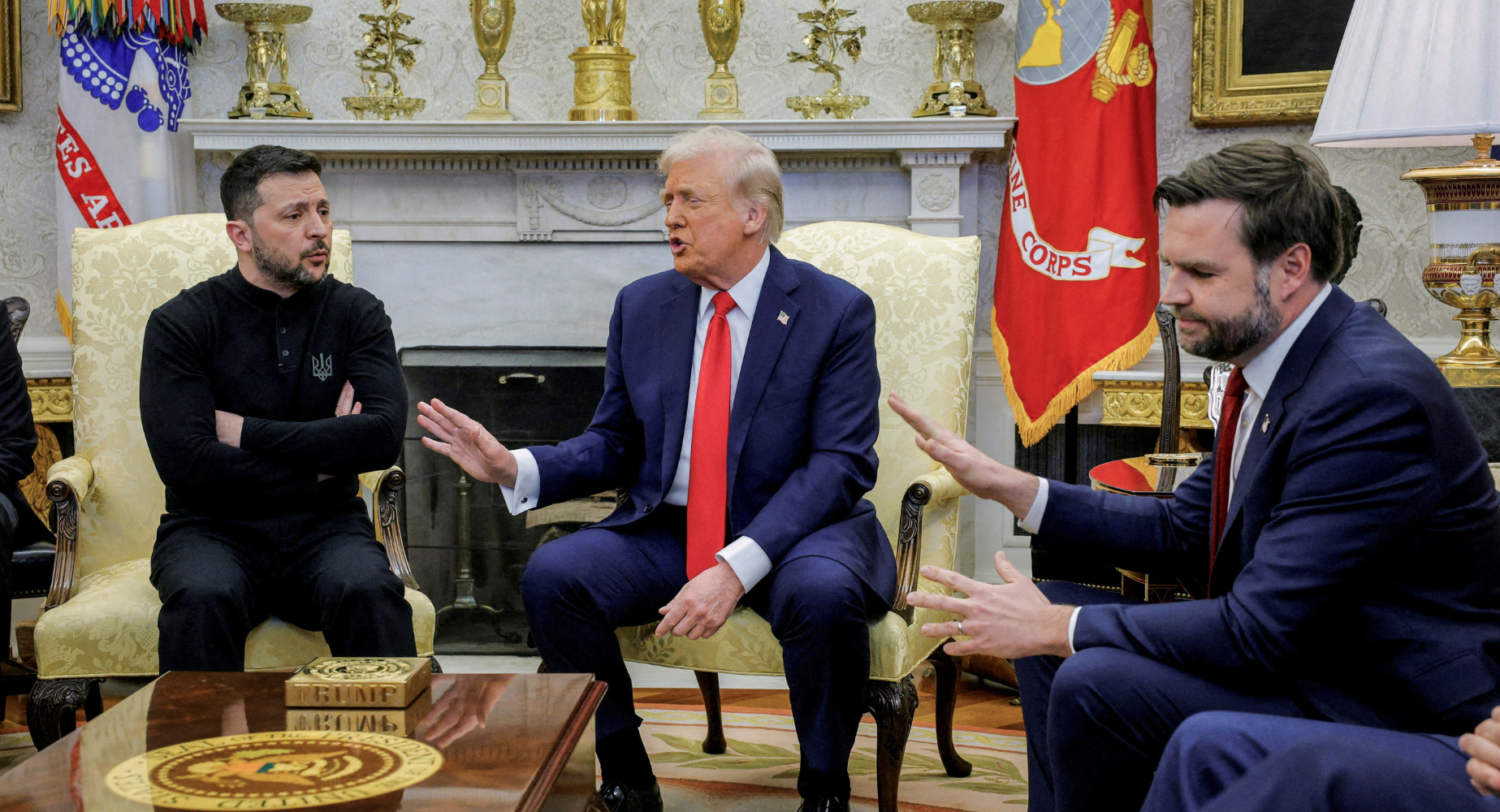
Toward Ukraine, even the prospect of success took hard diplomatic lobbying, a near-total replacement of direct U.S. military aid with authorizations for NATO purchases on Ukraine’s behalf, a proffered security guarantee in exchange for critical mineral rights, the stark realization that Europe cannot substitute for American power, and sharp public criticism of Zelensky for his recalcitrance. This included the infamous February 2025 White House confrontation where Trump and Vice President JD Vance bluntly told the Ukrainian president he was ungrateful and did not “have the cards” to win the war on his terms. But it was followed by a rehabilitation of Zelensky indexed to how convincingly he changed his attitude toward negotiations.
Toward Russia, Trump’s policy first involved expanding the U.S. sanctions regime to their highest-ever levels and then scaling them back – recently almost fully – in exchange for Moscow’s newfound willingness to engage in meaningful and direct negotiations with Ukraine for the first time in four years. Prospective trade agreements and joint economic deals have sweetened the pot. Critics have harped on Trump for “giving away too much,” but the fact remains that bilateral relations are back and will likely remain in place.
The negotiating positions remain far apart and still involve outstanding terms that may or may not be resolved soon. But within and because of the rubric of Trump’s strategy, in late 2025 the Ukrainians gave up on the 1991 borders and agreed to freeze the conflict along the current frontline, which would leave about 90% of the Donbas in Russian hands. For its part, Russia appears to have given up on total conquest of Ukraine and now agrees in principle to freezing the conflict along a modified front line, subject to agreed limits on Ukraine’s military power, Western alignment, and real or perceived anti-Russian cultural policies. Ukraine’s negotiators left the recent Abu Dhabi talks saying that the war’s end may well be in sight.
As the late realist Henry Kissinger predicted in the first days after Russia’s invasion in 2022, the war’s likeliest resolution would be an imperfect peace settlement that nobody really finds satisfactory – one might say the least bad option in a world of bad options. He later speculated that the settlement would involve some transfer of Ukrainian territory to Russia and some give-and-take from Moscow on the nature of Western security guarantees to Kyiv. Whatever the ultimate resolution may be, Trump’s realist approach has moved the ball forward and may yet get it into the end zone.