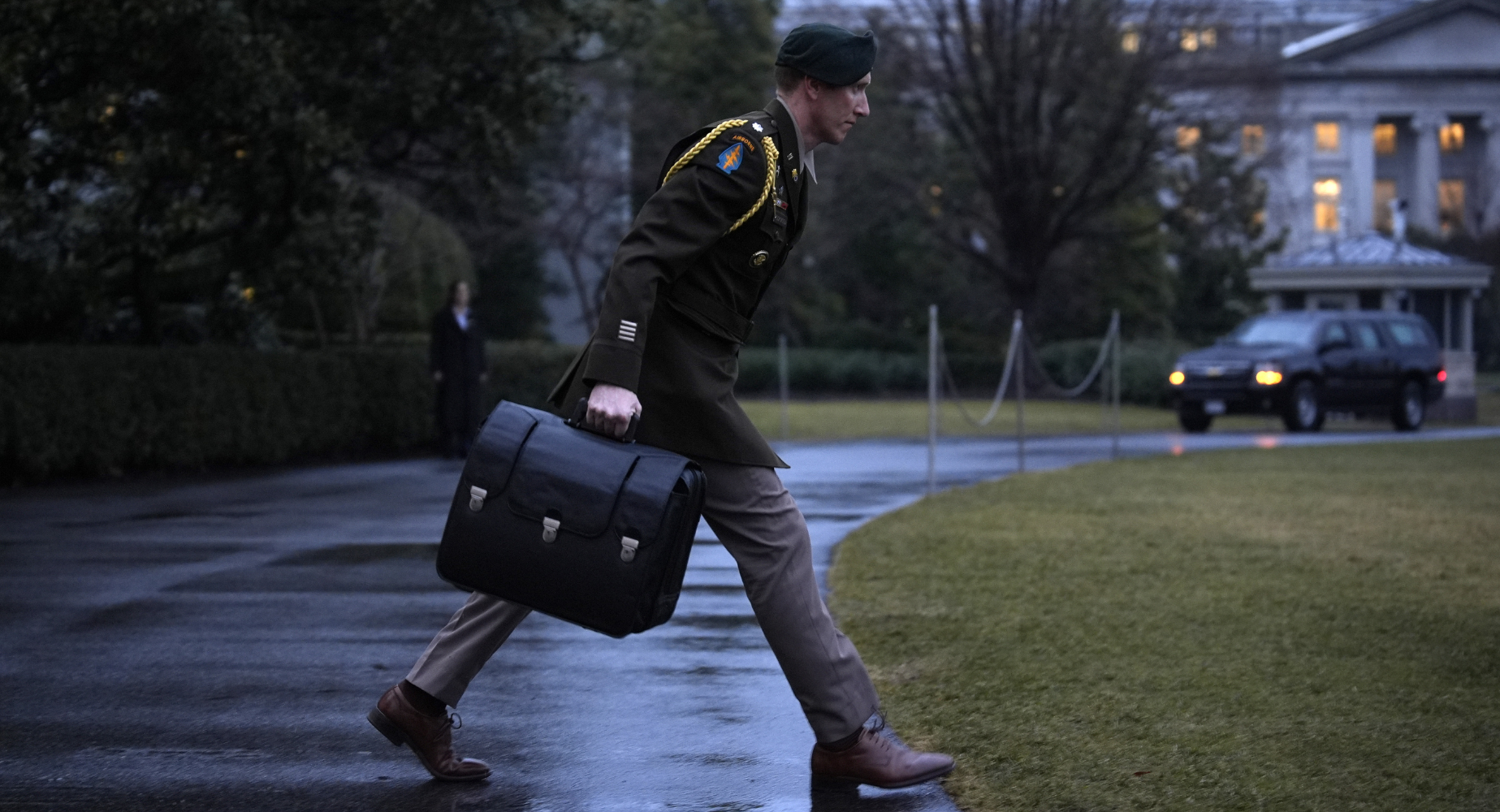
With an executive branch now declaring it obligatory to follow presidential military orders without hesitation and threatening to prosecute American military personnel for respecting relevant law (the Uniform Code of Military Justice), it is high time to ask the most urgent question: “What if America’s designated military commanders receive a bewildering, incoherent or manifestly illegal order from President Trump to launch nuclear weapons? For anyone who keeps up with the daily news, this is no longer a ridiculous or contrived scenario.
Notwithstanding the postwar judgments at Nuremberg concerning “superior orders” (authoritative judicial decisions that require all combatants to disobey unlawful orders), it is plausible that this president could at some point demand his “Secretary of War” and other chain-of-command subordinates to initiate nuclear war scenarios. Though any such demand could be impermissible on its face, Trump, Hegseth and certain others would likely label any associated disobedience as “treason.” Can anything still be done to prevent such literally intolerable scenarios?
As an academic specializing in strategic and jurisprudential matters for more than half a century, I first began to think about nuclear command decisions as a generic rather than US-specific problem. To be more precise, while working on an early “nuclear book” in the mid-1970s, I reached out to retired General Maxwell D. Taylor. On 14 March 1976, in response to my query regarding presidential debilities and unlawful orders, the former Chairman of the US Joint Chiefs of Staff offered authoritative answers.
Most noteworthy in his handwritten letter (attached hereto) was a warning about presidential irrationality. In the closing paragraph, Taylor cautioned, such irrationality would best be dealt with during the election process. Any potentially unstable presidential candidate who had managed to get elected could pose an unprecedented and “apocalyptic” problem.
What does this have to do with current presidential disfigurations of humanitarian international law? What is the determinable legal situation regarding questions of superior orders? Among other things, the legality of a presidential order to fire American nuclear weapons could depend on whether it concerned a “first use?”
There are many interrelated details. Codified protections against unauthorized firings are already built into any presidential order concerning nuclear weapons. These protections include multiple and substantial redundancies. Still, virtually all such mutually-reinforcing safeguards – including “psychological reliability” assessments – would become operative only at lower (sub-presidential) nuclear command levels. Significantly, these safeguards do not apply to the Commander-in-Chief, that is, to the elected President of the United States or to any cabinet-level official in the assigned chain of command.
Derivative meanings are straightforward. In both law and practice, there exist no readily decipherable grounds to determine the legality of a presidential order to use nuclear weapons. Inevitably, the codified military obligation to disobey an unlawful order would be shrouded in uncertainties. While certain senior personnel in the chain of command could at some point choose to invoke “Nuremberg Rules” (i.e., the universal obligation to disobey an unlawful order), any such time-urgent invocation would “reasonably” be rejected.
Ironically, the Trump administration’s defiling campaign against the refusal of unlawful orders (a campaign being waged against such American military heroes as former astronaut, Senator Mark Kelly) could precipitate a full-blown nuclear war. To wit, if US President Donald Trump were ever to order an American nuclear attack ex nihilo, i.e., as a “bolt-from-the-blue,” only chain–of-command willingness to reject an unlawful order could prevent an atomic holocaust.
There is more. If an American president operating within the chaos of his own making should issue an irrational or seemingly irrational nuclear command, the only way for the Secretary of Defense, the Chairman of the Joint Chiefs, the National Security Adviser and several possible others to obstruct this order would be problematic. Under the best circumstances, informal safeguards might manage to work for a time, but accepting a “best case scenario” on such existential issues could never represent a sensible approach. It follows, inter alia, that Americans ought promptly to inquire about more reliable institutional impediments to a potentially debilitated and persistently law-violating US president.
On such unique matters, the US will need to navigate in uncharted waters. While President Kennedy engaged in personal nuclear brinkmanship with the Soviet Union’s Nikita Khrushchev in October 1962, he allegedly calculated the odds of a nuclear war as “between one out of three and even.” This seemingly precise calculation, corroborated both by JFK biographer Theodore Sorensen and by my own later private conversations with former JCS Chair Admiral Arleigh Burke (my acquaintance, colleague and roommate at the Naval Academy’s Foreign Affairs Conference of 1977) suggests that President Kennedy was either genuinely irrational in imposing his Cuban “quarantine” or acting out variously-untested principles of “pretended irrationality.” In any event, JFK operated with the assistance of serious and capable strategic advisors. He did not transform the Department of Defense into the “Department of War.”
The most perilous threat of a U.S. presidential order to use nuclear weapons would flow not from any “bolt-from-the-blue” nuclear attack – whether Russian, North Korean or Chinese – but from a unique and uncontrollable process of escalation. Back in 1962, when Nikita Khrushchev “blinked” early on in the “game,” the Soviet premier prevented mutually irrecoverable nuclear harms. Now, however, certain escalatory initiatives undertaken by US President Trump could express incoherent and destabilizing decision-making processes.
Above all, Americans should meaningfully understand the grave risks of being locked into an escalatory dynamic from which there could be no choice apart from abject capitulation or nuclear war. Though this American president might still be well advised to seek “escalation dominance” in selected crisis negotiations, he would simultaneously need to avoid any catastrophic miscalculations. For the moment, prima facie, there is little cause for optimism about meeting this incomparably important obligation.
At one time or another, nuclear strategy is a “game” that Donald Trump will have to play with tangible intellectual underpinnings. To best ensure that his strategic moves will be rational, thoughtful and cumulatively cost-effective, it could be necessary to enhance the formal decisional authority of this president’s most senior military subordinates. At the same time, on the basis of what is already known about these figures, it is clear that the Secretary of Defense, Chairman of the Joint Chiefs of Staff, National Security Advisor and one or two others in nuclear command positions could at some stage become an integral part of the national survival problem.
Current arguments about disobeying unlawful orders are not directly related to issues of nuclear command authority. Nonetheless, the obligation to disobey unlawful orders is rooted in both national and international law and could at some point affect nuclear or pre-nuclear crises. Earlier, assorted legal writers had rejected the plea of “superior orders” as a defense against any pertinent charge of war crimes. Ironically, the German Code of Military Law operative during World War II declared that every soldier executes all orders undeterred by fear of legal consequences, but that this obligation would not excuse him in such cases where he “must have known” the order to be illegal.
This continuously-valid view was upheld by a landmark 1921 decision of the German Supreme Court in Leipzig. Accordingly, any subordinate who obeyed the order of a superior officer was liable to punishment if it had been known to him that the order contravened international law. Later, the defense of “superior orders” was rejected at the Einsatzgruppen Trial conducted by American military tribunal. Said the tribunal: “The obedience of a soldier is not the obedience of an automaton. A soldier is a reasoning agent. It is a fallacy of widespread consumption that a soldier is required to do everything his superior officers order him to do. The subordinate is bound only to obey the lawful orders of his superior.”
An American presidential order to fire nuclear weapons could represent the ultimate test of law-commanded disobedience. How such a scenario would actually play out is logically beyond any pre-crisis prediction or understanding. And yet, to ignore this narrative’s critical significance could ultimately express the most unforgivable failure of US citizen responsibility. Recalling General Maxwell Taylor’s letter to me of March 14, 1976 (attached hereto), the best protection against an irrational American president is “not to elect one.”