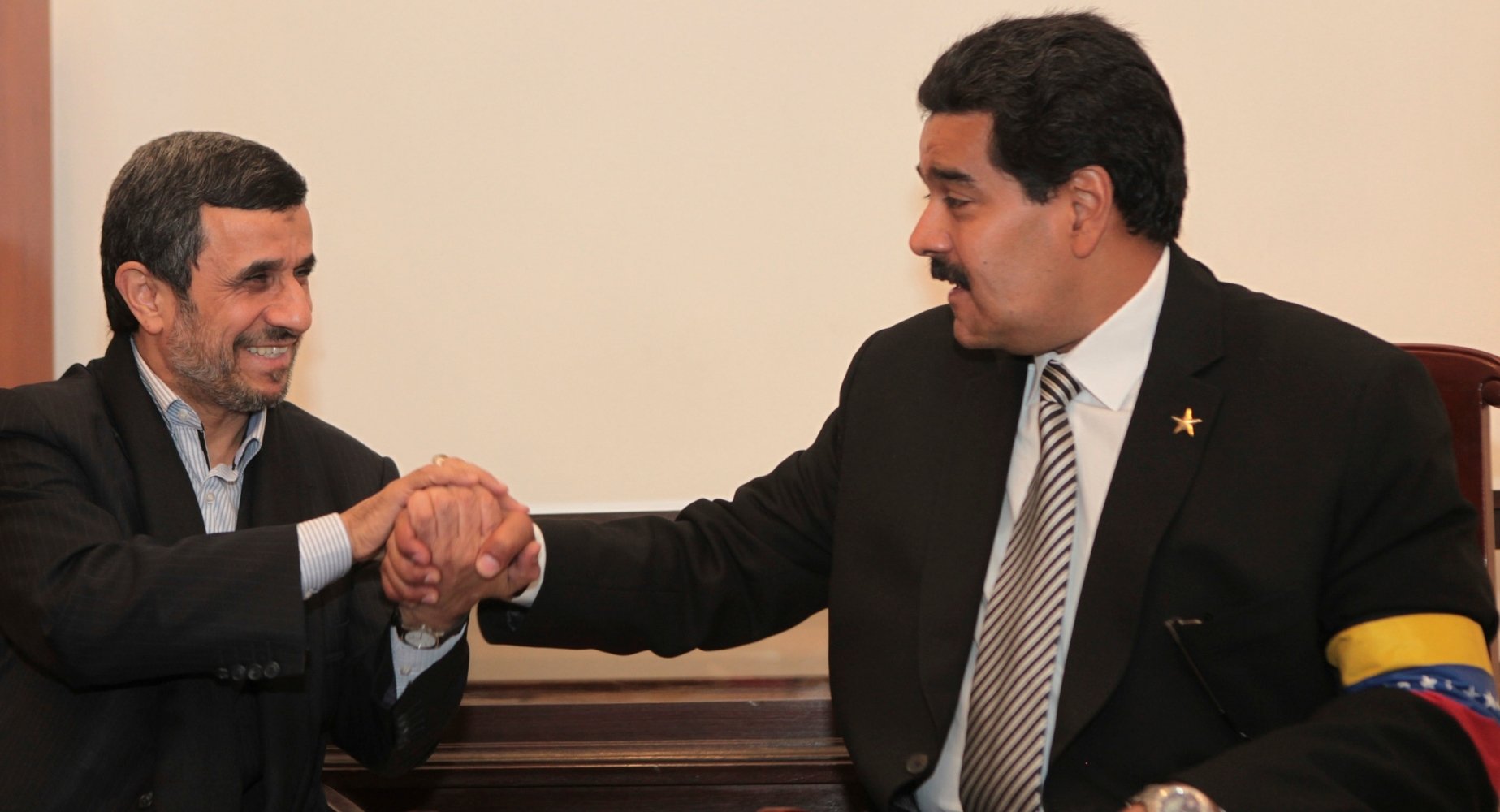
In May, The New York Times reported that Iran’s former president, Mahmoud Ahmadinejad, had allegedly been recruited by the United States and Israel to assume power if the Iranian regime was toppled.
Ahmadinejad has long had a troubled relationship with the Iranian establishment. He publicly accused senior regime figures of corruption, was later barred from running for president, saw several of his aides arrested, and was eventually placed under house arrest.
His resentment towards the regime raised the possibility that someone like him — a figure emerging from within the system but estranged from it — could be used to lead a transitional government. What the Trump administration, and perhaps the Israelis, appear to have envisioned was a variation of the Venezuelan model: placing a regime insider or former regime figure at the center of an attempted political transition as a first step toward regime change.
According to Israeli journalist Ronen Bergman, Ahmadinejad was fully aware of the plan to place him in power following the collapse of the regime.
Reports also claim that Israeli forces bombed Ahmadinejad’s residence, killing guards assigned to monitor him in an apparent attempt to free him from house arrest. Ahmadinejad was reportedly injured and has not been seen publicly since.
Apparently, Ahmadinejad later backed away from the plan.
Some observers, such as Behnam Ben Taleblu of the Foundation for Defense of Democracies, have expressed skepticism about the report itself, arguing that Ahmadinejad was among the most radical presidents Iran has ever had. Indeed, Ahmadinejad was a fierce antisemite who openly called for the destruction of the State of Israel, denied the Holocaust, and enthusiastically advanced Iran’s nuclear program.
Yet neither the United States nor Israel denied The New York Times report, which suggests that there may be at least some truth to it.
The first question, then, is why Ahmadinejad ultimately backed away from the plan. There is no clear answer, but it is reasonable to assume that someone like him — a man who built his entire political career within the Islamic Republic, who represented the hardline wing of the regime more aggressively than any president in the last three decades, and who even aspired to higher office — could never fully cooperate with the very powers he had spent his life opposing.
Indeed, Ahmadinejad emerged politically from the revolutionary milieu that shaped the Islamic Republic after 1979. He was associated with the student movement involved in the takeover of the American embassy in Tehran during the hostage crisis. Even if reports are correct that Ahmadinejad himself opposed the embassy takeover , the student organization with which he was affiliated became one of the regime’s foundational ideological pillars.
For someone so deeply shaped by the ideology and mythology of the Islamic Revolution, collaborating openly with the United States and Israel in a regime-change project may ultimately have been politically, psychologically, and ideologically impossible.
Whatever the explanation for why Ahmadinejad reportedly distanced himself from the alleged plan to help topple the Iranian regime, this would not be the first time the United States has faced similar situations involving attempts to rely on internal regime actors during a transition strategy.
A comparable case can be seen in the April 30, 2019 attempt to destabilize the government of Nicolás Maduro in Venezuela, commonly referred to as “Operación Libertad” (Operation Freedom). The effort involved opposition leader Juan Guaidó and relied, according to multiple reports, on anticipated defections or cooperation from senior figures within the Venezuelan state apparatus.
Among those frequently mentioned in reporting and leaks were Maikel Moreno, president of the Supreme Tribunal of Justice; General Vladimir Padrino López, Minister of Defense; Iván Hernández Dala, head of Directorate General of Military Counterintelligence (DGCIM);and General Manuel Cristopher Figuera, director of the Bolivarian National Intelligence Service (SEBIN).
Despite expectations that elements within the state might shift allegiance, the majority of the armed forces and key institutions ultimately remained loyal to Maduro, and the attempt failed to produce a decisive break within the regime.
According to then- U.S National Security Adviser John Bolton, key figures such as Vladimir Padrino López, Maikel Moreno, and Iván Hernández Dala ultimately remained loyal to Nicolás Maduro at the decisive moment. On April 30, 2019, Juan Guaidó — who at the time was recognized by the United States and several other governments as Venezuela’s interim president — appeared near the La Carlota air base in Caracas alongside a small group of armed personnel who had defected under the orders of Cristopher Figuera.
From that location, Guaidó publicly called for a military uprising, framing it as the “final phase” of “Operación Libertad.” In a short video message, he urged members of the armed forces to act in defense of the Venezuelan constitution and to join what he described as a democratic transition. However, despite expectations that additional military units would join the effort, widespread defections did not materialize. As anticipated reinforcements failed to appear, the momentum of the operation quickly dissipated, and Cristopher Figuera ultimately withdrew from the scene.
What can we learn from the failed April 2019 attempt to remove Nicolás Maduro in Venezuela?
When external actors such as the United States—or, in some interpretations, Israel or other allied powers—attempt to facilitate regime change by cultivating insiders within an authoritarian system, they face two fundamental risks.
First, those insiders may deliberately mislead external interlocutors, acting as double agents who exploit foreign interest to extract concessions, gather intelligence, or improve their bargaining position within the regime. Second, even in the absence of deception, potential defectors may ultimately be driven by fear: fear that the plot will fail, fear of exposure, and fear of severe punishment. Under such conditions, individuals who appear willing to defect may hesitate at the critical moment and ultimately retreat, thereby undermining the entire operation.
The events surrounding April 30, 2019 in Venezuela illustrate this dynamic clearly. Expectations of a rapid cascade of elite defections did not materialize, and key institutional actors ultimately remained loyal to the Maduro government. As a result, the operation collapsed.
In my view, part of the problem lies in a tension between cynicism and optimism in external planning. On one hand, there is an assumption that insiders may betray their regime if offered sufficient incentives or guarantees. On the other hand, this assumption can become overly optimistic when applied to actors deeply embedded in authoritarian structures—particularly in ruthless regimes that rely heavily on coercion, patronage, and ideological loyalty.
In such contexts, it is often unrealistic to assume that individuals who have risen through, benefited from, and been shaped by the system can easily detach themselves from it, especially when the risks of failure are existential.
To be sure, the case often associated with Delcy Rodríguez in Venezuela should not be interpreted as a straightforward story of democratic transition or successful reform. While there have been reports of limited economic liberalization measures, particularly in the oil and energy sector, these changes have not fundamentally altered the country’s political structure. The regime’s core institutions remain intact, and the broader patterns of authoritarian governance associated with the Chávez and Maduro era continue to shape political life.
Although some reforms and administrative reshuffling have been reported within the governing elite, there is no clear evidence of a systemic transformation of the state or a decisive break with established power networks. Similarly, while there have been periodic releases or exchanges of detainees reported in the context of negotiations and policy adjustments, significant concerns remain regarding the continued existence of political imprisonment and the broader restrictions on civil and political rights.
Overall, despite tactical adjustments in economic policy and governance, the underlying structure of authoritarian control and institutional continuity appears largely unchanged.
It is difficult to imagine that a figure such as Mahmoud Ahmadinejad would fully abandon the ideological framework within which he built his political career and become a genuine agent of transition away from the Islamic Republic. This expectation reflects a mixture of cynicism and naïveté.A similar skepticism applies to current or former regime insiders such as Mohammad Bagher Ghalibaf, a former commander in the Islamic Revolutionary Guard Corps Air Force and a long-standing establishment figure. The assumption that such actors could be persuaded to negotiate pragmatically with the United States and also accept concessions such as the dismantlement of Iran’s nuclear program underestimates the depth of institutional commitment and ideological socialization of the regime.
From this perspective, there is a need for a more realistic assessment of those rogue regimes that we seek to transform. Perhaps the military option needs to be reconsidered. If such possibility is too much of a burden on the U.S, Israel should be given a green light to do it alone.