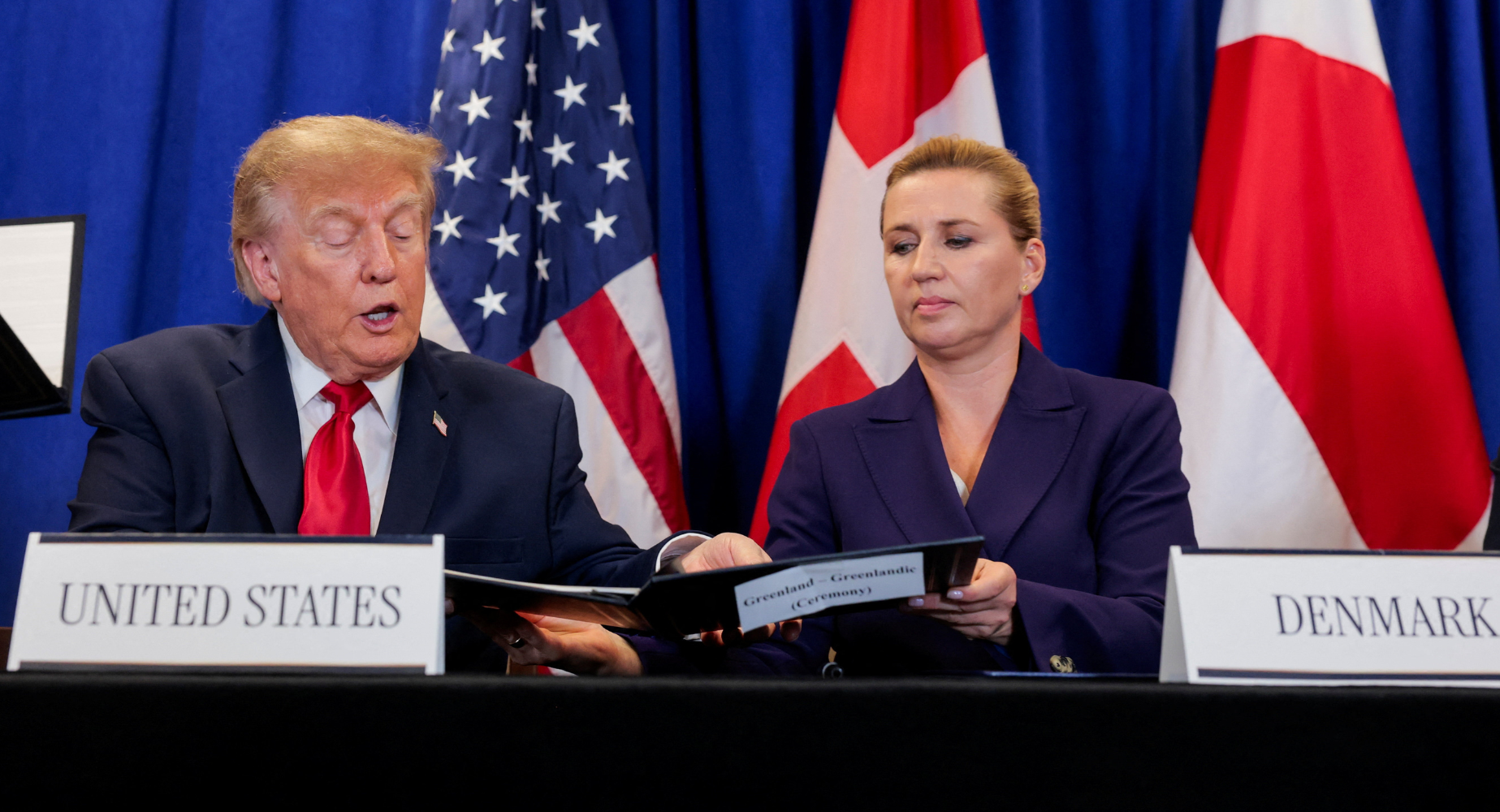
The signing of the Greenland agreement in New York on 22 September was, on the surface, an extraordinary moment of reconciliation. Donald Trump, Danish prime minister Mette Frederiksen and Greenland’s prime minister Jens-Frederik Nielsen stood together at the United Nations and signed an agreement that formally recognizes the sovereignty of the Kingdom of Denmark and Greenland’s right to self-determination.
“With this agreement, it is our estimate that the Kingdom of Denmark is at a better place than we were yesterday,” said the Danish leader after the signing.
Frederiksen called it a good agreement for Greenland, Denmark, the United States, NATO and Europe.
After the midterm elections
The American midterm elections of 3 November have added a new dimension to this question. In a striking rebuke to Donald Trump, the Democrats won control of both the House of Representatives and the Senate, ending the Republicans’ control of Congress. From January 2027, Trump will therefore face a legislature controlled by the opposition for the remaining two years of his presidency.
For Denmark and other European allies, the result may offer some reassurance. It demonstrates that American voters are still capable of imposing a political price on a president whose conduct has alienated important parts of the electorate. A Democratic Congress may also provide a more effective check on presidential power, through legislation, budgetary control and congressional oversight.
But it would be a mistake to interpret the result as an immediate restoration of transatlantic confidence. The election was fought primarily over domestic concerns, including the cost of living, inflation and dissatisfaction with the administration. It was not a referendum on America’s relationship with Europe, nor did it produce a mandate for a fundamental reversal of Trump’s foreign policy.
Indeed, according to AP Secretary of State Marco Rubio has made clear that the administration’s foreign policy will not change as a result of the Republican losses. The president remains the central decision-maker in this field. For Copenhagen, this is a crucial distinction. A change in the balance of power in Congress may constrain Trump, but it cannot guarantee that the United States will once again behave as the predictable ally Denmark has traditionally regarded it as being.
This is an important part of the Danish considerations regarding the Greenland issue.
A Real Crisis
The Danish-American dispute started in August 2019 when The Wall Street Journal reported that Trump had been discussing with his advisers the possibility of actually buying Greenland. That lead many Danes to think of 1917, when Denmark sold the Virgin Islands to the U.S. for $25 million in gold coin. But that was a very different case. The islands in the West Indies were a colony, and the sale took place as a negotiated purchase and after a referendum where 64.2 percent of the Danes voted in favor.
As opposed to this, Greenland is part of the Kingdom of Denmark, although the Greenlanders have extensive self-government. Mr. Nielsen’s correct title is chairman of Naalakkersuisut – the Greenlandic term for government. But still he played a very central part in the crisis that worsened considerably on 22 December 2024, when Trump, as president-elect, declared that “the ownership and control of Greenland is an absolute necessity” for US national security.
The affair now became a real crisis. According to a poll, made for Danish State Television in January 2025, 60 percent of Danes described the United States as an adversary, while only 17 percent still regarded it as an ally. This was after Trump had repeatedly refused to rule out the use of force.
In January 2026 Trump began presenting the dispute less as a question of actually acquiring Greenland and more as a matter of American security control over the island. At Davos in January he suddenly ruled out the use of force and said that he and NATO Secretary General Mark Rutte had developed the framework for a deal. Reuters reported that this led to negotiations over an update of the existing 1951 US-Danish defense agreement.
Is the US an ally?
Seemingly the dispute has settled down, but according to Danish thinking, an agreement is not the same thing as trust.
For Denmark, that distinction is particularly important. The Greenland crisis was not a conventional disagreement between two allied governments. For almost two years, Trump repeatedly spoke of acquiring Greenland and, at times, refused to rule out the use of military force. The object of his ambitions was not an abstract piece of territory but an autonomous part of the Kingdom of Denmark. The crisis therefore touched something unusually fundamental in Danish foreign policy: the assumption that the United States was not merely Denmark’s most important military ally, but also a country whose intentions could ultimately be trusted.
That assumption has been badly shaken.
A YouGov survey conducted in January, at the height of the Greenland crisis, found that 84 per cent of Danes had an unfavorable view of the United States, compared with 70 per cent just two months earlier. Even more strikingly, only 26 per cent regarded America as either an ally or a friendly country, compared with 80 per cent in 2023.
Another Danish survey, conducted for DR, Denmark’s public broadcaster, at roughly the same time, produced an even more dramatic picture: 60 per cent of respondents described the United States as an adversary, while only 17 per cent still regarded it as an ally.
These figures matter because Denmark has traditionally been one of America’s unusually close European partners. Danish soldiers have fought alongside American forces, Denmark has participated in American-led military operations, and Greenland itself has been an important element in American defense strategy since the Second World War. The relationship was not merely diplomatic. It was deeply embedded in Danish security thinking.
The September agreement has not dismantled that relationship. On the contrary, it considerably strengthens the American military position in Greenland. The United States will be able to modernize and expand its activities at Pituffik Space Base – previously known as Thule – and establish additional defense areas at Narsarsuaq and Mestersvig. The agreement also provides for the possibility of further American defense areas, subject to consultation and mutual agreement.
In other words, Denmark has not responded to the Greenland crisis by pushing America out of the Arctic. It has done almost the opposite: it has negotiated a more clearly defined American military role, but within a framework in which Danish and Greenlandic sovereignty is explicitly affirmed.
That may be the central paradox of the agreement.
Denmark still needs the United States. The strategic importance of Greenland has not diminished because of Trump’s behavior. If anything, the Arctic has become more important. Russia’s military presence, China’s growing interest in the region and the opening of new Arctic Sea routes mean that Denmark has a strong interest in maintaining American and NATO capabilities in Greenland. Danish Defense Minister Jeppe Bruus has already said that Copenhagen expects an increased NATO presence in Greenland and the Arctic to continue beyond the immediate crisis.
But strategic necessity does not automatically produce political trust.
Indeed, the new agreement can be read as an attempt to replace personal trust with institutional safeguards. The document is remarkably explicit about sovereignty, territorial integrity, Greenlandic self-determination and the conditions governing American military activity. It is also designed to survive a possible future independence of Greenland: an independent Greenland would be expected to remain within NATO and assume the relevant obligations of the agreement.
That is significant. Copenhagen and Nuuk are not simply taking Trump’s word for it. They are attempting to make the relationship less dependent on the personality of whoever occupies the White House.
This may be one of the most important lessons of the Greenland crisis.
For decades, Danish foreign policy could afford to treat the American alliance almost as a given. The United States was the indispensable military power in Europe; Denmark was a small but loyal NATO ally. Trump changed the psychological equation. He demonstrated that an American president could regard the territorial integrity of another NATO member as a matter open to negotiation — and could use public pressure, threats and economic leverage to pursue that objective.
The fact that the crisis has now ended with a negotiated agreement does not erase what happened before it.
Greenlanders appear to feel this distinction particularly strongly. The relief following the agreement has been substantial. Greenland’s leadership has described the deal as an important recognition of its right to self-determination, and celebrations followed the return of the negotiating team to Nuuk. But Reuters also reported continuing scepticism among Greenlanders. One local mayor put the problem succinctly: signing an agreement does not mean that trust has immediately returned; trust has to be rebuilt.
The same may ultimately be true in Denmark.
There is, therefore, a difference between working with Trump and trusting Trump. The Greenland agreement shows that Denmark can do the former. It does not yet demonstrate that the latter has been restored.
Strategic Capabilities
As seen from Copenhagen, moreover, there is no guarantee that the Greenland question has been permanently settled. Even after the September agreement, Trump has continued to speak as though the United States had effectively acquired the island. During the November midterm campaign, he repeatedly claimed that America had “got Greenland”, while the White House described the agreement as securing permanent American security control over the territory. This is not how Copenhagen and Nuuk interpret the document. The distinction may appear semantic, but it points to a fundamental disagreement over what the agreement actually means. As the new American defense arrangements are implemented, disputes over their scope and interpretation could easily bring Greenland back into the center of transatlantic politics.
And there is a certain irony in this. Trump set out to demonstrate American power over Greenland and Denmark. Instead, the crisis has encouraged Denmark and Greenland to strengthen their own strategic capabilities, brought greater European attention to Arctic security and forced the transatlantic relationship onto a more explicit contractual footing. The United States retains an important and potentially expanded military role in Greenland, but the price is that its Danish and Greenlandic partners have become considerably more cautious about the assumptions underlying that relationship.
The question facing Denmark is therefore not whether it will continue to cooperate with America. It almost certainly must.
The more difficult question is whether Denmark can once again take American reliability for granted.
The Greenland agreement provides a framework for cooperation. It provides security arrangements, military access and explicit recognition of sovereignty. What it cannot provide is something that no treaty can manufacture overnight: confidence that the United States will not again turn against the territorial interests of one of its closest allies.
That confidence will have to be earned over time.
For Denmark, the Greenland crisis may consequently prove to have marked the end of an old certainty. America remains an ally. But the era in which Danish policymakers could assume that American power and Danish interests would naturally point in the same direction has become much harder to sustain.
The agreement may have closed the Greenland crisis.
It has not yet closed the question of trust.