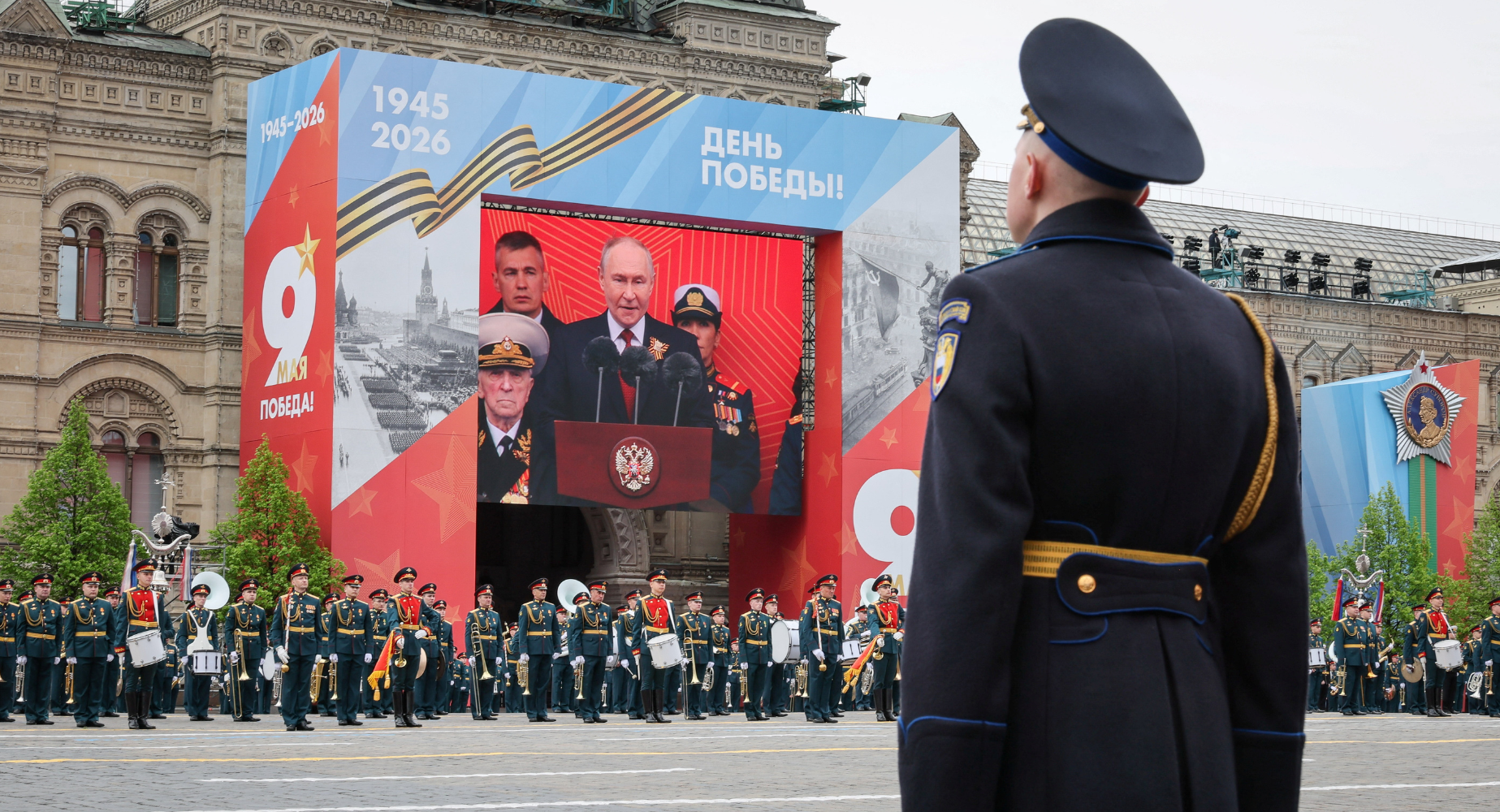
On February 24 Vladimir Putin began the fifth year of his disastrous war against Ukraine. It has sacrificed a million men killed or wounded in order to gain a fragile hold on only a fifth of Ukraine’s territory. It has crippled Russia’s flagship energy industry, depleted the National Wealth Fund and impoverished the Russian countryside, meanwhile crystalizing Ukraine’s national identity and transforming the country into a major producer of advanced military hardware. It has led to the expansion of NATO by two members, the doubling of the length of Russia’s border with NATO countries, and the sharpest increases ever in defense spending by NATO members. American pundits, who treat it as a high school football game, debate over who is winning and losing. But retired Russian generals, commentators on Moscow’s state TV, prominent members of Russia’s parliament (Duma), and ultra-patriotic “Z bloggers” have all declared not only that Russia has lost the war but that it is in danger of destroying itself in the process. Finland’s cautious and understated president, Alexander Stubb, calls the war “an utter strategic failure.”
THREE UNRESOLVABLE CHALLENGES
How does this defeat affect Russia’s future? Most commentators frame the question in terms of the personal fate of Vladimir Putin. Some note that he has already outlived the average Russian male by half a decade and is increasingly viewed by large segments of the public as an ancient who is out of touch. Yet at seventy-three he is in reasonably good shape. Hence, when change occurs at the top it is less likely that it will arise from Putin’s physical decay than from the accumulated impact of three intractable crises.
First, Russia has no money to maintain 2.4 million men in the military, yet to demobilize them would pose enormous social risks. A high percentage of the 1.3 million under arms are criminals and former convicts who were promised freedom if served at the front. Those who have already returned home are generating the major crime wave sweeping the country today. Hundreds of thousands of returnees who served under contract have yet to be paid. Desperate and embittered, they have turned to criminality.
Second, Russia’s demand for fresh capital is huge and insatiable. The war swallowed most of the funds needed to maintain basic infrastructures and services across the land. Outside of the three main cities domestic heating, water supplies, and building and road maintenance have collapsed. When several desperate governors complained publicly and pointed their finger at Moscow they were jailed. Meanwhile, Russian businesses that Putin ordered to retool to make drones, bombs, and other military hardware have no access to the major funds needed to convert back to making refrigerators and other civilian products. Elvira Naibiullina, the competent director of the State Bank, puts the crisis bluntly: Russia has blown through its financial reserves. It even lacks the funds needed to restore its crippled energy industry and will be in hock to whomever provides them, be it China, the Gulf states, or the U.S.
Third, Moscow is desperately short of the skilled and unskilled labor needed to restore the national economy. Russia started the war with a labor force of seventy-six million, which has now shrunk to seventy-two million. Close to 1.5 million men were lost through death or injury in Ukraine, not to mention the hundreds of thousands who fled at the start of the war. While some of these have returned, there are still three million Russians in Germany alone. These staggering figures pale by comparison with the demographic collapse that has been underway for a generation due to Russians’ exceptionally low rate of fertility. Overall, Russia’s population shrinks by one person every thirty seconds, leaving the labor force today barely two-fifths of that of the US.
The obvious solution to this demographic collapse is to welcome more immigrants. But Russia already hosts the world’s third largest number of immigrants, lagging behind only the US and Germany. Most of Russia’s newcomers being from Turkic and Muslim Central Asia, they pose what most Russians perceive as an ominous and grave cultural threat. An attractive alternative might be to embrace new labor-saving technologies so comprehensively as to reduce the demand for common laborers. Yet this is a will-o-the-wisp, as today’s Russia lacks both the money and skills needed to effect such a transformation.
MILITARY DEFEAT AND REFORM
Together, these are unavoidable features of Russian life today and will remain so with or without Putin. What, then, can we expect to happen to the country? Few analysts have addressed this question, important as it is. Back in 2023 a group of American, European, and Japanese analysts pondered Russia’s future and reached generally dark conclusions. Among them, Luke Coffey of the Hudson Institute predicted that several regions would secede, leading to great power competition over the entire territory; Pavel Baev of the Peace Research Institute in Oslo declared that Russia had reached a “dead end”; Paul Goble of “Window on Eurasia” predicted Russia’s fragmentation along ethnic lines; while Hiroyuku Akita, Nikkei’s respected commentator, predicted that Russia could evolve into a “giant North Korea,” resentfully dependent on China. A year later Stephen Kotkin of the Hoover Institution sketched out six possible lines of Russia’s future evolution, which he then reduced to five, ranging from vassalage under China to a kind of post-Algeria France but without a de Gaulle.
Surprisingly absent from these prognostications are the lessons of history. Whatever Putin may claim, Russia has already failed in its war against Ukraine and an ever-increasing number of Russians know it. This reality demands comparison with the three major military defeats suffered by armies of the Russian tsars since 1800. All present lessons of importance for Putin’s Russia. Thus, it was Russia’s defeat in World War I that led to the abdication of Nicholas II and the 1917 February Revolution. Alexander Kerensky proposed extensive reforms but continued the war, which opened the way for Lenin and the Bolsheviks. Only a dozen years earlier, imperial Japan destroyed Russia’s navy at Tshushima Bay, the first time an Asian state had defeated a European power. In an effort to recover from his humiliating defeat in the Russo-Japanese War Nicholas II grudgingly established Russia’s first elective national representative assembly and appointed the reformist but loyal Pyotr Stolypin as prime minister. Riding the wave of reform, Stolypin established the first unconditional right of peasants to own land. And three generations before Stolypin, Russia had suffered a humiliating defeat by France, Britain, Ottoman Turkey, and Sardinia in the Crimean War of 1853-1855. In that case the defeated tsar conveniently died, clearing the way for his thirtyseven year-old son, Alexander II, and an entirely new generation of reformers to take power. Not only did they abolish serfdom two years before Lincoln issued his Emancipation Proclamation but they established Russia’s first European-type courts and elective regional councils. Indeed, defeat in the first Crimean War led to what Russians still call their “Era of Great Reforms.”
While all three of these military defeats were accompanied by the loss of thousands of lives, the depletion of material and financial resources, and institutional exhaustion, they all led directly to important reforms. All the men who instituted the reforms had previously been loyal toilers within the system but whose experience led them to embrace change. In the most successful of these post-defeat reform projects—that of the Great Reforms—reform arose not from foreign pressure or a single leader but from an entire new generation of like-minded Russians. All three of these episodes of reform occurred because the old regime had played its last cards and was exhausted.
THE INEVITABLE TRANSITION: PHASE ONE
This brief historical review suggests two conclusions. First, regime failures can lead to change and reform with or without a change of the top leader. According to Russia’s constitution, if Putin were to be incapacitated or removed his successor would be the Prime Minister, Mikhail Misushtin, a respected economist and long-term head of the tax service. Thoughtful and respected, the mild-mannered and piano playing Misushtin would normally be an obvious candidate for a transitional role or more, were he not hindered by his Jewish origin and the constitutional demand for prompt elections. Even then, Mikhail Misushtin could emerge as everyone’s compromise candidate.
At that point there will be only two groups likely to exert a decisive role on the course of events: the Federal Security Service or FSB, successor to the KGB, and the captains of Russian industry. Why not also the military? Because the high command, discredited by its strategies in Ukraine, riddled by corruption, and narrowly focused on its own survival, will be sidelined. By contrast, the FSB will dedicate its ample resources to preserving the regime, whether or not it publicly controls events. This is natural, not only because Putin himself rose through the KGB’S ranks and relied on its help throughout his reign, but also because the KGB/FSB, having survived the collapse of the USSR, now views itself as the main guarantor of Russian continuity.
Meanwhile, Russia’s very survival will depend on the ability of its leaders to advance policies that will reverse the present downward economic spiral and begin to rebuild the country’s resources. For this task the key people will be Russia’s business elite. In the West it is customary to focus on the few dozen so-called “oligarchs” who, after the Soviet collapse, seized control of the country’s main industries and diverted the profits into their own pockets. They are still relevant. Not only do they have formidable resources and connections worldwide but they are for the most part still in their sixties, and therefore still able and willing to assume major national roles. Moreover, their numbers have been augmented by the emergence of somewhat younger business leaders in many fields, who have also done exceedingly well and are now keen to test themselves on the national stage. It is important that oligarchs of both the first and second wave have adroitly shifted as many of their resources abroad as possible.
The FSB, working with sympathetic members of Russia’s business elite and alienated military leaders, will surely play a key role in deciding Russia’s direction immediately after Putin leaves office. It is a fool’s errand to try to predict the direction of their efforts, or even to foresee the level of harmony or disharmony between the three forces. Yet some form of collaboration seems likely, for each needs the other: the FSB is positioned to take over but it needs a public face, the business elite seeks behind-the-scenes muscle, and bruised military leaders cannot alone save what’s left of Russia’s army.
What can be predicted with some certainty is that many core problems will remain unresolved and that such a condition of irresolution will impede Russia’s ability to gain favorable economic and political terms in its dealings with the major sources of capital worldwide. With or without Putin, some elements of the ideology he has championed, with its blending of Lev Gumilev’s Eurasianism and Alexander Dugin’s retrograde Orthodoxy, will linger on. Russian “Z bloggers” and other national zealots will continue to demand permanent control over Ukrainian territory. And in response to the chauvinism lingering in Moscow, Chechens and Ingush peoples in the Caucasus and some Turkic peoples in the Volga basin will demand independence, which will provoke a muscular response from whomever reigns in Moscow.
However the war against Crimea ends, it is highly unlikely that Russia’s leaders –with or without Putin– will solve these and other issues. At best they will remain in a state of semi-resolution. Meanwhile, Moscow will have to address its deepening dependence on China and China’s evident interest in expanding its economic and social presence in Russia’s East. It will be no simple matter to come up with other relations to balance this force, without making the kind of concessions to Europe that the FSB is unlikely to countenance. Meanwhile, Moscow will continue its plodding efforts to keep alive its own faltering answer to the European Union, the Commonwealth of Independent States. It is no simple matter to acknowledge the end of one’s empire.
Can any group of leaders last if faced with such formidable and incompatible challenges? More serious, can any regime do so if at the same time it is facing an acute and broad-gauged social crisis at home and is racked by crippling shortages of both capital and labor?
PHASE TWO: THE RISING GENERATION
Most efforts to conjure up the contours of post-Ukraine and post-Putin are static, like photographs. While sometimes brilliant in outline or detail, they tend to focus on the short term and to present only a single moment in time. As such, they are useless for anticipating longer-term developments and the strategies needed to manage them. In this context, let us try to ferret out some of the main forces shaping Russia’s longer-term future. The reason we must do so is that no arrangements designed to address the immediate problems besetting the country today are likely to be effective in addressing the issues that will dominate the future. Acknowledging that we lack the gift of prophesy, are there developments visible today that are likely to shape how Russia addresses the challenges of the future? Thoughtful observers will propose many answers to this question, but the one force that is both powerful and inevitable is generational change.
Why should this be the case? For one thing, the Putin generation and all those now over fifty have monopolized leadership roles since the start of the new century. As a result, whenever the inevitable crisis of generational leadership occurs, there is no large cadre of slightly younger but experienced leaders to step into their shoes. Russia is therefore likely to skip a generation, or at least to promote scores of men and women who are many decades younger than their predecessors were when they rose to power. Such a transition is likely to occur swiftly, far earlier than most today expect, and with a decisive impact.
Who, then, are Russia’s future leaders? One thing is for sure: we shall see the emergence of an emphatically post-Soviet generation of Russian men and women in leadership roles. Considering that Putin himself was almost forty when the USSR collapsed and that he is now in his third decade in power, the contrast between members of his cohort and their post-Soviet successors could not be greater, far sharper than any generational divide in the West. Beyond the rising generation’s lack of rooting in the Soviet era and addiction to new information technologies, it is members of that cohort who fought and died in the war and whose professional and personal lives have been most affected by it.
Those Russian men and women who will soon take charge of national life are by no means a homogeneous cohort. In fact, they consist of three quite different sub-groups: first, the upwardly mobile professional men and women in diverse fields who live in Moscow, St. Petersburg and Novosibirsk; second, the far more numerous men and women in smaller cities and towns across the land; and third, the 900,000 young Russians who fled the country in 2022 when Putin announced his war on Ukraine. For all the differences among them, they will emerge onto the national stage together, and with an impact that is as yet unknown but that will inevitably be consequential.
The hip young men and women of the capital cities view themselves as God’s anointed and conduct themselves accordingly. Lifted by relatively good salaries, they are competent, worldly and ambitious, yet very judicious in choosing with whom to associate and which causes to espouse. While there are a few outspoken souls among them, most of whom are quiet and prefer fashionable socializing to risky political engagements.
By careful design, very few of the million and a half million of Russian men who died or were disabled in the war came from the big cities. Most of these came from smaller centers or towns that were barely touched by the oil-fed boom that rolled on to 2011. This second group is composed of those who survived. Most cities with populations less than 100,000 actually lost population after 2010, which caused the number of jobs available to this group to plummet. Those not drafted were lucky if they found work in war-related industries but will be unemployed when the war ends. Their wives and young families are already suffering. Experiencing the decay of local life that resulted from the collapse of local budgets, young men and women of this group cannot help but compare their fate unfavorably with those only a few years older, and their own poverty with the comforts of their undrafted contemporaries in the largest cities. It is no wonder that millions of such young people came to despise the war and anything related to it, and today harbor deep resentments that have yet to be fully aired publicly.
A much smaller yet very important segment of the rising generation is comprised of the 900,000 young men and women who fled Russia in 2022-2023 and the smaller number who departed thereafter. There were certainly many draft dodgers and scammers among this third group, but there were also large numbers of engineers, rock stars, computer programmers, and architects among those who fled. Some have settled permanently abroad, but the war’s end will doubtless bring a flood of returnees, who will bring with them important skills, international contacts, and expectations that have been fanned by their experience abroad. Prominent among them will be political activists and pundits from many fields, who have been meeting abroad and have formed networks of like-minded people both abroad and in Russia itself.
BUILDERS OF THE NEW RUSSIA
This successor generation will come to power on the heels of a defeated and discredited regime. Its members will pick over the ruins of the Putin era, saving what they consider worthy and discarding the rest. Both the differences and the commonalities among these three segments in the rising generation are bound to affect Russia’s politics. While it is far too early to predict, it is more than likely that the sheer numbers of those who stayed home in smaller cities and towns and who suffered far the greatest number of wartime casualties will cause that group to demand higher taxes on wealth, fiscal decentralization, and both local and regional self-government. It would be surprising if they do not champion some kind of socialist populism. Those who have lived and worked abroad may claim central roles in international investments and foreign relations generally, while it is safe also to assume that many of those already active in the major cities will demand that the government not interfere with their enterprises or impose crippling taxes on them. However, both groups will have to reckon with the passion for decentralizing populism that prevails every beyond the three or four major cities. At the same time, members of all three groups will likely view the ideology and chauvinist harrumphing of the Putin era with revulsion, and will delay years before embracing any new national ideology.
Obviously, we can only speculate on how members of the successor generation in Russia will view their country’s place in the world. However, we can be sure that any arrangements regarding Ukraine, Russia, and the West that Putin or his immediate successors make today are bound to be temporary. Not only are Putin, his team, and his generation all long in the tooth but their eyes are focused on the rear-view mirror, saving what they can of their dignity after a bold initiative that went badly awry. We should therefore not expect great discontinuity in Moscow’s first steps to end the war and beyond, but we can be confident that they will be temporary and that more fundamental shifts will soon follow. These will be driven by the diverse members of the rising generation whose members have either been neglected by national policy or exploited as cannon fodder. They will likely reject Putin’s fantasies of imperial leadership and the martial pomp that accompanied it, just as their forebears turned their backs on the empty pomposity that preceded and accompanied the Crimean catastrophe of 1853-1855. No one knows whether or how long such a period of relative openness and reform will last, or whether or when it might be followed by a new phase of imperial conquest and domestic repression.
A WESTERN RESPONSE
Whatever the longer-term prospects, Russia’s disastrous war on Ukraine has created the potential for a period of reform and renewal in Russia. How should the United States and Europe respond in the present? In the short run they will still be dealing with Putin or members of his circle. They should have learned by now that Putin respects only armed might, and that no deal with his team will provide more than a pause in the battle. It is therefore imperative for NATO to continue to support Kyiv militarily as its forces grind down Russia’s willingness and ability to sustain the war. When more serious negotiations finally begin, the western partners should bear in mind that a successor generation is on the lip of power in Russia and that they should therefore not “hand away the store” beforehand. A resolute and unhurried negotiating posture, combined with quiet outreach to the rising generation of Russians, will hasten the inevitable transition in Moscow. Only this promises the kind of long-term settlement and peace that Ukraine, Europe, and America all seek.
Younger Russian men and women are already exploring paths to their future and bring to that task a far deeper understanding of the world than their predecessors. Their grasp of modernity embraces the West, while also taking sober cognizance of China, India, Asia, and the Middle East. Americans and Europeans should engage with them as colleagues, potential competitors, and friends. Given the rich and sometimes painful life experiences of younger Russians, there will be no place for the condescension that marred many East-West interactions after the collapse of the USSR. Instead, the inevitable rise of a new generation in Russian public life brings the West an opportunity to listen to new voices from post-Putin Russia–and not do all the talking itself.