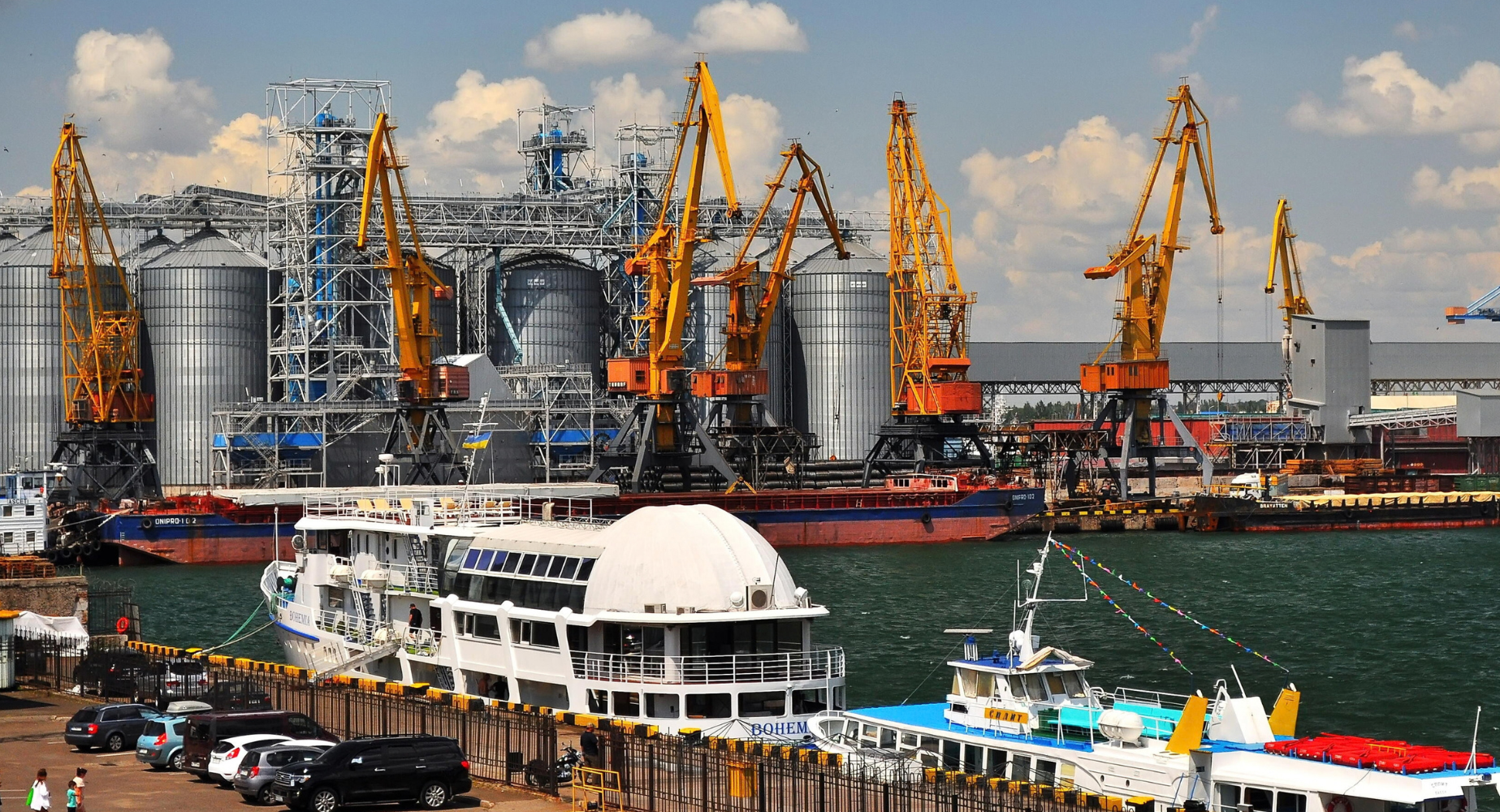
In 1994, my father began building TIS, a private port near Odesa. Today, I run it together with my brother and our founding partners. Ukraine’s ports are among Russia’s primary targets—and they are also my family’s life’s work.
Since the beginning of the full-scale invasion, I have also been a co-founder of Superhumans, Ukraine’s leading war-trauma center, which provides free prosthetics, reconstructive surgery, rehabilitation, and psychological support to civilians and service members injured in the war.
Every day I see the war from two sides: at Superhumans, what it does to people—their bodies, minds, and lives; at the port, what it does to business and the economy—infrastructure, jobs, investment, and Ukraine’s links to the world.
I do not usually write opinion columns, but I am told that Americans too rarely hear directly from Ukrainian businessmen, so I am making an exception. I would like to explain what it means to run a business under constant attack, and why business can help lay the foundations for a just peace.
I am grateful to the members of the American negotiating team for coming to Ukraine in person and seeing that the image of our country created by Russian propaganda bears no relation to reality. Air-raid sirens sound constantly, yet offices remain open, government institutions continue to function, public transport keeps running, and children still go to school.
This is who we are. We do not wait for charity, and we do not ask the world to abandon its own interests in order to save us. We act, adapt, and find solutions—even, and especially when we get very little sleep at night.
The sea is the foundation of Ukraine’s economy, and we compete with Russia for exports to global markets. That is why Russia blockaded our ports before it began bombing our cities. Shipping was later reopened by our military alone—diplomacy had been sabotaged. Now, for the second time in five years, our ports are once again de facto closed. We are bombed every day, and our team spends more time in shelters than outside them.
This is a global issue. If this blockade persists, up to 40 million tons of grain that Ukraine would normally export could also be stranded. Much of it is feed grain, particularly corn, so consumers around the world, including in the United States, will soon feel the consequences in the price of meat.
The situation on the Black Sea sounds like a catastrophe. And yet here am I. My partners are here, too. We are not discussing selling the business or moving our assets abroad. We are only asking ourselves how to continue with less risk.
This is how all of Ukraine operates today. In recent weeks, many of the country’s largest companies have come under serious attack. None is considering shutting down or leaving its industry. Instead, they are looking for new resources.
When we were first forced to halt operations from February to August 2022 during the first year of the war, we continued to meet our obligations to the EBRD and IFC, whose financing had helped us build the Neptune grain terminal in partnership with Cargill. Then, in 2026—when no serious person could still regard the war in Ukraine as a short-lived disruption that would soon be over—we attracted MSC, the world’s largest container shipping company, as an investor in one of our terminals.
Investment during a war is possible. Companies operating in a country at war can meet their obligations. Ukraine is not a country waiting to be saved. It is a country that knows how to work, understands that its economy must remain functional, and is capable of being a reliable partner under the most difficult circumstances.
More than that, investment in Ukraine today can become one of the shields that make us stronger. Every serious international investment increases our economic resilience, strengthens our ties with the world, and creates another interest that Russia must take into account.
We are approaching the fifth anniversary of the full-scale invasion. Today, no one is under any illusion that appeals to reason will make Russia stop. Russia respects strength. And Washington possesses unquestionable power—power that Russia cannot ignore and must regard as a threat to its ambitions.
The greater America’s presence in the Ukrainian economy, the greater our combined weight. Every American company, investment, asset, and long-term commercial interest in Ukraine strengthens the relationship between our countries and raises the price Russia must pay for attacking us.
I know from personal experience what American support can achieve. Superhumans is the only Ukrainian nonprofit organization to have secured political-risk insurance from the U.S. International Development Finance Corporation during the full-scale war. I am profoundly grateful for this trust, and I firmly believe that we should not remain unique.
But individual success stories do not yet constitute an investment system. Political-risk insurance and guarantees for strategic projects can help turn what remains exceptional into a replicable model.
The U.S.-Ukraine Reconstruction Investment Fund provides a foundation for a broader partnership. But the opportunities extend far beyond mineral extraction. American companies can invest in energy, ports, logistics, agricultural processing, defense technology, manufacturing, healthcare, housing, and reconstruction.
We can offer America the opportunity to turn the commitments it has already made into a long-term strategic and economic asset. President Trump is right: America should profit from having believed in Ukraine before others did.
Ukraine, meanwhile, will continue developing drone technologies, strengthening its military capabilities, and learning to defend itself more effectively. We will continue building our own strength. When Ukraine’s growing military capabilities are combined with America’s economic, political, and strategic power, together we gain enough weight to push the aggressor towards a just peace.
A just peace must provide for long-term air defense and secure navigation in the Black Sea; predetermined and automatically applied consequences for renewed aggression; and the use of frozen Russian assets to finance reconstruction. The country responsible for the destruction must bear the cost of rebuilding.
Ukraine, in turn, will fulfill its side of the bargain by ensuring transparent governance, independent audits, open competition, protection of private property, predictable regulation, and genuine accountability for corruption.
The best peace agreements are not those that produce a beautiful photograph on the day they are signed. They are the agreements for which no one will have to apologize ten years later.
Do not give Russia a respite. Invest in a Ukraine that knows how to build under fire—and help us secure a peace Russia cannot afford to break.